Home Blog Page 21

Women’s health advocates applaud Manitoba’s plan to subsidize prescription birth control

0
Women’s health advocates applaud Manitoba’s plan to subsidize prescription birth control

Birth control will soon become free for all Manitobans with a prescription, the province announced Tuesday.

The announcement, made during Premier Wab Kinew’s Tuesday throne speech, makes good on an election promise the NDP campaigned on. The party previously pegged the cost to implement the universal coverage of select contraceptives at $11 million per year.

“Reproductive health care is a right. Our government will protect and affirm Manitobans’ right to access abortion services, protect abortion providers and make prescription birth control free,” said Tuesday’s speech, which was read by Lt.-Gov. Anita Neville in the legislature.

The NDP previously said the plan would include several prescription and over-the-counter birth control methods, including the morning-after pill, hormonal injections, copper and hormonal intrauterine devices and oral contraceptives, but not condoms.

Health Minister Uzoma Asagwara says the move prioritizes women’s health care.

“We want to send a clear message to women — and those across Manitoba who need this aspect of health care — that our government is working very hard to make sure that you know your health care is a priority,” they told reporters outside of the legislative chamber on Tuesday.

Asagwara says the province is having conversations with local experts in order to ensure accessibility to birth control everywhere in Manitoba, particularly in rural and remote areas.

“There’s no one-size-fits-all in terms of how we do this. There’s going to be different approaches we need to take.”

Health Minister Uzoma Asagwara says the province is having conversations with local experts in order to ensure accessibility extends across Manitoba, particularly in rural and remote areas. (CBC)

Manitoba is set to become the second Canadian province to provide universal access to prescribed birth control. British Columbia was the first to implement the same measure earlier this year.

Caitlin Bloxom, a nurse with Winnipeg’s Klinic Community Health, says it can be “absolutely impossible” for some to access contraception due to costs and barriers to clinics that offer it for free.

“I think it’s a huge step if we can make this an affordable service for people who need it,” Bloxom told CBC News on Tuesday.

“This is going to save health systems money, and I think the benefits are just very clear for the individual and communities as well, so I really see no downsides.”

Unplanned or unwanted pregnancies can lead to psychosocial distress and added costs on the health-care system, she said, and people have the right to control their bodies and prevent unwanted pregnancies with medications proven safe at doing so.

“It would just be removing that barrier of cost for people.”

Bloxom also works in Klinic’s walk-in teen clinic, which she says provides free birth control.

“One of the primary reasons that we see teens coming in to us is for accessible birth control,” she said, adding that the program removes barriers for teens who have a right to contraception but do not want to disclose their use of it to parents and/or caregivers.

“Certainly, this is something that I imagine is not available in many smaller communities, unfortunately,” she said.

‘Birth control should not be a luxury’

Though she is happy with Tuesday’s announcement, Bloxom says she would like to see more outreach clinics bring birth control to people in schools and homeless encampments to further improve access to contraceptives.

“I think this is a very important piece of the puzzle, but big-picture-wise, I think we have a long way to go.”

Dr. Rupinder Toor, medical director and founder of the IUD & Women’s Clinic in Calgary — which advocates for the federal government to provide universal access to birth control nationally — says free for the public doesn’t mean free in general.

“But the good news is that we know that studies have shown that every dollar that we invest in universal contraception can save the system up to nine dollars in the public sector,” she told CBC News on Tuesday.

A woman is shown smiling.
Dr. Rupinder Toor, medical director and founder of the IUD & Women’s Clinic in Calgary, says Manitoba’s plan to provide universal access to prescription birth control is a ‘phenomenal policy.’ (Submitted by Rupinder Toor)

Toor says providing free birth control “evens the playing field,” since the most effective forms of contraception are longer-acting options, which are cost-effective in the long run but can cost as much as $500 upfront.

“I think this is a phenomenal policy, and I would encourage all provinces to consider this, but I would really encourage the federal government to be looking at this as a policy,” she said.

“We’re in an affordability crisis right now, and birth control should not be a luxury item.”

24 Best Whole30 Snack Ideas and Easy Recipes to Try

0
24 Best Whole30 Snack Ideas and Easy Recipes to Try

Heard about the Whole30 diet and thinking of giving it a whirl? It’s a good idea to learn as much as possible about this eating plan before you dive in.

According to data from Cleveland Clinic, Whole30 is an elimination diet — for 30 days, you completely cut out dairy, grains, beans, sugar, alcohol and many other foods. You increase your intake of certain nutritionally-dense whole foods instead. The point of Whole30 is to reset your system — you get rid of foods that you might be sensitive or allergic to (like lactose or gluten), then slowly reintroduce them into your diet and see how your body reacts. It’s not intended for weight loss, although you may drop some pounds on it.

Before to you try Whole30

Like many diets, it’s controversial. “While it may be helpful to eliminate alcohol, artificial sweeteners, added sugar and food additives, there are cons to this diet,” says Sue-Ellen Anderson-Haynes, MS, RDN, founder of 360Girls&Women and spokesperson for the Academy of Nutrition and Dietetics. “There’s no scientific evidence to back up its claims. It’s restrictive, cutting out several food groups and foods such as whole grains and legumes. This is a concern, since research supports that these high fiber and nutrient dense foods reduce the risk of cancer, heart disease and diabetes.”

Weight loss, health and body image are complex subjects — before deciding to go on this diet, we invite you gain a broader perspective by reading our exploration into the hazards of diet culture.

That said, an elimination diet like Whole30 is only meant to be done for a short period of time. “I don’t recommend the Whole30 diet to my clients to improve health,” says Cate Ward, PhD, RD, a scientist and dietitian in San Francisco, CA. “Focusing on incorporating more whole foods, such as vegetables, fruit, intact grains, nuts, seeds and legumes, without necessarily eliminating all processed foods, can make this type of dietary change much more sustainable in the long run.”

There are some people who should avoid Whole30, too. According to data from the National Academy of Sports Medicine, those with a history of disordered eating shouldn’t try the diet, since it’s so limited in scope. And for anyone, “After following a restrictive plan, you can often end up feeling all-or-nothing with food,” says Laura Silver, MS, RD, founder of Silver Street Nutrition in Brooklyn, NY. “You oscillate between being ‘really good,’ by following food rules, and ‘really bad’ for breaking them. Neither of these extremes feels great physically or mentally.”

An elimination diet is meant to be short term. And it’s smart to talk to your healthcare provider to get the go-ahead before starting. “If you want to undergo an elimination diet to find triggers or other digestive issues, follow up with your doctor or a registered dietitian,” says Anderson-Haynes.

What makes a good Whole30 snack?

If you’re insistent on giving it a try, you need to keep refueling, as elimination diets can sap your energy quickly. You can’t snack on processed stuff like popcorn or potato chips, but there are healthy alternatives.

“If you’re trying to avoid certain food groups similar to those in the Whole30 diet because of established health or medical reasons, an example of a filling snack would be whipped savory avocado spread with roasted vegetables or a handful of unsalted nuts, dried fruit or a homemade seed and fruit bar,” says Anderson-Haynes.

Lots and lots. You can’t have: Sugar of any kind, and no real or artificial sweeteners. You need to skip dairy, Grains, gluten legumes, except for peas and green beans, as well as any food containing carrageenan (an additive in some dairy and non-dairy products) and sulfites. Plus, there’s no alcohol. 

Trying to plan out healthy snacks on a strict eating plan like Whole 30 is tricky–but we did the work for you. Read on for different snacks you can have if you’re cleared to try Whole30.

Whole30 Snack Ideas

We’ve got simple grab-and-go options as well as links to healthy recipe-based choices. And you don’t have to be following the Whole30 eating plan to enjoy these.

Guacamole

    Perfect guacamole starts with perfectly ripe avocados. If they aren’t quite ripe yet, placing them in a paper bag with an apple does the trick. Make sure to roll the top of the paper bag closed and keep it at room temperature. The avocados should be noticeably softer in 12 hours.

    When it comes to texture:If you mash everything together by hand you can maintain some chunks, but if you prefer smooth guac, the food processor is the right option. If you’d like to have just a little texture, try pulsing the mixture and check frequently to make sure it’s not getting too smooth.

    GET THE RECIPE


    Granola

    Granola can be a healthy, yummy way to fuel up for the day. This recipe from our friends at Delish uses almonds, pecans, dried cranberries, unsweetened coconut and lots of seeds: pumpkin, flax, sunflower, and sesame — plus some spices. To make it Whole30, eliminate the honey.

    GET THE RECIPE


    Air-fried burger

    Pop a pre-made beef burger stuffed with onion into your fryer and get a quick protein boost. Top it with pickles and tomatoes.


    Collagen smoothie

    Actress Jennifer Garner reportedly swears by her “Be Well Smoothie,” which is full of berries. To keep it Whole30, make sure the almond milk doesn’t contain carrageenan and that the almond butter is unsweetened.

    GET THE RECIPE


    Prosciutto with melon

    It’s a classic dish, suitable for snacking. Slice a cantaloupe, and wrap the slices in prosciutto.

    prosciutto  melon salad

    ingwervanille//Getty Images


    California sushi bites

    This quick and easy snack from Delish, where cucumber and crab meat take center stage, is just as delicious as your fave takeout version. Sub in a Whole30-compliant mayo, like one made with avocado oil.

    GET THE RECIPE


    Hard-boiled eggs

    You’ll see so many methods online, but ours will help you get them right, every time.

    GET THE RECIPE


    Air-fryer squash soup

    Soup is a wonderful, filling, cozy snack. Our version is particularly satisfying, plus it’s easy to make in your air-fryer!

    air fryer squash soup with pepita seeds

    mike garten


    Olives and almonds

    A winning combination you may have never tried! Check to make sure the olives you choose are gluten-free.


    Bruschetta-stuffed avocados

    Stuff an avocado and voilà! You have a snack. (This also makes a filling meal.) Balsamic glazes sometimes contain sweetener, so skip that to keep it Whole30 compliant.

    GET THE RECIPE


    Apples and avocado

    Smash up one-quarter of an avocado and add one-eighth teaspoon wasabi powder plus a pinch of salt and spread onto one sliced apple. The apple adds freshness and satisfying crunch; the avocado serves up filling, healthy fats; the wasabi adds a punch of heat and flavor; and the pinch of salt boosts the ingredients’ natural flavors.


    Green bean salad

    If you have some leftover cooked green beans, try making this crunchy snack: Combine 2 tablespoons of dried cranberries with two tablespoons toasted pepitas, one cup of the leftover beans and drizzle with olive oil.


    Chia pudding

    Use your choice of Whole30-compliant plant-based milk (like cashew or almond milk), chia seeds, a Medjool date and spices like cinnamon. Blend the milk and the date until it’s smooth, and then pour the milk, chia seeds, and spices into a jar. Let it sit in the refrigerator for a few hours or overnight. The chia seeds will expand, soak up the milk, and thicken the mixture. Top off with your favorite fruit.

    healthy dessert with chia seeds, blueberries, strawberries, raspberries and granola horizontal

    Anastasia Dobrusina//Getty Images


    Cashew butter and banana slices

    Spread or dip away to your heart’s content. For an extra burst of taste, try stirring in a teaspoon or two of unsweetened cocoa powder.


    Snack board

    Fill a cutting board with sliced apples, grapes, berries, sliced bell peppers, carrots and other seasonal fruits and vegetables. Dips you can use include Whole30-compliant hummus (made with something other than chickpeas — try making your own with cauliflower instead), ranch or green goddess dressing.


    Baked sweet potato

    Top your potato with salsa for a new taste adventure. This is a particularly quick snack if you microwave the sweet potato. With our recipe, you’ll just skip the feta and black beans to make it Whole30-approved.

    GET THE RECIPE


    Pistachio, dried apricot and raisin trail mix

    Bag up a mix of these nuts and dried fruit for an energy boost! The trail mix is a convenient snack to keep around in a large jar, and then portion out into an on-the-go container for car rides or hikes.


    Green apple with almond butter

    Since peanuts/peanut butter aren’t allowed on Whole 30, switching up your nut butter can give apples a flavorful new twist. Try sprinkling with cinnamon, too.


    Lettuce and pickle wraps

    A simple, tart and tasty snack: Just wrap your pickles in lettuce, and crunch away!


    Frozen grapes

    Wash a bunch of grapes and stash in the freezer for a cold, refreshing treat that can satisfy your sweet tooth naturally.


    Banana and berries cup

    Mix banana slices with raspberries, strawberries and blackberries – this makes a delicious breakfast, too.


    Veggie stir-fry with coconut oil

    Try a hunger-busting healthy mix of red bliss potato, red, green and yellow pepper, scallions, tomato and squash and sauté in coconut oil – the peppers give a hint of sweetness that will really complement the dish.

    stir frying and sauteing a variety of fresh colorful market vegetables in a hot steaming wok with vegetables on on a turquoise colored wood table background below the wok

    enviromantic//Getty Images


    Seafood sampler

    Fresh broiled cod and shrimp, and steamers with clarified butter (which has no milk solids) – total heaven. Yes, this is a meal — but the leftovers can be a snack!


    Deliciously decadent fries

    For a real treat (and you deserve one): Cut russet potatoes into thick wedges, and air fry them until they’re golden brown.

    Headshot of Lisa Mulcahy

    Contributing Writer

    Lisa is an internationally established health writer whose credits include Good Housekeeping, Prevention, Men’s Health, Oprah Daily, Woman’s Day, Elle, Cosmopolitan, Harper’s Bazaar, Esquire, Glamour, The Washington Post, WebMD, Medscape, The Los Angeles Times, Parade, Health, Self, Family Circle and Seventeen. She is the author of eight best-selling books, including The Essentials of Theater.

    Headshot of Stefani Sassos, M.S., R.D.N., C.D.N., NASM-CPT

    Nutrition Lab Director

    Stefani (she/her) is a registered dietitian, a NASM-certified personal trainer and the director of the Good Housekeeping Institute Nutrition Lab, where she handles all nutrition-related content, testing and evaluation. She holds a bachelor’s degree in nutritional sciences from Pennsylvania State University and a master’s degree in clinical nutrition from NYU. She is also Good Housekeeping’s on-staff fitness and exercise expert. Stefani is dedicated to providing readers with evidence-based content to encourage informed food choices and healthy living. She is an avid CrossFitter and a passionate home cook who loves spending time with her big fit Greek family.

Glen Powell on His Fitness Routine, Finding Love & Being a Leading Man

0
Glen Powell on His Fitness Routine, Finding Love & Being a Leading Man

IT HAS BECOME TRITE TO compare friendly, happy men to golden retrievers, but actor Glen Powell’s retrieverdom is clinical. This man cannot help but look warmly, excitedly, and adoringly at whoever is near. Onscreen, such as when he played Hangman in last year’s Top Gun: Maverick, the role that brought his career from a simmering breakout to a boil, he can be a dick. Offscreen, he is hopeless.

While Powell was in Australia this past spring filming Anyone but You—a romantic comedy that he will not discuss when we meet in September, out of solidarity with the actors’ strike (any reflections on specific projects included here were gathered during an interview conducted after the strike ended)—he joined his costars in taking in the sights. He got caught in the rain. He rode atop a double-decker bus. He went to the zoo and fed a giraffe a carrot. In every photo, Powell had a wide grin on his face, like a kid on a roller coaster—this, he tells me, is called “the Powell face,” and his whole family is prone to it. In shots with his costar Sydney Sweeney from their Australia interlude, along with one well-documented appearance at CinemaCon in April, he looked overjoyed—he looked, many thought, very much in love.

These photos were coupled with news of Powell’s split from model and designer Gigi Paris; specious reports from the Daily Mail of strife between Sweeney and her fiancé, Jonathan Davino (who in spite of being “photographed carrying a bag and a dog bed out of their shared L. A. home” is still engaged to Sweeney); and an Instagram post from Paris, who had evidently unfollowed both Powell and Sweeney, captioned “know your worth & onto the next.” Suddenly everyone was certain that Powell and Sweeney were having a passionate affair, chaperoned by an Australian giraffe. The evidence was in their eyes.

preview for Glen Powell | Gym & Fridge

Except that Powell looks at everyone like that. (Sweeney, too, suffers from resting baby-bunny face.) I experience this myself on an early fall afternoon on the patio of the restaurant at Chateau Marmont in Los Angeles. It’s a gloomy day and the restaurant is thinly populated and subdued, but when Powell bounds in behind the hostess, the few other diners perk up. He’s wearing a baseball hat emblazoned with the logo of Caliwater (in which he is an investor), a Speedmaster watch from Omega (for which he is a “friend of the brand”), and a navy polo shirt from Brioni (for which he is the face of a new campaign), as well as jeans and beige suede shoes (no apparent affiliation). He looks lovingly at the hostess as she seats him, and then he looks lovingly at the server who takes his order for the first of three iced coffees with almond milk that he will consume in the next few hours. He cannot possibly be having a secret affair with all of them. His default facial expression seems to be simply “I love you.”

Getting into dick mode for Top Gun: Maverick required significant forethought and research, in fact. He and his co-star Tom Cruise discussed the role extensively: “We would watch movies and talk about certain actors that he was kind of like, what the body posture was,” he recalls. Cruise pointed out that while every other character in the room was worried about carrying out their assigned mission–a rollercoaster flight conducted at sweaty-palms speeds–Hangman had to have total confidence in his abilities, and had to be totally unapologetic about that swagger. “He was like, You as a person are very apologetic. You don’t want to hurt people, you want to treat people well, you apologize even when you don’t need to. You can’t have any of that in your eyes.”

But ack, those eyes! Powell has wild-card features. Any one of them, arranged or deployed differently, could have looked nondescript. But his mouth, with its barely there upper lip, and his eyes, with their overhanging lids, somehow come together in a face that can switch instantaneously from jocular to flinty, from sly to severe. He says he used to be concerned about his small eyes, worrying that they disappeared onscreen, but now he thinks they might be his most recognizable feature. (His abs may beg to differ.) “There was an era of actors back in the day who just all had these squinty eyes. It was like the cowboy films—the tough, steely-eyed guys.” He squints and makes his mouth into a thin line, and instantly he does evoke Clint Eastwood, looking critically at the blanched horizon. Then he reanimates back into retriever mode.

glen powell

Powell is often compared with stratospheric movie stars: Brad Pitt, Matthew McConaughey, George Clooney, and Cruise (“There will never be another Tom Cruise,” he says when I bring this up: Cruise, he says, had a mechanical issue on an F-18 while shooting Maverick. “He and the pilot landed the plane with a wire,” he says. “He smiled, got out of the plane. I was like, That guy almost died, and he’s smiling.”) In recent years, streaming services have overwhelmed Hollywood, throwing more films, shows, and bright young actors at viewers than ever before and shortening the contrails of fame. Meanwhile, Marvel and its ilk have been flinging a parade of chiseled action heroes at audiences for the past decade. Under these conditions, many in Hollywood are asking what a leading man in 2023 is. But even those who can’t confidently define a leading man feel comfortable calling Powell one.

“Character actors—they can be great actors, but you might not follow them everywhere. A leading person. . . it’s just ‘I like them,’ ” says Richard Linklater, who directed Powell in Fast Food Nation (2006) and Everybody Wants Some!! (2016) and who cowrote and produced the indie film Hit Man with him. In Hit Man, which leaped from the festival circuit to Netflix, Powell stars as a nerdy professor who goes undercover as a hit man; this required him to play roles within a role. The challenge of delivering such a layered performance, he explains, is choosing moments to reveal the “real guy.” He had to litter his acting with strategic imperfections. “The audience is still oriented to the fact that this is a performance, and that there are flaws in a performance, always,” he says. “That’s sort of the joy for the audience, is wondering if he’s gonna get caught–wondering if he’s gonna get found out.”

Linklater admires how even when his character’s actions are morally questionable, Powell doesn’t lose his antihero quality. That’s the real test of a leading man, the director says—“you literally let your leading people get away with murder.”

What has been obvious to everyone else has snuck up on Powell, who has only recently started to feel like a star. For the most part, he says, the shift has been subtle, “just like the weather has changed a little bit.” But then there was the time, while he was scrolling on his phone in an airport in Atlanta, that he felt the primal prickle of being watched, and he looked up to see that everyone in the terminal (“the entire terminal,” he says; “it was like a Black Mirror episode”) was filming him on their phones. And at a concert not long ago, he noticed that the man at the urinal next to his was attempting to take a midstream selfie with him.

glen powell

It was during the frenzied analysis of his photos with Sweeney in Australia, however, that he realized he had entered a new galaxy. “When all that stuff happened, you know, publicly, it felt disorienting and unfair. But what I’m realizing is that’s just a part of this gig now,” he says. The affair (“the alleged affair,” Powell corrects when I allude to it) has become another book in the vast library of fame’s small inconveniences. For now these moments don’t disturb him. He regards them as reminders to focus on what is important and real: namely, his family, his friends, and work that he’s proud of making. Yet in Hollywood, a prophecy is congealing around him. Powell is looking down at his phone, but everyone in the proverbial terminal is watching him.

At a time when the idea of the leading man seems imperiled, many in Hollywood are looking at Powell as the one who might pull the sword from the stone and define the next generation of leading actors. He has earned this attention just by being Glen Powell—pleasant, talented, funny, motivated Glen Powell. (And he is of course in amazing shape: Check out his full weekly training schedule in this exclusive workout story.) These are the prerequisites to leading-manhood, but they’re also the things that Hollywood tends to leech out of its chosen ones. As the adjustments demanded by stardom metastasize from slight shifts in the weather to full-blast tempests, can he hold fast to the qualities that make him so likable?

breaker

POWELL IS ENTERING this complex new stratum of his career right as he is entering a complex new stratum of his 30s. He just turned 35, and this, too, has required some adjustments. He has begun to recognize, for example, that certain foods and habits make him feel like shit. He can’t drink beer like he used to. He has also seen the folly in consuming 40-plus ribs in a sitting, which he claims to have done at the Salt Lick BBQ in Driftwood, Texas.

As a small-eyed man, he explains, he has to be careful around ribs. If he eats too many. . . He holds up his fists in front of his face and squeezes them tight, mimicking puffy peepers. “I can eat so much, and I think just for me, on a health level, it’s not necessarily taking the fun out of your life; it’s just riding the brake. Because I can go nuts if I want to.” Today, because he has a photo shoot tomorrow, he is not taking any risks, eye-wise. When the server returns, he orders a hummus platter—he eats the vegetables, I eat the flatbread—and salmon. (Before shooting the beach football scene in Maverick, he tells me, he and his fellow actors ate carefully. After they had shot the scene, spending hours doing push-ups in the sand, frolicking Abercrombie & Fitch-style, and struggling to throw a football with hands slippery from coconut oil, everyone went out and celebrated with beer and tater tots. Later they learned that the camera had actually only been on Cruise all day; they would have to re-tone, re-frolic, and re-shoot.)

Dating is also more fraught for Glen Powell than you might think. The logistics of meeting people are among the “little checkpoints where the world has shifted a few degrees” with his recognizability, he points out after we place our orders. “If you talk to a girl or something like that, and you’re like, We have a really great connection, we’re having a really great interaction, and then they ask you for a selfie, it’s like, Oh. . .”

the definition of a movie star is somebody you want to grab a beer with and when you get too drunk and leave the bar you can trust him with your wife

The logistics of his career can feel like another obstacle to dating. Powell grew up in Austin and has been visiting his family there often, but he is otherwise nomadic, driving between Los Angeles, Austin, and various movie sets in his Chevy Silverado High Country. “I just don’t think drinking the water of any one place for too long is healthy,” he says. (He has been thinking about buying a house in Austin or New York.) He admires Linklater, who primarily roosts in a magical outpost in Texas. But for now Powell prefers to wander the earth, “being a little uncomfortable and not letting roots grow too deep, you know?”

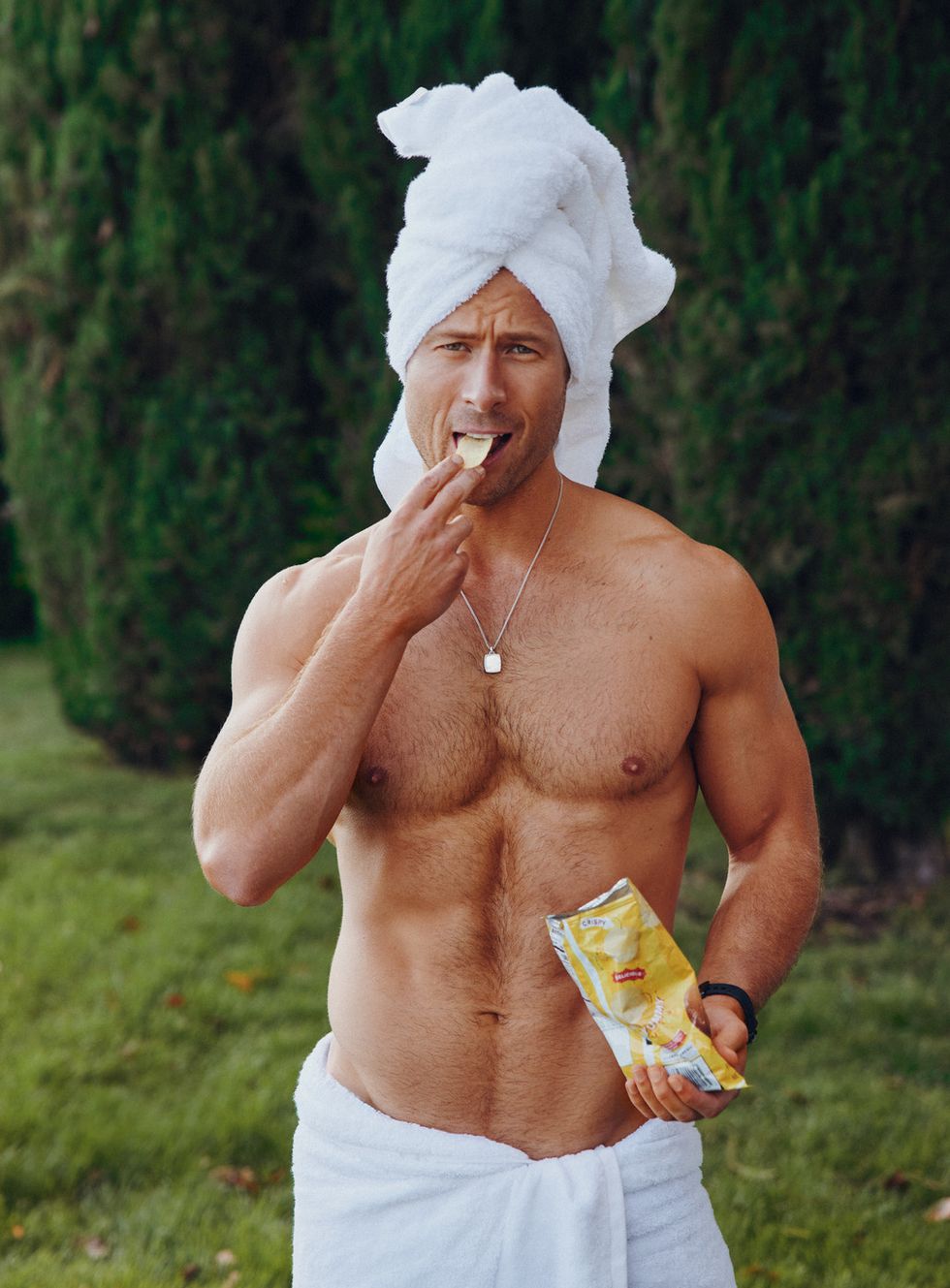
Sitting at Chateau Marmont, Powell looks simultaneously “of L. A.” and not “of L. A.” His polo feels decidedly un-Hollywood; the biceps emerging from it, which are so defined that they look like they’d make a wooden thunk if whacked, are ultra-Hollywood. (Powell began working with Ultimate Performance, which he calls “rip-roaring strength training,” after an ex-girlfriend profiled Kevin McHale, detailing the actor’s post-Glee transformation with the trainers.) When he first moved to California, he recalls, armed with polos and jeans—“basically what I’m wearing now”—he felt some pressure to adopt the actor uniform of the time: tank top, leather jacket, beanie. “After going through all these little identity crises, you slowly circle back to your truest form,” he says with a shrug. He tries not to spend too much time in Hollywood, because he finds that when he’s here he focuses on the fluff around the business rather than his growth as an actor. He explains this via a stream of metaphors: Angelenos are “heat-seeking missiles”; in L.A., “the chorus in your play is too loud.” When he leaves California, and particularly when he’s at home with his family in Austin, he feels that he approaches his work with more purity.

But he acknowledges that his rootlessness could be frustrating for a hypothetical wife and any hypothetical children. At this stage of his career, he says, he might get a call on any given day summoning him to Bulgaria for five months.

glen powell

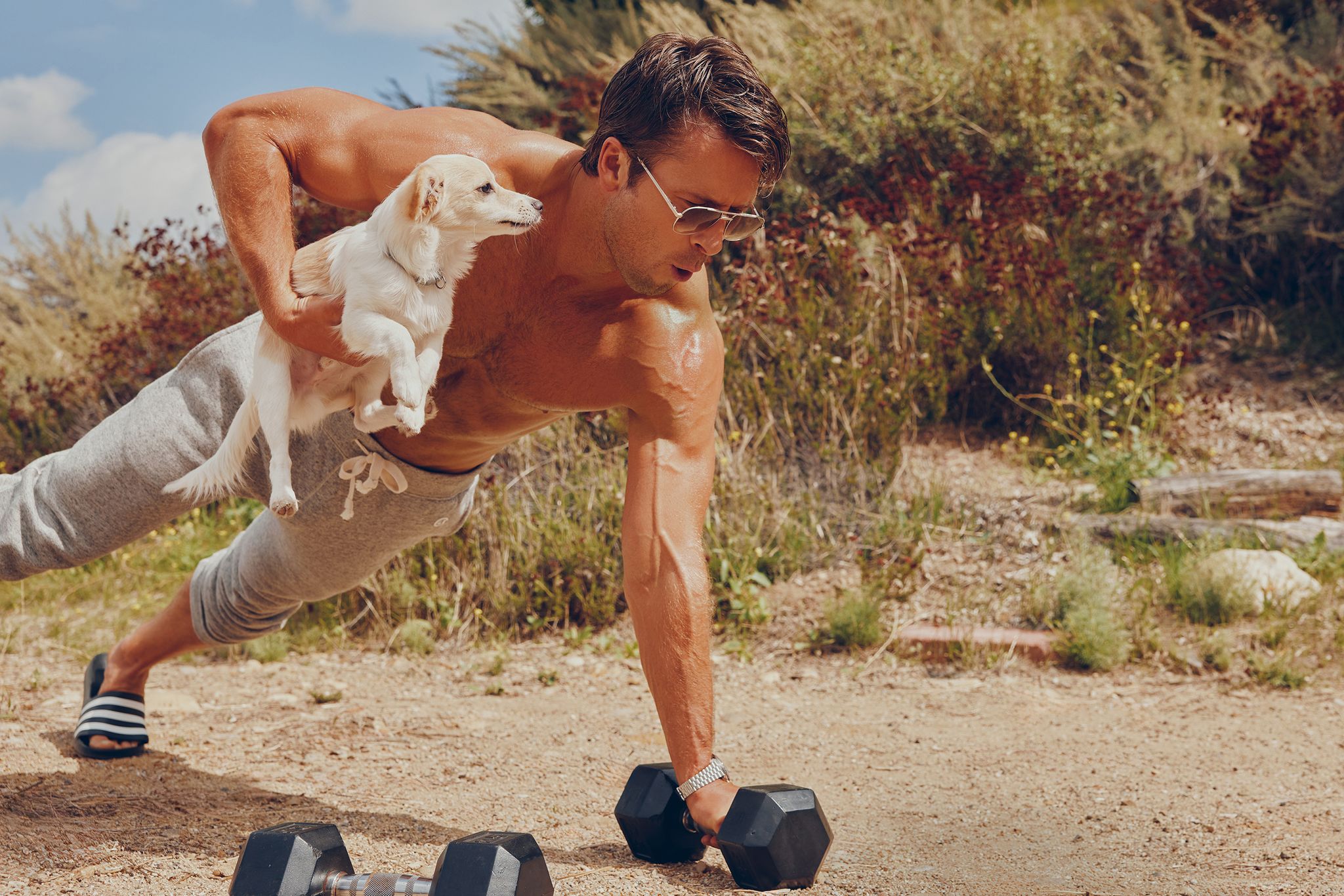
“That’s why I became a dog dad,” Powell says. Over the summer, the actor adopted a rescue dog named Brisket, a medley of small breeds (with, Powell qualifies, the soul of a bear) who earned his name from the white lines around his face and along his back, which resemble marbling. While shooting Twisters in Enid, Oklahoma, he saw a photo of Brisket when he had hit his “low of lows”—more likely in Oklahoma than in other places, I’ve found, there being little on the horizon to distract someone from their despair—after the end of his relationship with Gigi Paris. “I needed to put love into something. I saw Brisket’s face and fell in love.” Should he be dispatched overseas for the role of a lifetime, Brisket is more portable, in both size and temperament, than most women. But he would like to meet someone—a human—with patience for his lifestyle.

“I think that’s the thing that has been on my mind the most recently,” he says. Being surreptitiously photographed at the airport is one thing; not having the bandwidth to be a good partner looms larger. “When the sun is shining, you gotta make hay. And you gotta chase this while you got it. And on a romantic level, you gotta find a teammate who is down for that adventure, down for that uncertainty, down for that thing. It’s a lot to deal with. Honestly, I really try to be a great partner. When I love, I love hard. I also understand that the speed and uncertainty of my life is a very hard thing to put up with.”

breaker

ONCE POWELL HAS finished eating, he turns himself perpendicular to the table, sinks a bit in his chair, and stretches out his long legs until he is as close to horizontal as possible while remaining technically upright. He crosses his arms, foregrounding the biceps. Our interview has stretched beyond the allotted hours, and when I ask him whether he needs to leave, he says he may have to go feed his parking meter but makes no move to do so.

He can be, as he puts it, a people pleaser, a personality type that is less tenable now that more people want more from him. “What I’m realizing right now is that you have to give yourself grace for not responding to everybody right away, and not texting everybody back, and not having to be there at every single thing. Because I was known for saying yes to three dinners in a night. I would go to a five o’clock, a seven o’clock, a nine o’clock. I would just try to make everybody happy.”

I wonder if this instinct to not be a dick is what those who extol his “leading-man qualities” are referring to, and I ask Powell about it. “What is a leading man? What is a leading woman? I don’t know—it’s not a thing,” he says with a laugh. “It’s just people who continue to work.”

I’m disappointed in the answer, and when I say so I see Powell begin cleaving for a less cynical response. “When I first moved out to L. A.,” he starts off, then he pauses for a long moment, buffering, and starts again. “When I first moved out to L. A., there was a guy named Ed Limato, who signed me.” The agent had also signed Antonio Banderas, Richard Gere, Mel Gibson, Matthew McConaughey, Meryl Streep, and Denzel Washington, Powell explains; he had looked up to Limato as a guardian angel until his death in 2010. (At that point the agency dropped Powell and left him, for two years, on his ass.) “Ed told me,” he continues, qualifying that he is almost certainly misremembering the phrasing, “the definition of a movie star is somebody you want to grab a beer with, and when you get too drunk and leave the bar, you can trust him with your wife.”

glen powell

He’s describing a decency deeper than golden-retriever niceness—a golden retriever is gonna be all over your wife. Powell is friendly, to be sure, but he is also very intelligent and profoundly grounded. (He attributes this to having two sisters who lovingly but constantly check him.) He brings to mind the high school golden boy who easily drifts into the popular crowd but who is somehow immune to their insecurities and competitions. In Linklaterian terms, he’s a Pink (Dazed and Confused): the big man on campus who is still chill, still principled.

“I don’t worry about Glen at all. As far as I can tell, there’s no bad habits there,” says Linklater, laughing. Besides, Powell seems to have a genuine enthusiasm for the work. He’s now an actor, a producer, and a cowriter: Hit Man is an auspicious forerunner for future multihyphenate projects. “You gotta love it enough that you like every part of it,” Linklater adds—and Powell does. “Ben Affleck had a certain quality like that. He just thought big, even as a young man. It was like, ‘Oh, he has a big picture.’ Glen does, too.”

When it’s time to leave the restaurant, it takes a while to exit as Powell navigates a gauntlet of beautiful women. He poses for a photo with a duo at a table nearby, then stops to say goodbye to one of his acquaintances, with fabulous blond waves, and her friend, with fabulous brunette waves and a small white terrier who is fully extended on the chaise next to her, apparently dead. “He’s very old,” the woman says apologetically, as though the dog might otherwise stand to pay his respects. (Is there a more satisfying pairing than a glamorous young woman and a truly decrepit dog?) The terrier senses eyes upon him and lifts his head slightly, revealing a curly Mohawk—bold styling for a geriatric.

After a quick hug during which I, unfortunately, dissociate, Powell hurries away to finally feed his meter. I meander down to street level in a daze, then jolt back to cognizance and race back up to the restaurant. So tipsy on Powell’s charms was I that we had inadvertently dined and dashed at Chateau Marmont. I still don’t feel qualified to diagnose a leading man, but I suspect that’s a symptom.

glen powell
breaker

SPEED ROUND

What you bought with your first major paycheck?
“A sauna.”

Favorite book?
Devotions, by Mary Oliver.”

Favorite book when you want to sound cool?
“[Laughing] The Fountainhead, by Ayn Rand.”

Workout anthem?
“A playlist of random house music Daisy Edgar-Jones gave me.”

Frenemy workout?
“The sled. It kills you. It’s a full-body thing—it prevents you from being the guy who just wants to look good.”

Most exciting phrase in the English language?
“One thing I learned from a costar is to say ‘Here it comes’ right before a take. It’s a sense of anticipation. It’s a sense of ‘Let’s get after it.’ ”

Weirdest fan interaction?
“Signing body parts not appropriate to sign.”

Euphemism for sex?
“Smokin’ the brisket.”

glen powell mens health december 2023 cover

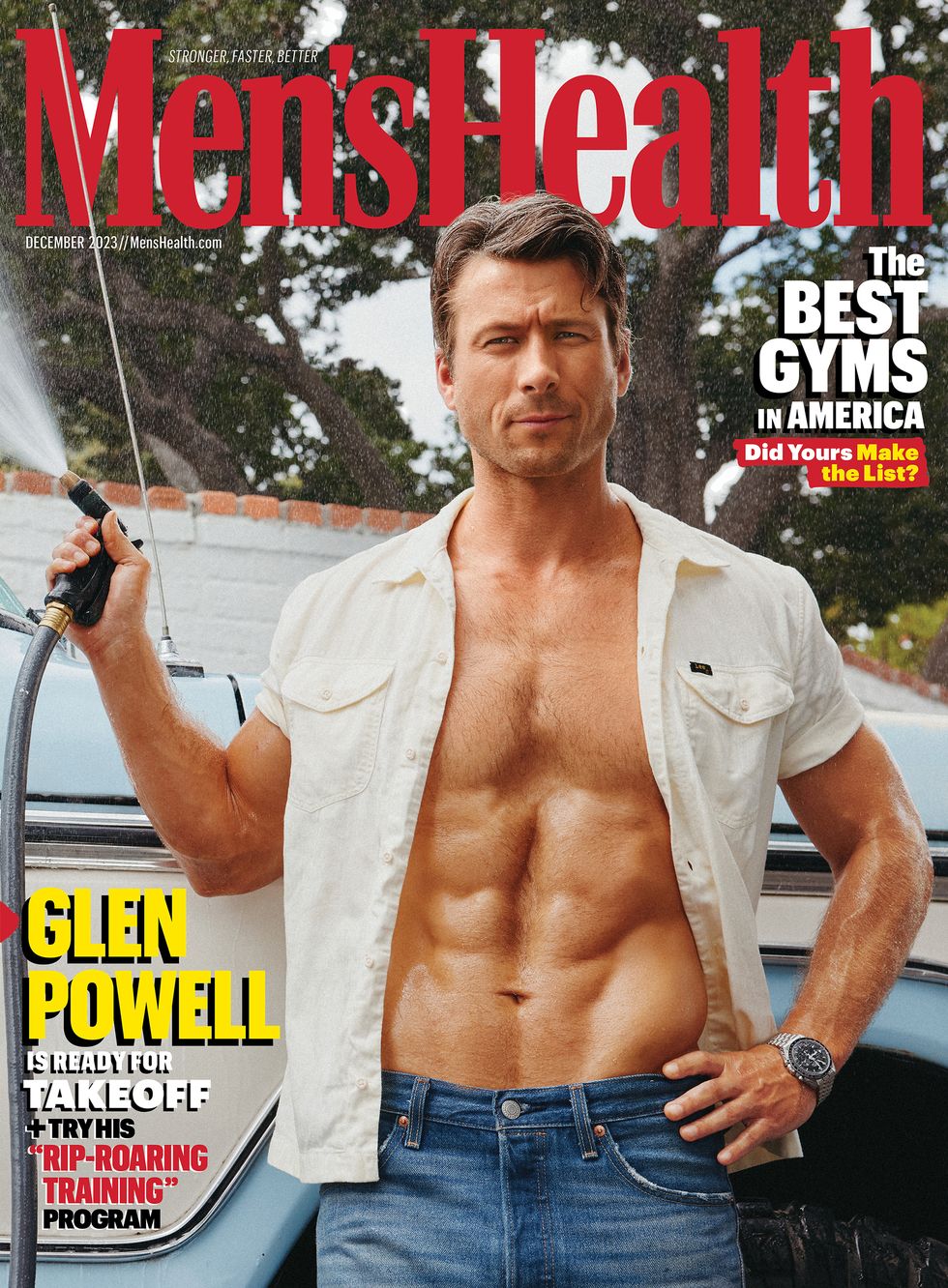
This story originally appears in the December 2023 issue of Men’s Health.

Headshot of Lauren Larson

Lauren Larson is a writer and editor based in Austin and her work also appears in GQ, Texas Monthly, and The New York Times.

Strictly pro Amy Dowden, 33, dazzles as our December cover star

0
Strictly pro Amy Dowden, 33, dazzles as our December cover star

As we draw towards the end of the year, it’s natural to compare expectations versus our actual lived reality of the past eleven months.

One person whose 2023 played out dramatically differently to how she pictured it is Strictly Come Dancing professional Amy Dowden.

Not long after she and husband Ben Jones (her former dance partner, with whom she runs a dance school) touched down following their picture-perfect Mauritian honeymoon in April, Amy was diagnosed with grade three breast cancer.

The South Wales-born dancer, 33, shared the news with her hundreds of thousands of followers. And, in the months since, she’s become one of the UK’s most recognisable – and rooted for – patient advocates.

It’s thanks, in no small part, to how generous she’s been with sharing raw insights along the way.

There was the emotional video, uploaded in mid-September, in which loved ones took turns to help cut off her shoulder-length, dark blonde hair. It’s been liked over 281,000 times.

Or another, uploaded earlier this month, where a teary but triumphant-looking Amy rang the bell at Birmingham’s Good Hope Hospital to signify the end of her chemotherapy treatment.

And now, in another triumphant move, Amy’s fronting Women’s Health‘s December issue.

In her cover interview, Amy reveals why she decided to pose for the cover of our magazine without wearing a wig and just how much it’s meant to her to still have a role in this season of the BBC’s shiniest-floored show.

Plus, she shares why – even after all she’s endured – she really does not want, or need, people’s pity.

How Amy’s experience with chronic illness inspired her to be so open about her breast cancer journey

South Wales-born Amy is no stranger to health challenges. She’s spoken at length about her experience with Crohn’s disease – a chronic, incurable gastrointestinal condition – in her acclaimed BBC documentary Strictly Amy: Crohn’s and Me.

‘Finding out I had Crohn’s [Amy was diagnosed age 19 following eight years of symptoms] I didn’t ever have anyone in the public eye to look up to or to say to my friends, “That’s what I’ve got”,’ Amy recalls.

‘And I just had a little moment: I imagined teenagers being able to go to school and being able to embrace [not having hair] or go swimming and just be like, “I’m like Amy who’s off Strictly.” And that just gave me the confidence to go, “Yeah, let’s do this”.’

Mark Cant | Women’s Health UK

If someone receiving a cancer diagnosis so young – following two decades of struggle with a debilitating health condition that’s seen her hospitalised on multiple occasions – feels blisteringly unfair, that’s something not lost on Amy.

Does she ever feel angry about it?

‘Oh yeah,’ she confirms, without hesitation.

‘I always say, I never asked [for] this to happen to me. I’ve always worked so hard. I’ve always been a good person. I looked after myself, I’ve exercised well, haven’t smoked…I do get angry. I just think I’ve been dealt a difficult one.’

‘I think it’ll take a while to accept,’ she shares. ‘It took me a long time to accept my Crohn’s. Until I’m back dancing and back to my normal self, I don’t think I will accept it.’

What’s brought Amy joy, during chemotherapy and beyond

Amy is, clearly, itching to get back in her dancing shoes.

While that won’t be possible for this season of Strictly (fracturing her foot, days after finishing chemotherapy, precludes her making that much-longed-for return) she’s still very much at the heart of the series.

‘Watching Strictly has been a great help,’ she shares. ‘I’m my fellow professionals’ biggest cheerleader. I know people are like, “Yeah, yeah…” but we’re the best of friends.’

‘Honestly, not a day goes by without Dianne [Buswell] checking in on me; Carlos [Gu]; Katya [Jones]… production have gone above and beyond to make me part of the series as well,’ she adds.

‘To have no part in it would have been soul-destroying. And not good for me mentally, whatsoever. I don’t know what I would have done, I’ll be honest with you.’

Then there’s been the support and care of her husband, Ben Jones. ‘He’s been through so much with me with my Crohn’s but I guess, like, nothing will ever break us now,’ she shares.

Acts of service – and close attention – seem to be his love language. ‘If I mention something once, he’ll buy it, or if it’s a food I want, he’s cooking it.’

amy dowden in a gold dress

Mark Cant | Women’s Health UK

Amy’s steadfast friends – who have taken it in turns to go with her to chemotherapy appointments – have played a fundamental role.

Then there’s the community of women with breast cancer, who Amy calls her ‘pink sisters’.

‘I never thought at 32 I’d be diagnosed with breast cancer,’ she tells WH. ‘It’s a club you would never wish to be in, but when you’re in it, it’s the most loyal club you could ever be part of.’

‘I can speak to my fellow pink sisters and instantly they get it.’

Why it’s important to avoid making people dealing with health issues feel ‘other’

You probably could have guessed that underneath the gleaming smile and abundant sequins our cover star has a heart of gold.

But Amy is also a powerful and perceptive voice on the way we act around – and engage with – people who are unwell.

‘I just want to be treated as normal,’ she says. ‘When I’m walking outside and I’ve got my headscarf on, I don’t want looks of sympathy or feeling sorry for me – I’m Amy.’

‘Sometimes, people don’t know how to address it,’ she says of the awkwardness many feel around serious illness.

‘Just ask how I am – I will answer you. We don’t want you to feel sorry for us. We’re embracing it. Stand strong with us…Don’t give me that pity look – I don’t need it!’

Here’s to standing with our loved ones while they face health challenges. And saluting those – like Amy – who are drawing strength from sharing.

Read the full Amy Dowden interview in the December issue of Women’s Health, on sale now

Girl Scouts making herbal cold remedy kits for homeless people

0
Girl Scouts making herbal cold remedy kits for homeless people

A Baltimore County business owner is teaching kids how to make herbal cold and flu remedies that will ultimately benefit homeless people.Sheila Hall, owner of Unique Scripts Wellness Spa in Randallstown, focuses on functional medicine, holistic therapies and herbal remedies. Now, she’s working with Girl Scouts troop 5395 to use herbal remedies to help people in need. Hall believes cough syrup made from herbs can heal just like any other cough syrup you’ll find on a drug store shelf.”I’ve always felt that we should look for natural remedies before just going and getting medicines and drugs if they aren’t necessary or if the doctor hasn’t prescribed them to us,” said Hall. “Learn how to just go in your own kitchen cabinet and grab garlic and apple cider vinegar and peppers and learn how to use those to help you feel better.”Hall is teaching the Girl Scouts how to make herbal cold and flu remedies.”I want to teach them how awesome things we get naturally are and how awesome it is that it can heal us and how it can help boost our immune system, make us feel better, keep us healthy, things that we have naturally in the Earth,” said Hall. Hall and the Girl Scouts are mixing up natural remedies and taste-testing along the way. Then, they put the remedies into wellness care kits that will go to people struggling with homelessness.”It’s going to get cold and it’s easier to get colds and flus because they are just outside,” said Asia Dubose, a Girl Scout. “More people helping, more people off the streets.”Del Matthews, the Girl Scouts troop leader, said she’s grateful her girls are getting this experience.”I think it’s a good learning experience for them to show that there’s always people who need other things, help or whatever you may need, and these girls can see that giving back makes you feel really good,” Matthews said.Hall will deliver the care kits to the Night of Peace Emergency Homeless Shelter in Windsor Mill on Nov. 18.

A Baltimore County business owner is teaching kids how to make herbal cold and flu remedies that will ultimately benefit homeless people.

Sheila Hall, owner of Unique Scripts Wellness Spa in Randallstown, focuses on functional medicine, holistic therapies and herbal remedies. Now, she’s working with Girl Scouts troop 5395 to use herbal remedies to help people in need.

Hall believes cough syrup made from herbs can heal just like any other cough syrup you’ll find on a drug store shelf.

“I’ve always felt that we should look for natural remedies before just going and getting medicines and drugs if they aren’t necessary or if the doctor hasn’t prescribed them to us,” said Hall. “Learn how to just go in your own kitchen cabinet and grab garlic and apple cider vinegar and peppers and learn how to use those to help you feel better.”

Hall is teaching the Girl Scouts how to make herbal cold and flu remedies.

“I want to teach them how awesome things we get naturally are and how awesome it is that it can heal us and how it can help boost our immune system, make us feel better, keep us healthy, things that we have naturally in the Earth,” said Hall.

Hall and the Girl Scouts are mixing up natural remedies and taste-testing along the way. Then, they put the remedies into wellness care kits that will go to people struggling with homelessness.

“It’s going to get cold and it’s easier to get colds and flus because they are just outside,” said Asia Dubose, a Girl Scout. “More people helping, more people off the streets.”

Del Matthews, the Girl Scouts troop leader, said she’s grateful her girls are getting this experience.

“I think it’s a good learning experience for them to show that there’s always people who need other things, help or whatever you may need, and these girls can see that giving back makes you feel really good,” Matthews said.

Hall will deliver the care kits to the Night of Peace Emergency Homeless Shelter in Windsor Mill on Nov. 18.

Advancing oral health equity in the digital era

0
Advancing oral health equity in the digital era

The connection between oral health and overall well-being remains a persistent, untreated, and unaddressed issue in the United States. The CDC suggests that more 50% of Americans over the age of 30 have some degree of gum disease,1 which can have links to cancer, heart disease, stroke, diabetes, and other health issues.

While health-care organizations alone cannot control all the factors that contribute to poor oral health, they can make oral care more accessible and transparent by leveraging tools that are available in today’s digital marketplace. What’s more, they can meet the growing customer preference for these types of tools.

According to Statista, 88% of customers expect companies to have an online self-service portal.2 They want to manage their benefits 24/7 from any device, and when they run into a question, they want the tools and information at their fingertips to help them address it.

Oral health care and health equity are inextricably linked. Beyond just customer satisfaction and convenience, digital tools represent an important step toward fostering health equity by streamlining tedious, administrative back-end tasks and in turn, improving the quality of care throughout a patient’s journey.

You might also be interested in

New data: Americans are still not getting the dental care they need

4 areas where digital tools help advance oral health equity

1. Help patients understand the connection between their oral health and overall well being

Digital tools give members a better care experience. They make things more accessible and information more transparent so that patients understand the implications their oral health has on overall health. The functions of the mouth are often taken for granted, yet the ability to speak, smile, taste, and chew are important contributing factors toward quality of life and depend on the health of the teeth, gums, and mouth. At a minimum, dentistry and oral health need to be considered a part of medicine and overall health to facilitate optimum care and help close the equity gap.

Portals and mobile apps help foster this by establishing strong connections with patients through messaging tools, which can be used to send reminders and promote appointments and the continuation of care. They help supply oral health education materials as well as materials that address specific health concerns. This makes information more accessible and provides everyone with resources and assistance to achieve successful outcomes.

2. Enable a better member care experience

Portals and mobile apps can improve access to care by removing many of the common barriers to care. For instance, tools in multiple languages enable patients to find a provider and present information at the appointment, allowing for more equitable access. Portals and mobile apps offer capabilities to find providers through proximity and ratings, enhancing the member experience by directing patients to providers who can deliver the most appropriate, effective, and efficient care.

3. Empower dental practices with data-driven analytics and insights

Digital technologies significantly contribute to enhancing oral health equity by highlighting performance improvements in relevant areas. According to Harvard Public Health, lowering the barriers to access relevant data helps identify health disparities and craft actionable strategies to address them.3 Data-driven market analysis, provider analysis, benefit plan analysis, and reimbursement analysis empowers the dental industry to address oral health inequalities efficiently, which ensures resources are allocated where needed and treatment outcomes are measured effectively.

Combining insights from data analysis with member-facing digital solutions, such as find-a-provider tools, creates actional steps toward closing the health equity gap. This is done by using data-driven insights to automatically direct patients to high-performing providers, which enhances the patient experience while rewarding deserving providers.

4. Streamline workflows within dental practices

Incorporating digital tools into dental practices helps streamline operations by eliminating cumbersome manual workflows. Automating burdensome administrative tasks frees up valuable staff time, reduces the risk of errors, and enhances efficiency by minimizing duplication of services across entry points. For instance, real-time eligibility automatically checks that coverage is active and features real-time treatment plan reviews, claim processing, and immediate EOBs. This enables practices to provide complete cost transparency and collect exact patient balances at the time of service. 

By automating repetitive tasks, dental practices can optimize resource allocation, which enables them to provide a higher standard of care to a broader patient base. Transitioning to digital processes equates to cost savings, allowing dental practices to redirect resources to improve access to care and other crucial areas, such as philanthropic efforts and targeted oral health equity initiatives. 

The future of digital tools is now

The preference for self-service is part of a growing user experience trend that has become as important to buying decisions and customer loyalty as the products and services being offered. With digital tools here to stay, it’s important to recognize the long-term benefits that go beyond the immediate scope of convenience.

There is a great deal of work that needs to be done to create the systemic links and inner collaboration to include dental health in the general health-care conversation. With technology more accessible than ever, the digital era can bring improvements in linking dental care and overall health while directly affecting areas contributing to oral health equity.

Technology shapes patient perceptions, and having digital self-service is a winning proposition for dental providers and their members, payers, groups, and brokers. Dental benefit portals such as Skygen’s member portal enable patients to get answers and manage tasks and transactions with speed, efficiency, and convenience.

Digital tools can increase member satisfaction, lead to expanded relationships, and transform operations to digital workflows and real-time transactions, increasing efficiency and significantly reducing costs. The digital transformation to automation platforms and flexible strategies helps ensure everyone has the opportunity and ability to access quality dental care.


Larry Paul, DDS, is the chief dental officer for Skygen, overseeing all aspects of the company’s dental utilization review and management activities. He’s the clinical face of the company with a focus on using technology to empower population health-based efforts. He uses his clinical expertise to understand the member and provider experiences to ensure the best possible outcomes. Dr. Paul serves on several boards, including the board of visitors for his dental school alma mater, Temple University Kornberg School of Dentistry.


Editor’s note: This article appeared in the November 2023 print edition of Dental Economics magazine. Dentists in North America are eligible for a complimentary print subscription. Sign up here.


References

  1. Gum disease. Centers for Disease Control and Prevention. Last reviewed November 18, 2020. https://www.cdc.gov/oralhealth/fast-facts/gum-disease/index.html
  2. Do you expect a brand or organization to have an online self-service support portal? 2023. https://www.statista.com/statistics/810374/share-of-customers-by-if-they-expect-brands-to-have-a-self-service-portal/
  3. Gonzalez JC. Health data is fragmented and biased. Here’s how we clean it up. Harvard Public Health. June 13, 2023. https://harvardpublichealth.org/health-policy-management/data-democratization-is-a-must-for-better-public-health-outcomes/

Optimizing Patient and Physician Experience Improves Access for Axia Women’s Health

0
Optimizing Patient and Physician Experience Improves Access for Axia Women’s Health

Axia Women’s Health is on a mission to provide top-tier care for women. To achieve their goal, they are proactively streamlining internal processes and optimizing their EHR to reduce physician workload. The result is more personalized encounters and improved patient experiences. Here is how they did it.

Women’s Healthcare

With 450 providers spread across five states on the East Coast and in the Midwest, Axia Women’s Health (AxiaWH) are at the forefront of changing the landscape of women’s healthcare. AxiaWH offers OBGYN, fertility, and other ancillary services such as mammograms to patients.

According to the Centers for Disease Control and Prevention (CDC), 15.2% of women aged 18 and over are in “fair” or “poor” health in the US. Increasing access to women’s health services is key to improving the health of women across the country. This is part of what drives the team at AxiaWH to provide high quality, personalized care to as many women as possible.

Healthcare IT Today sat down with Eduard de Vries, Chief Information Officer at Axia Women’s Health to learn more about their successful efforts.

Reducing Administrative Burden

The team at AxiaWH is working in close partnership with their EHR provider eClinicalWorks to reduce the administrative burden on physicians. Together they are leaving no stone unturned.

“We are making sure to get all the relevant patient information from hospitals and other providers,” explained de Vries. “Our providers can see that visit in our EHR so they can make the best clinical decision with the most up to date information.”

Reducing Patient Burden

In addition, AxiaWH has invested in digital front door technologies so that patients can fill out intake forms and pre-appointment information while they are still at home. This leads to a more meaningful human connection when patients visit AxiaWH. In this way, AxiaWH ensures that their patients feel seen, heard, and cared for beyond just their clinical needs.

“Patients expect these conveniences,” said de Vries. “If I go to Starbucks, I don’t stand in line anymore. I order my drink before I get there through the app. No compare that with coming into a hospital or a clinic and being asked to fill in a lot of paperwork. That’s just not the way we want it to be. At some point that inefficient process will reflect on how they perceive the quality of care they receive.”

AxiaWH did not just focus on the inbound side of the patient experience, they also invested in improving their payment processes so that it is a seamless as possible for both patients and clinic staff. Through eClinicalWorks, patients can pay with a single click or tap.

Recruiting Advantage

According to de Vries, the positive impact of these changes isn’t just a boost to the patient experience; it is also provides AxiaWH with an advantage in recruiting new physicians. Making doctors’ work more comfortable and patient-focused is a compelling proposition in a competitive healthcare market.

By leveraging technology and streamlining processes, AxiaWH is ensuring that their patients receive high-quality care, both in clinical services and the overall patient experience. Their focus on continuous improvement is a testament to their dedication to women’s health and well-being.

Watch the interview with Eduard de Vries to learn:

  • How many more patients a physician is able to see in a day AND still go home for dinner
  • What role AI will/should play in women’s health
  • Which technologies AxiaWH is keeping their eye on

Learn more about Axia Women’s Health: https://axiawh.com/

Learn more about eClinicalWorks: https://www.eclinicalworks.com/

Listen and subscribe to the Healthcare IT Today Interviews Podcast to hear all the latest insights from experts in healthcare IT.

And for an exclusive look at our top stories, subscribe to our newsletter and YouTube.

Tell us what you think. Contact us here or on Twitter at @hcitoday. And if you’re interested in advertising with us, check out our various advertising packages and request our Media Kit.

eClinical Works is a proud sponsor of Healthcare Scene.

The limits of nutritional supplements: they don’t cure or prevent ailments, nor are they harmless | Science

0
The limits of nutritional supplements: they don’t cure or prevent ailments, nor are they harmless | Science

On the shelves of a pharmacy, every bottle makes a promise: “Energy and vitality.” “Immunity.” “Prostate comfort.” Boxes of pills – or “nutritional supplements” – guarantee that they can reduce “oxidative damage” while boosting “sexual desire” and “fat burn.”

A few feet away, on the shelves of a supermarket, the pattern is repeated: multivitamins, minerals and various combinations of herbal extracts are offered for “joint well-being” or to help the consumer achieve “detoxification” or “extra vitality.” However, the scientific community views all of these promises with suspicion, cautioning that there’s a lot of marketing at play, rather than actual effectiveness. These supplements don’t cure or prevent diseases… and they’re not harmless, either.

Nutrition experts warn of the limitations of these products and point out that – beyond those who suffer from specific diagnosed nutritional deficiencies – nutritional supplements lack effectiveness in treating conditions or preventing the appearance of ailments. In the worst cases, these concoctions can even pose certain risks to one’s health, if ingested without supervision, or if quantities higher than the maximum recommended amount are consumed.

In the eyes of the law, many of these supplements are classified as foodstuffs, not drugs. And, foods that are intended to complement (not replace) a normal balanced diet, these supplements include vitamins, minerals (such as calcium or magnesium) and probiotics. They can also be amino acids – such as glutamine – or compounds derived from plants, such as caffeine or ginseng. Unlike medicines, food supplements don’t require authorization for sale and can be dispensed in any location where food is sold, from a pharmacy to a supermarket. But Azahara Nieto – a dietician and nutritionist – warns that, no matter how natural they are or may seem, “they’re not harmless.” And furthermore, he emphasizes: “If your diet is complete, you don’t need supplementation.”

Experts note that it doesn’t make sense to resort to certain food supplements unless a nutritional deficiency is detected. “There are primary deficiencies, when a nutrient isn’t in the diet, as well as secondary deficiencies, in which a nutrient – despite being present in the diet – for whatever reason doesn’t metabolize well. It doesn’t end up [being absorbed] and must be provided through other means,” explains dietician Juan Revenga.

Obese people undergoing bariatric surgery, for example, require vitamin and mineral supplementation. Vitamin B12 supplements are also recommended for individuals who follow a strict vegetarian lifestyle. Another supplement that may be needed – according to Jordi Salas-Salvadó, professor of Nutrition at the Rovira i Virgili University of Tarragona – is folic acid in women who wish to become pregnant. “A folic acid supplement is recommended to prevent neural tube alterations in the baby.” A neural tube defect can cause problems in the nervous system, such as spina bifida. According to scientists, iron supplementation in pregnant women also serves to prevent premature birth or low birth weight in those who are at risk of deficiencies.

The weight of marketing

In practice, however, the phenomenon of dietary supplements goes beyond necessity. A survey published in the Spanish Journal of Human Nutrition and Dietetics revealed – after surveying 2,630 Spaniards – that 70% of the population studied had taken some form of supplement in the last year, whether food supplements, plant extracts, products for athletes or pills to lose weight. In the United States, a health survey reported that more than half of Americans had taken a dietary supplement in the previous month. The majority claim that they take them to improve their health, their sports performance, or to lose weight. “There’s a lot of marketing and a tendency to supplement poor management of daily nutrition with supplements. To compensate for this, we believe that the supplement makes up for the situation caused by our habits,” says Violeta Moizé, a dietitian and nutritionist at the Hospital Clínic of Barcelona.

But there are no miracles to be found in those pills. “They’re products that contain concentrated substances that we can find in food,” Revenga insists. This is particularly the case in Western countries, where there’s “a beastly food availability” – there are no shortages of any food. “These products are marketed because people want to be deceived. On those little boxes, it says ‘more energy, less fatigue, more vitality’ and that’s attractive to us. Pseudo-miraculous properties are transferred to these prfoducts,” the dietician sighs. But magic recipes don’t exist. “Vitamin D is related to the immune system, but taking more vitamin D won’t make us more immune to COVID. We can only have an immune system within [the boundaries of] our human nature – we won’t be superheroes,” he emphasizes.

According to scientific literature, beyond the few cases that have been identified and reviewed by health professionals, food supplements have a limited scope. The intake of vitamin and mineral supplements among healthy people doesn’t reduce the risk of diseases, nor are weight loss supplements an effective method against obesity. Nor do omega-3 fatty acids – which can help reduce triglycerides – have a clear and forceful impact on the prevention of heart ailments.

Last year, a U.S. Preventive Services Task Force (USPSTF) review of the role of dietary supplements in disease prevention concluded that “Vitamin and mineral supplementation was associated with little or no benefit in preventing cancer, cardiovascular disease and death, with the exception of a small benefit for cancer incidence with multivitamin use.”

Following its analysis, the USPSTF advised against the use of beta-carotene or vitamin E to prevent cardiovascular disease or cancer, concluding that the available evidence is insufficient to calculate the risk and benefit of taking other nutritional supplements to prevent these diseases. Regarding these conclusions, scientists from Northwestern University wrote an editorial in JAMA, in which they warned: “The most common reason why people report taking supplements is to improve or maintain general health. However, whole fruits and vegetables contain a blend of vitamins, phytochemicals, fiber, and other nutrients that likely act synergistically to provide health benefits. Isolated micronutrients may act differently in the body than when naturally packaged with a host of other dietary components.”

On the other hand, since these products are considered food rather than drugs, “they have no obligation to prove what they say they do,” Revenga warns. They don’t require a medical prescription, either. Any individual can consume them on their own… although these products are by no means risk-free.

The dangers of consuming excessive amounts of vitamins

To begin with, one of the dangers is the control of quantities. “If you eat healthy and take a multivitamin, maybe you’re overdoing it,” Revenga notes. The dietician points out that there are recommended maximum daily intakes for all nutrients and, if these limits are exceeded, one may experience “toxic or deleterious effects.”

“Many of these nutrients can limit the absorption of other nutrients,” he explains, or interfere with the activity of other organic functions. They can also cause adverse side effects. “If you consume too much phosphorus, you’ll limit [your body’s] calcium absorption. If you take too much iodine, thyroid function can be disrupted. If you take a lot of vitamin D, you can have diarrhea.”

Along these lines, Salas-Salvadó warns that “absorption and bioavailability isn’t the same as when you get your nutrients through food.” He offers another example: “With antioxidants – such as vitamin A, E, or selenium – if we eat a varied diet, we’re consuming various amounts of different antioxidants that are good for health. But if you go overboard and take large amounts [of the vitamins], this can have oxidizing effects. The important thing is to have a balanced diet and consume nutrients in normal physiological doses.”

Nutritionist Violeta Moizé also warns about the danger of “overmineralization.” “You can saturate other channels, because all these micronutrients are cofactors of reactions that occur within our bodies. They’re needed in certain quantities for a function to be carried out… [but], if you exceed the amount, you can saturate [your system].”

With nutritional supplements that incorporate plant extracts, experts draw attention to the lack of studies about their safety. Revenga criticizes the fact that manufactures advertise unproven benefits. “It’s the exotic component that serves the manufacturer on a sales level. It’s putting glitter on it,” he scoffs. In an article published in the International Journal of Environmental Research and Public Health, Polish researcher Regina Wierzejska points out how “recent years have witnessed the appearance of numerous preparations that include plants that have never previously been used in Western medicine. Their mechanisms of action have not been sufficiently investigated and described, while the labels usually fail to include information about the contraindications, which does not mean they do not exist. Herbal components, especially herbal mixes, may have a negative effect on the drug mechanisms of action, both by accelerating excretion from the body or by producing dangerously high concentrations in the blood.”

Adulterated supplements

Another threat is the illegal incorporation of substances that the manufacturer doesn’t identify on the box and the consumer ingests unknowingly. There are substances that can cause adverse effects, or interact with other drugs that the individual is taking. The Spanish Agency for Food Safety and Nutrition (AESAN) closely monitors what are deemed to be “pharmacologically active substances marketed as food supplements,” warning of their presence. This occurs, above all, with compounds that claim to increase sexual vigor, promote muscle development, or accelerate weight loss.

In a study that analyzed the adulteration of dietary supplements to improve sexual function, it was found that the majority contained phosphodiesterase inhibitors, such as sildenafil (present in Viagra). And, in several samples, there was even a dose of these substances well above the maximum approved amount recommended in drugs. “This is an adulteration that’s especially dangerous when a person takes medication, for example, to control blood pressure,” Revenga says. And the same thing happens, he adds, with “natural” slimming products, which incorporate antidiabetic active ingredients. Last year, the AESAN launched three alerts regarding the presence of active ingredients similar to those used in the manufacturing of Viagra in food supplements, along with another warning about an anti-obesity drug in a supplement that was presented as a “natural product.”

“The word ‘natural’ is a key that opens many doors. A snake bite or a volcanic eruption are also natural,” Revenga jokes. Experts urge that caution be exercised when it comes to the consumption of these substances. The nutritionist Azahara Nieto recommends that, before making any decision, people should “review their diet to see what they need… and not self-diagnose or self-prescribe anything.” It’s always best to consult with your family doctor or other health professional… and to be weary about miraculous promises.

“There’s a lot of marketing out there. Advertisements are made for things that are backed up by no evidence [and there’s] no mention about the unwanted effects they may have,” Salas-Salvadó affirms. In its recommendations, the AESAN warns that “natural does not mean safe, help for weight control only makes sense [when accompanied by] a healthy lifestyle, sports performance requires adequate training and a healthy diet… and no food supplement is useful when it comes to sexual relations.”

Sign up for our weekly newsletter to get more English-language news coverage from EL PAÍS USA Edition