No one should be expected to continue working without being fairly compensated. The lady health workers (LHWs) fall into this category of employees who deserve proper remuneration for their efforts.
The role of LHWs is important in Pakistan, where health is a low priority for the authorities. Thousands of women are deprived of basic healthcare, and many die from preventable health issues.
Before the LHW programme was implemented in the early 1990s, thousands of women went through life without ever consulting a doctor or getting any proper medical care. For many women, LHWs are the only link to the health sector. Despite their valuable contribution, they are killed and abused for their work.
Mobina Shafeeq, a lady health worker based in Karachi, said, “While imparting awareness about women’s and children’s health, our efforts extend to empowering them with knowledge about their rights and improving their overall quality of life.”
The LHW programme was launched in 1994 in Pakistan, focusing on launching a family planning campaign across the country. It was meant to conclude at the end of the campaign. To execute this, “LHWs were hired for a nominal salary,” said Maqsood Ahmed, a trade unionist and labour rights expert.
The concept was to train women fieldworkers to help women access healthcare facilities. Women who had studied up to middle school and were above age 35 were hired for the programme. They were given 15 months of training on how to go from door to door and dispense basic health services to the marginalised women.
“When the campaign concluded, the LHWs were absorbed by the health department. However, they were not granted the same status as other health department employees due to the absence of a service structure for them,” emphasised Ahmed.
He added that the main reason for the non-payment and delayed salaries of LHWs is the absence of a service structure – “This is also why LHWs are working in the same grade without receiving any increments for years or pension after retirement.”
The LHWs formed the All Lady Health Workers’ Programme Union (ALPU) giving them a platform to not only amplify their voices but also give them strength in numbers. Led by chairperson Bushra Bano Arain, the ALPU worked constantly to spread awareness among the members through workshops and other activities to empower them.
Maqsood Ahmed said that the main reason for the non-payment and delayed salaries of LHWs is the absence of a service structure – “This is also why LHWs are working in the same grade without receiving any increments for years or pension after retirement”
Bushra Arain began working as an LHW when she was young. “Over the years, I have realised that if we don’t stand up for ourselves, others will only try to push us back. I decided to stand up for other LHWs and help them understand their rights.”
Bushra expressed, “LHWs are tasked with more than their routine responsibilities. Working in the field, we’ve become targets for terrorists. Although our primary role is to deliver health services, we’ve been assigned security duties at polling stations and conducted census, among other tasks.”
She said LHWs are not paid for their extra work, but “they continue to do so fearing sacking”.
“Upon joining the union, I came to realize the multitude of rights women possess, and I believe their lives could significantly improve if only they were more aware of these rights,” said Mobina Shafeeq, a lady health worker based in Karachi.
In 2012, the Supreme Court issued an order to regularise LHWs. It mandated the development of a service structure for them. Despite the court’s directive, the order was not executed as intended. While some LHWs were regularised, confusion arose regarding pension eligibility for those regularized after 2012, as a minimum of 10 years of experience is required. This situation created significant challenges for those who had been working for two decades, with hundreds of LHWs being deprived of their rightful benefits.
Commenting on the complexities of the situation, Maqsood said, “After the 18th amendment, the LHWs became the responsibility of the provincial governments, which was unable or unwilling to develop a proper service structure for them. This began causing a lot of problems for the LHWs. They continued to work despite the serious terror threats and life threats, many paying with their lives.”
About 118 LHWs have been killed in the field so far, while many more have been injured. These workers are expected to work beyond their prescribed duties and not expect to be paid. Seeing this situation, “the ALPU began campaigning strongly, demanding that the apex court’s orders be implemented properly,” he added.
Maqsood worked closely with NOWCommunities (an NGO that works with trade unions on labour rights) to train the LHWs about the importance of trade unions and their other rights – “It was heartening to see the response to the union’s call last year against the non-payment of salaries. It showed that the LHWs were no longer going to allow anyone to take them for a ride.”
LHWs received a Covid allowance during the vaccination campaign, which provided some relief to low-paid workers. However, this allowance was rescinded immediately after the campaign concluded. The ALPU leadership criticised the decision, highlighting that LHWs operate in highly perilous conditions, putting themselves and their families at risk.
Bushra and other LHWs were beaten up and even arrested when they protested in 2022.
The government funds allocated to healthcare are insufficient despite the abysmal health indicators in the country. During the fiscal year 2023-23, the government allocated Rs24.21 billion for the healthcare sector – 2.8 percent of the total development budget and a mere 0.05 percent of the gross domestic product (GDP).
Pakistani women are the most vulnerable when it comes to health. Just the high maternal mortality rate indicates how bad the situation is in the country. Pakistan has one of the highest maternal mortality rates in South Asia, which makes the LHWs more important in Pakistan.
According to a survey in 2018 conducted by the National Institute of Population Studies, “the MMR is nearly 26 percent higher in rural areas as compared to urban areas due to a major difference in health care services provided to people living in urban areas as compared to those living in distant regions.
Mobina Shafeeq said, “We try to help women a lot through our work and advice to bring a good change in society. The impact may be extremely low as it is just the beginning, but I am sure if LHWs keep persevering, they will be able to empower women in a small way, which can go a long way and improve the life of someone down the line.”
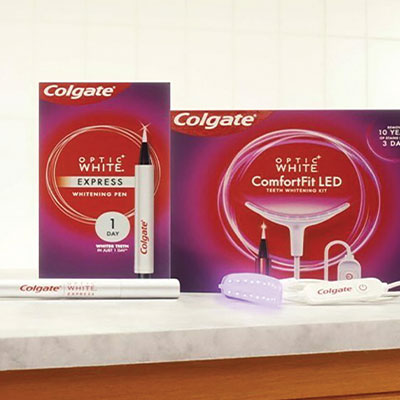
Colgate’s Optic White collection remains a favorite with consumers.
Oral care continues to put a smile on consumers’ faces. Dollar revenue gains were recorded across the three main categories of mass market oral care—toothpaste, toothbrushes and mouthwash—although unit sales were down, per recent data from Circana (see chart). Companies in the category—from market leaders to indies—continue to focus NPD on improved formulations and devices designed to deliver healthier, whiter smiles.
Earlier this year, Colgate-Palmolive unveiled its vegan Colgate Optic White Express Teeth Whitening Pen and Optic White ComfortFit LED Teeth Whitening Kit. The whitening pen, which is available by itself and as one-half of the ComfortFit LED Teeth Whitening Kit, dispenses a vegan, gluten- and sugar-free hydrogen peroxide serum when clicked at the bottom and brushed onto teeth. Once teeth are coated, the ComfortFit LED device is applied. Powered by a smart phone or tablet using Android or iPhone adapters, the lightweight, flexible device conforms to any mouth shape for a comfortable fit. It emits purple light and is low-wave length and high-energy, helping the hydrogen peroxide serum break down targeted stains quickly and effectively.
Similarly, Smile Brilliant introduced Night Out! Dental Stain Concealer. With purple toothpaste all the rage, according to Spate, Smile Brilliant uses Color Science Technology with a water-soluble formula that it maintains works “just like purple shampoo” to neutralize yellow hues.
Another product, HiSmile’s V34 Colour Corrector Serum, has the same effect and has been popularized on Instagram by Kim Kardashian.
Consumers’ wish to add color to their oral care routines presents an opportunity for brands to partner with influencers to make “get ready with me” videos using the amethyst-colored paste, per New York City-based trend tracker, Spate.
Another tooth whitening innovation was rolled out by Cocofloss. Its Cocoshine Whitening Toothpaste uses 3% nano-hydroxyapatite to gently brighten teeth and boost enamel strength in two flavors: Delicious Mint and Lychee Breeze. The company made Inc. Magazine’s 5,000 fastest-growing company list this year.
Colgate recently tapped Ashley Tisdale for a marketing campaign.
Colgate launched Plaque Pro Release toothpaste following market research that showed plaque is the No. 1 reported dental problem in America with as many as 75% of consumers concerned about the issue.
Market heavyweight Colgate saw a void in the market for such a product that could help keep dental plaque at bay and the entire mouth as healthy as possible between professional cleanings. The brand teamed with actress Ashley Tisdale, and set up a Manhattan pop-up during the summer. Over two days, the brand offered passersby the chance to “come clean” about their oral care.
“Less than one-third of people feel very confident going to the dentist. At Colgate, we are determined to increase those odds by helping people feel more prepared for their appointments so they can be totally honest,” said Salma Kaddouri, integrated marketing and communications lead, Colgate-Palmolive. “With Colgate Total Plaque Pro-Release, we are excited to have a toothpaste that can help people be proactive about their oral health and head into the dentist feeling more confident.”
Colgate Total Plaque Pro Release was made with smart foam technology designed to break down plaque. Unlike other fluoride toothpaste, Colgate says its smart foam technology utilizes a wetter foam that creates smaller bubbles along the gum line and teeth that dissolve and lift away harmful plaque bacteria. Colgate scientists say gingivitis can be reversed and prevented using Plaque Pro Release. The product’s 0.45% stannous fluoride combats gingivitis and cavities. This claim is backed by clinical studies which revealed that at the four-week mark, 12 hours after brushing, there was at least a 50% reduction in bacteria. In a separate study, gingivitis was reduced by 43% when used twice-daily.
“We think that the unique, enhanced stabilization of stannous fluoride combined with the smart foam effectively controls bacteria to help control plaque buildup, and also provide overall gum health,” said Bob D’Ambrogio, senior technical associate, at Colgate.
To combat teeth sensitivity, Tom’s of Maine—another brand in the Colgate-Palmolive family—rolled out Sensitivity + Whitening Fluoride Free Toothpaste. Its amino acid arginine and calcium carbonate complex delivers pain relief within 60 seconds.
Also offering whitening innovation for sensitive teeth is Elims. Founded by cosmetic dentist Dr. Casey Lau, with his wife Belinda, the toothpaste brand is biotech-backed and made with food grade ingredients to fight sensitivity, whiten teeth and remineralize them. Elims uses tubes made from sustainable sugarcane from Brazil to reduce carbon emissions. And it works with Terracycle to dispose of used tubes.
“From a formulation standpoint, we don’t use fluoride,” explained Belinda Lau. “We use nano-hydroxyapatite, which is a natural mineral alternative to fluoride at 10%. We wanted a formulation that was both natural and also clinically effective. All our clinical studies show that on a microscopic level, our toothpaste remineralizes your teeth the same as sodium fluoride. The way that nano hydroxyapatite works is it basically replasters your teeth with what it’s already made of.”
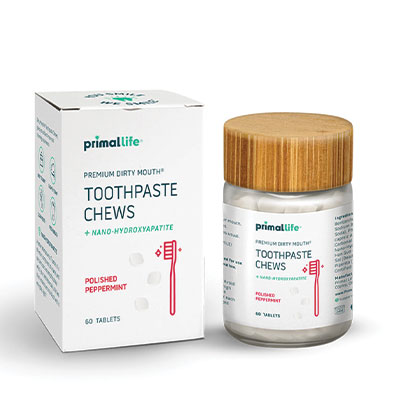
Primal Life has organic oral care products such as toothpaste chews.
Nanohydroxyapatite was invented by NASA in the 1970s.
“When astronauts go into space, they can’t see a dentist. They created this so that astronauts could have really strong teeth like a coat of armor going into all these space missions,” observed Lau. “In the 1980s, a Japanese tooth company bought the patent from NASA, and they’ve been manufacturing this style of toothpaste [since then]. We’re one of the few brands that actually have that.”
The brand also makes what it calls a more sustainable version of popular whitening strips. Elims uses the same ingredient (hydrogen peroxide) embedded in a technology that dissolves. As the strip dissolves, the Elims strip whiten teeth.
Primal Life Organics’ Real White Dental Boost reduces sensitivity, too. It is formulated with nano-hydroxyapatite to make teeth stronger and boost whiteness.
The brand’s Dirty Mouth Gum Drops are made of a detoxifying blend of 11 essential oils to rid the mouth of toxins and impurities found on the teeth’s surface and gums.
Also offering tooth remineralization is CariPro by Brilliant Smile. The brand’s latest innovation is Sustained Release Enamel Armor Remineralization Gel. Similar to a sealant hygienists apply after a professional cleaning, Enamel Armor is gently brushed onto teeth after brushing with toothpaste, preferably at night. Like its name suggests, Enamel Armor helps strengthen weakened enamel, providing lasting relief from tooth sensitivity, according to the company. The vegan gel reportedly repairs micro-fractures and exposed pores as consumers sleep.
An ancient tradition to clean the entire mouth is experiencing a renaissance. Oil pulling is rising in popularity, according to Spate. Currently, it’s experiencing an average of 116.0K monthly searches and 65.9% year-over-year growth. This ancient ayurvedic technique uses vegetable oil to draw out bacteria from the mouth, including Streptococcus mutans, which can cause cavities and gingivitis.
One of the top-searched brands for this trend is Georganics, according to Spate’s research. The oral care brand offers an oil-pulling mouthwash to remove bacteria and debris between teeth while cleaning the entire mouth.
Mass market mouthwash sales are up 9.7%, according to recent data from Circana.
In September, Listerine partnered with Compound, a Black-founded creative agency that celebrates Black culture, to introduce the Whoa Collection, which offered a limited-edition bottle embellished with artwork designed by visual artist King Saladeen. An accompanying marketing campaign was designed to close the gap in relation to the diversity of dentistry. A live auction of Saladeen’s canvas that inspired the bottle art was held at an event in Brooklyn. A portion of the proceeds from the collection benefited Increasing Diversity in Dentistry, a blossoming nonprofit focused on the development, mentorship and retention of Black dental professionals.
According to a recent report by the Centers for Disease Control and Prevention, 47.2% of adults aged 30 and old have some form of periodontal disease, which can arise from oral hygiene neglect and failure to floss in between teeth where food debris, plaque and tartar can linger.
In honor of National Dental Hygiene Month in October, Listerine released a trio of new mouthwashes targeted to gum health, bad breath and teeth strength.
Advanced “Clinical Solutions” formulations address top patient concerns like early gum disease, tooth decay and persistent bad breath. The innovations were developed by dentists and hygienists and include Antiseptic Gum Health, Teeth Strength and Breath Defense.
Listerine Clinical Solutions Antiseptic Gum Health offers the brand’s most advanced antiseptic formulation and contains 67% more zinc chloride than Listerine Antiseptic Gum Therapy and Antiseptic Ultraclean.
Teeth Strength is powered by Rapid Fusion Technology, a unique fluoride delivery system that increases fluoride uptake and remineralization to provide a stronger tooth surface. Rapid fusion technology facilitates the release of more calcium and phosphate ions from saliva compared to neutral rinses. Fluoride binds to these ions leading to the formation of fluorapatite—a durable and resistant mineral for stronger teeth.
The brand’s Breath Defense contains a triple action formula backed by clinical studies. Zinc chloride and a proprietary technology neutralize and transform odor molecules while the four essential oils kill bad breath-causing bacteria.
The new product line is available exclusively at Walmart and a national launch in slated for early 2024.
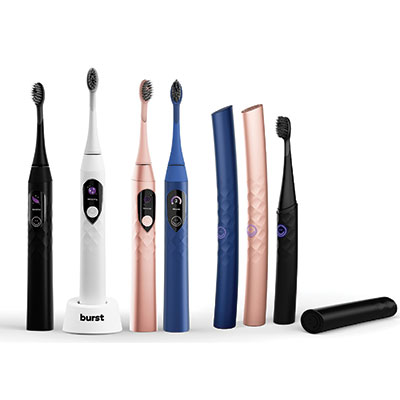
Burst specializes in high-technology toothbrushes.
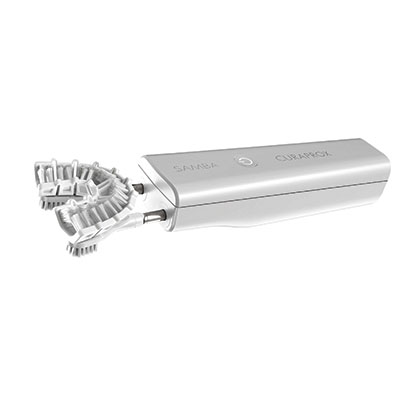
The latest creation at Curaprox is the Samba whitening device.
Innovative electric flossers from Slate Flosser and Waterpik are leading the charge for easier, more effective flossing.
Slate Flosser is an electric flosser that combines high-grade floss with 12,000 sonic vibrations a minute. Gum Sweeps remove plaque and bacteria between gums and teeth. The device flosses teeth, stimulates gums and cleans the tongue for complete oral care.
In May, Waterpik expanded its handheld water flosser collection with the new Cordless Slide.
With a collapsible design, the Cordless Slide was created with two factors in mind—effortless storage and travel. The compact model can be easily stored standing up or laying down, making it perfect for putting in a drawer or packing in a small travel bag. It features a rechargeable lithium-ion battery for up to four weeks of use from a single charge, three precision flossing tips designed to clean the whole mouth, and three pressure settings for a customizable clean. Cordless Slide is also waterproof and can be used in the shower.
More recently, in August, Waterpik rolled out its Sensonic Electric Toothbrush.
Developed with dental professional and consumer input, clinical research and novel technology, the Waterpik Sensonic Toothbrush features advanced sonic technology and a specially designed bristle pattern that hugs the natural contour of tooth surfaces. According to the brand, Waterpik Sensonic is clinically shown to remove up to four times more plaque bacteria than manual brushing in hard-to-reach areas and helps protect against gingivitis, cavities and bad breath.
This year also saw the launch of Burst Oral Care’s Pro Sonic Toothbrush and Curve Sonic Toothbrush. The new tools were six years in the making, according to Co-Founder and President Brittany Stewart.
P&G continues to be a leader in dental care with Oral-B and Crest.
Oral care brands are always striving to make teeth cleaning a more seamless task for children (and their parents).
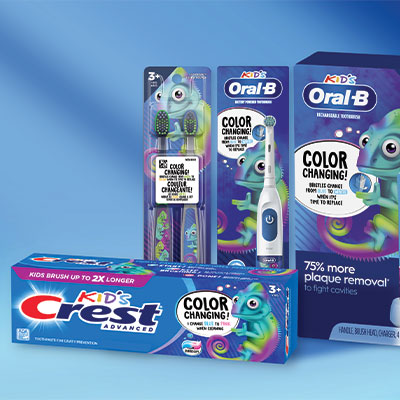
In March, P&G launched Crest Kids Color Changing Toothpaste. Designed to make brushing fun, the color-changing technology transforms the bubblegum-flavored toothpaste from blue to pink to indicate when it’s time to rinse—and not a moment sooner. This helps kids get a thorough cleaning of their teeth for up to two minutes to prevent cavities. Crest Kids teamed with social media creator Dani Schaffer who represented the product with her son who served as the brand’s “Kid Correspondent.”
In tandem with the release, the brand is rolling out a line of color-changing themed toothbrushes with Oral B.
In August, Crest and Oral B teamed with Jesse Williams for a Back-to-School campaign called “Closing America’s Smile Gap.”
By showcasing their morning and nighttime routines, the campaign is designed to shine a spotlight on kids lacking basic oral care supplies.
For every Oral B or Crest product purchased between August 1 and September 30, the brands donated oral care supplies to a child in need. According to P&G, 44% of children in low-income households brush less than the recommended amount (twice a day). Children in high-income families account for 73% of children who adhere to twice-daily brushing instilled by their parents.
“The basic necessities we take for granted—like a toothbrush, toothpaste and routine dental checkups—can be game-changers for those without access,” said Williams. “I’m proud to partner with Crest and Oral B to help end oral health inequity.”
Brands are also addressing new ways to make oral health more inclusive for those with disabilities.
Curaprox Swiss Premium Oral Care introduced the Samba Toothbrush. It is purportedly the world’s first robotic toothbrush to afford people with disabilities the ease of brushing their teeth effectively and independently. The October launch coincided with National Dental Hygiene Month and Down Syndrome Awareness Month.
Whether using color, flossing innovations or oil pulling to encourage better hygiene habits, oral care brands are drilling home the importance of clean teeth. They are leveraging social media and the power of influencers with candid videos and testimonials that can wonders in getting consumers to sink their teeth into new products.
Exposure to crime and fear of victimisation has been shown to have detrimental effects both on people’s mental health (Dustmann and Fasani, 2014) and on their physical health by restricting physical activity (Janke et al, 2016). These negative effects are amplified for women.
A new strand of research explores the potential negative effects of a variety of stressful events during pregnancy, which can then affect the health of children early in life (Currie and Rossin-Slater, 2013; Black et al, 2016).
This raises the question of how exposure to crime among pregnant women, or just the fear of it, may negatively affect unborn children. Any such effects on the health of children are very concerning given the potential life-long negative impact on both health and socio-economic outcomes.
Poor health at birth has been shown to have long-term consequences, including effects on educational attainment, earnings and even mortality (Oreopoulos et al, 2008; Almond and Currie, 2011).
How does indirect exposure to crime affect the health of newborns?
Indirect exposure to serious violent crimes – for example, by witnessing homicides and assaults during pregnancy – has been shown to have negative effects on the health of newborns in a variety of settings.
One study has shown the negative effect of exposure to violent crime from the escalation of the Mexican ‘war on drugs’ on birthweight, a proxy for the health of children at the time of their birth (Brown, 2018).
Other research documents a similarly negative effect of day-to-day violence in Brazil on gestational length and birthweight (Foureaux Koppensteiner and Manacorda, 2016).
In addition to these two studies for middle-income countries, researchers have shown similar outcomes in Detroit in the United States (Grossman and Khalil, 2022).
This work documents the negative intergenerational effect of crime exposure. But it leaves the question of the underlying mechanism largely unanswered. Focusing on exposure to the most severe violent crimes is likely to underestimate the overall effect of crime, and fail to establish whether these effects extend to more common crimes, such as theft and robbery.
How does mothers’ experience of being a victim of crime during pregnancy affect their children’s health at birth?
Answering this question requires access to much more precise datasets, namely those linking crime records with birth records.
Using such linked records, one recent study shows that in utero exposure to assault from intimate partner violence significantly increases the incidence of adverse birth outcomes (Currie et al,2022). The overall social costs from those assaults based on the negative health consequences of the children are estimated to exceed $3.5 billion annually in the United States.
Focusing on assault during pregnancy makes it difficult to distinguish the physical effects of injury to the mother from other effects (including psychological effects) that may affect the unborn child.
In contrast to looking at victimisation from intimate partner violence, a recent study explores the more general effect of being a victim of crime on birth outcomes (Menezes and Foureaux Koppensteiner, 2023). Using data from Brazil, this focuses on the two most frequent crimes involving a victim – theft and robbery – to provide new insights into the detrimental effects of crime on unborn children.
One common issue with these studies is that becoming a victim of crime might not be random. This can be influenced by neighbourhood characteristics, or characteristics of the victim, among other traits.
To get around this, the researchers control for residential and individual characteristics, and take account of seasonality and time trends.
This is important as, for example, poorer neighbourhoods tend to be more violent and women residing there might have worse birth outcomes for other reasons. By comparing birth outcomes for women residing in the same neighbourhood, it is possible for researchers to estimate causal effects.
Being a victim of crime during pregnancy negatively affects birthweight by, on average, 15 grams (see Figure 1). Despite this relatively small average effect on birthweight (equal to about 0.5% of mean birthweight), the magnitude of the effect is large compared with those found in other studies. For example, it is about seven times the (positive) effect of receiving nutritional support during pregnancy in the form of food stamps (Almondet al, 2011).
The effect is particularly strong at the lower end of the birthweight distribution, with an increase in the propensity of children to be born with low, very low or extremely low birthweight (less than 2,500, 2,000 and 1,500 grams respectively) of 10%, 14% and 38% relative to the baseline incidence.
This increase in children born with low birthweight is particularly worrying given the considerable negative consequences of low birthweight for short- and long-term outcomes in health, education and the labour market (Fletcher, 2011, Almond et al, 2005).
Figure 1: Estimated effects of being a victim of crime during pregnancy on birthweight (BW) and low BW indicators
Source: Menezes and Foureaux Koppensteiner, 2023
To understand the long-term effects of being a victim of crime during pregnancy better, the study looks at hospitalisations of children after birth. Figure 2 shows an increased risk, of around 6%, of hospitalisation due to victimisation, compared with the average.
The authors also find that children of mothers who are victims of crime during pregnancy are more likely to attend neonatal intensive care units (ICUs). This is important for two reasons. First, the increase in ICU attendance indicates more severe cases of hospitalisation. Second, neonatal ICUs are among the most expensive components of a hospital. This means that there is also a substantial increase in the direct cost of hospitalisation.
Figure 2: Estimated effects of being a victim of crime during pregnancy on hospitalisation risk, log cost of hospitalisations and hospitalisation in neonatal and regular ICUs
Source: Menezes and Foureaux Koppensteiner, 2023
Who is affected most by being a victim of crime?
The effect of crime is not the same across individuals, with children of some mothers suffering particularly strongly. Figure 3 reports the effect of victimisation separately by indicators of socio-economic status.
Across the different outcomes of birthweight, the effects for mothers with lower socio-economic status are more pronounced. This may indicate that the economic loss from being a victim of robbery and theft plays a key role in explaining the negative effect.
In addition, the effects are driven by being a crime victim late in pregnancy (during the third trimester). With foetuses putting on most weight in utero in the last trimester, this suggests that nutrition may play a role in the reductions in birthweight, for example, due to the economic impact of victimisation.
Figure 3: Estimated effects of being a victim of crime during pregnancy on birthweight (BW) and low BW indicators by socio-economic background
Source: Menezes and Foureaux Koppensteiner, 2023
Taken together, this evidence indicates that being a victim of crime during pregnancy is a contributor to the intergenerational transmission of inequality by affecting the health of the next generation.
Previous research on the cost of crime has focused mainly on the consequences of direct and indirect exposure for adults, including estimates of the effects on mental health (Dustmann and Fasani, 2014) and earnings (Bindler and Ketel, 2022). The potential consequences for children have been less studied.
RUNNING IS MUCH more than just putting one foot in front of the other. There are whole systems of the body working together with each footfall—so when something is off, it doesn’t take much to throw yourself totally out of whack.
I know just how that happens, unfortunately. I ran a marathon last year, and after all of the training mileage and the big race was finished, I wound up with a painful hamstring problem that followed me for months afterward.
I spent hours on dedicated physical therapy and took some time off the road. Now, the injury seems to be finally healed enough for me to resume a normal running regimen. Before I get too far down that path, however, I wanted to make sure that I wasn’t just setting myself up for an express trip back to the PT’s office. I went straight there instead, checking in with Dan Giordano, DPT, C.S.C.S. at Bespoke Treatments in NYC to see what high tech solutions are available to help me run stronger.
Giordano had just the tool: Runeasi, which purports to help PTs and coaches identify the weak points in your stride that can lead to inefficiencies—and later down the line, injuries.
What Is the Runeasi 3D Gait Analysis
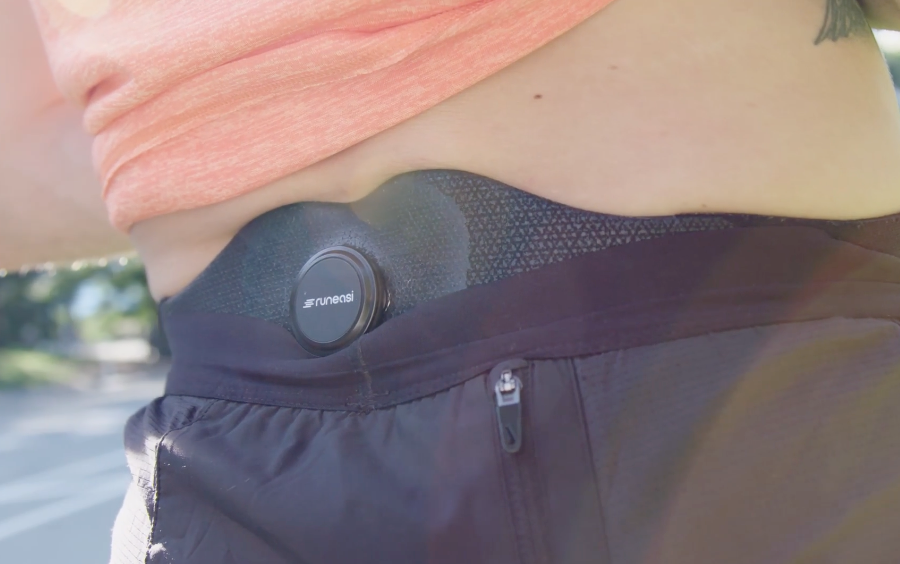
The high-tech solution comes in the form of a sensor attached to a strap that looks and feels just like the running belts long distance athletes wear to carry stuff along with them on the road.
Men’s Health
Using the tool is a two-pronged process—after collecting data on a run, the software gets to work, analyzing the movement information to determine what asymmetries and compensations exist in your gait (the cycle your leg travels through when you run).
Gait analysis itself isn’t new. You might have even seen specialty running retailers that offer the service in a blocked-off area of their stores. The really high-level testing requires the subject to run on a treadmill so the PT or coach can assess video footage and data, then provide their own feedback and recommendations. Runeasi uses software to do that, trained on data from over 10 years of research collected by the Human Movement and Artificial Intelligence Research Groups of KU Leuven in Belgium and Stellenbosch University in South Africa. Runeasi’s software suite was also validated using data from the industry gold standard Vicon motion capture system, according to Runeasi CEO and cofounder Kurt Schütte, PhD.
Runeasi is also different from other gait analysis because it measures the ground impact with each stride and the body’s response, according to Giordano. The tech uses three parameters to do this: dynamic stability, symmetry, and impact loading.
Men’s Health/Bespoke Treatments
Dynamic Stability
This measure is based on the side-to-side wobble of the hips (essentially, how well you can stabilize the hips while running). “A poor score can indicate poor hip control, which increases the work of your stabilizing muscles,” says Giordano. “This could reduce your running efficiency (how much energy you consume with each step) and increase your risk of overuse injury.”
Symmetry
This is the difference between the right and left sides of your body and how they work together. This also impacts running efficiency, and poor scores might signal likelihood of injury, according to Giordano.
Impact Loading
This refers to how much you load your body while running. “This is strongly determined by the capacity of the lower limb muscles and how they work together to absorb the impact of running,” says Giordano.
The Runeasi sensor also gauges running cadence (strides per minute) and ground contact time (time spent with the foot on the ground).
The biomechanical sensor in Runeasi doesn’t depend on treadmill sessions. You can strap it around your midsection (with the sensor on your sacrum, or lower back) and run anywhere. That position is important, according to Runeasi’s Timothée Vander Linden. Similar tools often attach to the shoe or lower body, but Runeasi wanted a more full-bodied approach. “If you go too low, if you put sensors on the shoes or on a tibia, you’re not as accurate as you would like to be upwards,” he says. “You also want to know what’s happening up the kinetic chain, and how your lower limbs are coping with [ground impact], or your lower back or even your core.”
Schütte says this allows the tech to be more individualized and accurate. “You can pick up compensations patterns at the hips, but if you had it with the feet or your shins, you would you lose a lot of information about actually how is your body responding to the running—the speed, the incline, the shoes you’re running in, that type of thing.”
The Runeasi Test and Results
I was ready to put this system to the test. Set up took just a few taps on Giordano’s tablet, and we headed out to NYC’s Central Park with nothing but a tablet and my running gear to get an initial reading. The belt didn’t bother me in the least once I clipped it around my waist, and I took off down the Central Park loop for a brisk five-minute jog. There’s no special protocol to follow to collect the data, so I ran just like any other day. My hamstring didn’t bother me at all, which made me curious about exactly what I might learn once the Runeasi software got to work.
I finished, and Giordano got the program up and running. The system took just a few minutes to churn through the data and return a personalized report, complete with scores and feedback for each of the three parameters and a larger, overarching recommendation for next steps to improve my runs.
Men’s Health/Bespoke Treatments
Overall, Giordano told me that I ran well. The overall scores were good—all in the “green,” which means I’m in fairly good shape form-wise. But that doesn’t mean that there weren’t areas for improvement, and there was one major takeaway from the test: Runeasi knew that I had a left leg injury, and what imbalances that existed in my stride were to compensate. That seemed remarkable to me—even after months of PT and feeling balanced, this little sensor knew my injury history immediately.
Better still, the system provided Giordano with a set of exercises I could do to help combat that compensation and build strength so that my body can do a better job handling those ground impact forces. We walked through those movements right away—and I’m putting them into my routine so that I can hit the ground running even stronger than before.
The Leg-Strengthening Exercises
Bodyweight Squat Drop
3 sets of 10 to 15 reps
How to Do It:
Start standing with your feet just further than shoulder-width apart.
Lift your arms over your head and rise up onto your toes. Hold this position for a beat.
Explode downwards, landing on your heels and descending down into a squat. Shoot your arms behind yourself to emphasize the movement.
Box Step Off
3 sets of 10 to 15 reps
How to Do It:
Start standing with both feet on a box, standing close to the edge or with your toes just off the edge.
Step one foot off the box and out in front of you, keeping your balance on your other planted leg.
Lean forward with your torso, allowing your other foot to come off the box so that you land softly with both feet planted on the floor, bending your knees to descend into a squat position to absorb the shock. You can raise your hands to help coordinate this movement.
Stand back up.
Rear Foot-Elevated Split Squat Jump
3 sets of 10 to 15 reps
How to Do It:
Start with one foot elevated behind you on a bench or platform. Get into a position with your front knee at a 90 degree angle. You should be aiming to have your shin near a vertical shin in relation to the floor. Your weight should be resting in the middle of your foot, rather than in your toes or heels.
Press off the floor with your front foot and jump up off the floor, driving your knee up and cycling your arms like a runner. Keep your rear foot in position on the bench.
Land softly, with your weight in the middle of the foot to absorb the shock.
Brett Williams, a fitness editor at Men’s Health, is a NASM-CPT certified trainer and former pro football player and tech reporter who splits his workout time between strength and conditioning training, martial arts, and running. You can find his work elsewhere at Mashable, Thrillist, and other outlets.
Contributed by Madeleine Burry Last updated 2023-09-11T00:00:00-05:00
Browse through the vitamin aisle in the pharmacy—or peruse page after page of offerings in online stores—and you’ll see a wide variety of supplements and herbal remedies available, often with bold statements about the products’ effects.
How much merit do these claims have when it comes to hearing?
Here, a look at what supplements may offer when it comes to safeguarding your hearing and counteracting hearing loss—along with the limitations of these over-the-counter products.
Diet matters
Here’s one truth: What you eat can affect your overall health—and the health of your ears.
“Accumulating evidence suggests that a healthier diet, such as one that resembles the Mediterranean diet or DASH (Dietary Approaches to Stop Hypertension) diet, may help protect against aging-related hearing loss,” Dr. Sharon G. Curhan, MD, and director of The Conservation of Hearing Study, says. Part of this is because these diets are better for your blood circulation, and, in turn, healthy blood flow is important for healthy hearing.
Dr. Sharon Curhan
But vitamin intake plays a role here, too.
“Our NIDCD-funded research shows that individuals with higher intakes of certain vitamins…whether from diet or supplements, appear to be at lower risk for developing hearing loss,” she says. (NIDCD is the National Institute on Deafness and Other Communication Disorders.)
That is: Your nutrient intake may help safeguard your hearing.
“Eating a healthy diet and adequate nutrient intake can help protect against a number of adverse health outcomes and possibly could also help protect against progression of hearing loss,” Dr. Curhan says.
In-depth: Diet and hearing loss
To learn more, see:Can a healthy diet reduce your risk of hearing loss? Here’s what the research says.
Emerging area of research – the impact of supplements
If what you eat affects hearing, it stands to reason that taking supplements might also make a difference, whether your goal is to protect your hearing or counteract hearing loss or other ear issues.
But the research simply isn’t there yet to make a one-to-one connection between supplements and hearing.
“Currently there isn’t enough evidence to make clinical recommendations regarding the use of vitamins or supplements for hearing protection,” Dr. Curhan says. Furthermore, she adds, “more evidence is needed to determine whether additional intake (i.e. over and above the standard recommended doses) may influence hearing health.”
That said, there are some vitamins, minerals, herbs and other dietary supplements that potentially help reduce the risk of hearing loss and tinnitus:
Vitamins and minerals
Folate
Folate is a B vitamin that your body uses to make DNA and for cell division, according to the National Institutes of Health Office of Dietary Supplements (ODS). Many foods are a natural source of folate—nuts, beans, and vegetables, to name a few. Plus, most breads and cereals are fortified with folic acid, a synthetic form of the vitamin.
Because it’s so common, most people get enough folate through their diet, per the ODS.
Through Dr. Curhan and her team’s research, they found that people with a higher intake of folate “appear to be at a lower risk for developing hearing loss.”
For instance, in a 2010 study published in Otolaryngology–Head and Neck Surgery by Dr. Curhan and others found that for men who were age 60 or older, “total folate intake was associated with a reduced risk of hearing loss.”
That mirrors other studies around folate.
For instance, in a randomized clinical trial in the Netherlands, supplementing with folic acid “slowed the decline in hearing of the speech frequencies associated with aging.” Impressive, but note that those effects may not be as meaningful for Americans, who unlike the study participants, have ready access to foods that are fortified with folic acid.
Other B vitamins
Other B vitamins may also be of interest when it comes to ear health. For instance, babies with a vitamin B6 deficiency may experience abnormally acute hearing, per the ODS. And vitamin B12 may be important as well. An older study in the American Journal of Clinical Nutrition concludes that insufficient vitamin B12 (along with low folate) “may be associated with age-related auditory dysfunction.”
It isn’t clear how long someone would need to take a vitamin B12 supplement to benefit from it. A 2020 study looked at the medical records of 117 patients with sudden sensorineural hearing loss who took supplemental B12 plus adenosine triphosphate (ATP) for different lengths of time (less than 2 months to 4+ months). The results showed that some patients recovered some of their hearing, but those who initially had more severe hearing loss didn’t do as well. However, the length of time they took B12 and ATP didn’t seem to influence overall hearing improvement.
Vitamin B12 may also be helpful treating chronic tinnitus for people with a deficiency in the vitamin, according to a 2016 study published in the journal Noise and Health.
Carotenoids
Carotenoids, such as beta-carotene, are a yellow, red, or orange substance found in plants as well as fruits, grains, and oils, according to the National Cancer Institute. For an example, think of the hue of carrots and sweet potatoes. They’re both an antioxidant and a provitamin (aka something that converts into a vitamin—in this case, carotenoids can convert into vitamin A within your body).
A higher level of carotenoid intake may reduce your risk for hearing loss. For instance, in a 2015 study published in the American Journal of Clinical Nutrition (Dr. Curhan is one of the authors), having a higher intake of certain carotenoids (as well as folate) was linked with a lower risk of hearing loss.
A 2015 clinical trial tested if beta-carotene, along with other vitamins and selenium, help people with sudden sensorineural hearing loss. One group of patients took the supplements in addition to standard treatments, such as steroids. Another control group only received the standard treatments. After a month, the group who took the beta-carotene and other supplements had better hearing improvement than the control group.
Omega-3
People who eat a healthy diet tend to have
lower rates of hearing loss, research shows.
You can only get omega-3 fatty acids from things you eat (that is, your body can’t produce them on your own) and these fatty acids have a number of important functions in organs and systems in your body, from your immune system to your heart, according to the ODS.
Omega-3s are present in fish, which are often a star player in the Mediterranean diet, which Dr. Curhan mentions help protect against age-related hearing loss.
A 2010 study published in the American Journal of Clinical Nutrition notes an inverse association between a high intake of omega-3 polyunsaturated fatty acids and hearing loss (as in, the more omega-3s people ate, the lower the rate of hearing loss). As the study authors write, incorporating omega-3s into a person’s diet “could prevent or delay the development of age-related hearing loss.”
Research from Dr. Curhan and her team, published in 2014, found that eating fish regularly was associated with a lower risk of hearing loss in women.
If eating fish isn’t your preference, many people opt to get omega-3 fatty acid through fish oil supplements.
Zinc
The mineral zinc may be helpful when it comes to tinnitus—but only for people who have a zinc deficiency, according to Tinnitus Today. That is, if you’re low on zinc (which is more common if you’re a vegetarian, have alcohol use disorder, or have certain digestive disorders, per the ODS), taking zinc may be helpful for reducing your tinnitus symptoms.
But if you have normal zinc levels, supplementing won’t make a difference when it comes to your tinnitus.
Magnesium
Another mineral, magnesium, appears to particularly improve low-tone hearing when added to steroid treatment in people with sudden hearing loss, according to a small trial from 2004.
Magnesium also may help reduce the severity of tinnitus symptoms, according to one small study. More research is needed, but for now, magnesium is one of the most widely marketed supplements (along with zinc) for reducing tinnitus symptoms per the Australian Journal of General Practice.
Herbal remedies and other supplements for hearing loss and ear ringing
Vinpocetine
First, a definition: vinpocetine (or VPC) is similar to a compound found in the periwinkle plant, according to Memorial Sloan Kettering Cancer Center (MSKCC). Preliminary studies have examined this compound for its potential beneficial effects against memory loss, cancer, and Alzheimer’s disease, per MSKCC.
One year-long clinical study published in 2021 in the Journal of Pharmacological Sciences examined the effects of VPC as a treatment for acquired sensorineural hearing loss (meaning hearing loss that wasn’t present at birth but developed later) and concluded that it “helps to stop hearing impairment and even improve hearing.”
Ginseng
And what about ginseng? The well-known plant has been used for centuries in traditional Chinese medicine (TCM), according to Mount Sinai. It’s an incredibly popular herbal remedy thought to promote heart health, reduce stress, and a whole laundry list of other diseases.
And this plant may also help with hearing. One 2019 review calls out that clinical studies (albeit small ones that often lack a proper control group) have shown that ginseng and other TCM herbs have reduced tinnitus symptoms and improved the hearing threshold for people with sensorineural hearing loss.
Ginsenoside Rc, an active compound in Panax ginseng, appears to help protect cochlear hair cells and reduce inflammation in mice, according to a 2023 study. The compound could potentially be beneficial for preserving hearing, but clinical research is needed to confirm this.
Coenzyme Q10 (CoQ10)
This antioxidant that your body makes on its own decreases with age, per the Mayo Clinic. Research suggests that it may reduce blood pressure, decrease migraines, improve physical performance, and deliver other benefits as well, according to the Mayo Clinic.
And when it comes to hearing, a 2010 study found that supplementing with CoQ10 “may have beneficial effects in the treatment of sudden sensorineural hearing loss.”
Ginkgo biloba
Ginkgo biloba, which derives from a tree, is a bestseller in the supplement aisle, according to Mount Sinai. And, it’s “the most studied dietary supplement in tinnitus treatment,” according to a 2018 out-of-print article in Tinnitus Today, a publication from the American Tinnitus Association (ATA).
Despite all this research, there’s no clarion call to turn to this supplement for tinnitus, since some clinical trials have shown a positive effect from taking it, while others have shown no effect at all, per Tinnitus Today.
A 2022 Cochrane review analyzed 12 studies totaling more than 1,900 participants. The investigators were unable to draw any meaningful conclusions as to the potential benefits or harms of ginkgo for tinnitus when compared to placebo.
Melatonin
Tinnitus and sleep have a rough relationship: the ringing can make it hard to ease into rest, while not getting enough sleep can increase the symptoms. Melatonin is a hormone found in your brain that’s important to regulating your circadian clock, which helps determine many body functions, including when you sleep.
Small wonder, then, that melatonin is a popular supplement for people who struggle to fall asleep. When it comes to tinnitus, taking melatonin may be helpful, per Kaiser Permanente.
More: Tinnitus supplements: Helpful or harmful?
One supplement to potentially limit
Because they’re available over the counter, it’s tempting to think of supplements as being no big deal. But while taking them can have positive effects, it’s not always the case that they’re free from harm. Along with being pricey and sometimes leading to harmful interactions with medications and other conditions, some supplements may harm ear health.
“Our findings that very high intake of vitamin C may increase the risk of hearing loss suggest that ‘more’ is not always ‘better,’” Dr. Curhan says.
This is true for one of the most familiar vitamins—vitamin C, which is found in many fruits. Many people think it can boost the immune system, but it is possible to take too much.
“Our findings that very high intake of vitamin C may increase the risk of hearing loss suggest that ‘more’ is not always ‘better,’” Dr. Curhan says.
Supplements are promising—but no silver bullet
Because lots of things besides diet affect hearing, and no vitamins are directly linked to hearing health, eating a balanced diet is still the best way to get the nutrients your body needs to function effectively.
And, it’s worth noting the clinical guidelines of the American Academy of Otolaryngology–Head and Neck Surgery Foundation on supplements as a tinnitus treatment: “Clinicians should not recommend Ginkgo biloba, melatonin, zinc, or other dietary supplements for treating patients with persistent, bothersome tinnitus.”
Most members of the group responsible for developing the guidelines felt supplements had a greater chance of doing harm than good.
So where does that leave you? Your best bet is to consult with your family doctor before adding any vitamins or supplements to your diet for hearing loss or tinnitus. If you have any concerns about your hearing, contact a hearing care professional near you.
You may also want to read up on these lifestyle tips to prevent hearing loss.
More: Clinical trials on hearing loss – how to participate
Note: This piece was medically reviewed in September 2023 by Dr. Patricia Weiser, a licensed pharmacist and medical writer. She obtained her Doctor of Pharmacy degree at the University of Pittsburgh.
We include products we think are useful for our readers. If you
buy through links on this page, we may earn a small commission. Here’s our process.
How we vet brands and products
Healthline only shows you brands and products that we stand behind.
Our team thoroughly researches and evaluates the recommendations we make on our site. To establish that the product manufacturers addressed safety and efficacy standards, we:
Evaluate ingredients and composition: Do they have the potential to cause harm?
Fact-check all health claims: Do they align with the current body of scientific evidence?
Assess the brand: Does it operate with integrity and adhere to industry best practices?
We do the research so you can find trusted products for your health and wellness.
Since its inception in 2008, the Noom diet, or Noom, has quickly grown to become one of the most searched diets.
According to Noom, people who use the program and adopt a healthy lifestyle can expect to lose 1–2 pounds (lb) (0.5–1 kilograms [kg]) per week.
However, you may wonder whether Noom is just another fad diet or an effective program for healthy, sustainable weight loss.
While I know people who use Noom on a regular basis, I decided to try the platform myself to see whether it’s a program I’d recommend to others.
This article covers everything you need to know about Noom, including what it is and how it works, what I liked, and what I think could be better.
Noom is a mobile app you can download to your smartphone or tablet. Because the program focuses on behavioral changes, Noom calls itself a lifestyle, not a diet.
The app provides:
Weekly challenges and educational information: Topics involve nutrition, stress management, goal setting, and healthy habit formation.
Tools to track your progress: These allow you to log your meals, exercise regimen, and body weight.
A virtual coaching team: Noom guides and interest-based communities, known as Noom Circles, are meant to help you stay on track. Individualized coaching is also available for an additional fee.
Biometric tracking: These features help you monitor your blood sugar and blood pressure levels.
Noom offers a 7-day trial if you’d like to test it out before paying the monthly fee.
diet review scorecard
Overall score: 3.7
Weight loss: 5
Adherence: 4
Whole body health: 3
Nutrition quality: 4
Health promotion: 2.5
BOTTOM LINE: The Noom diet encourages you to eat low calorie, nutrient-dense foods and monitors your progress via a mobile app. Although its well-established methods are likely effective, it focuses mostly on increasing weight loss rather than improving overall health.
If you’re ready to try Noom, here are the steps you can take to get started.
1. Take the online quiz
To start with Noom, you take a simple quiz on the company’s website or the app.
The quiz collects information about your age, weight, health status, and fitness goals. It also asks for details about your current diet, activity levels, and any habits or behaviors that may affect your health.
Here are a few of the questions the quiz asked me:
What feelings are you hoping to achieve during your journey with Noom?
Which best describes the area you live in?
How long has it been since you were at your ideal weight?
Have any life events led to weight gain in the last few years?
2. Set your goals
The app uses information from the online quiz to create a custom plan and provide a realistic timeline for reaching your goals.
As I went through the quiz, the app adjusted my estimated timeline for reaching my target weight based on my answers.
3. Start using the app
Noom requires users to spend just a few minutes per day on the app. The app provides daily educational articles, tips, and activities you can complete at your own pace.
The app also encourages you to log your food intake, exercise, and weigh-ins; send messages to your Noom guide; and join Noom Circles, which are coach-led, interest-based communities, for added support.
Additionally, Noom offers an in-app reward system called NoomCoin. It’s designed to increase motivation to help you complete your daily tasks.
You can easily customize the amount of time you want to spend on Noom lessons each day and can choose from specific ranges, including:
1–4 minutes
5–8 minutes
9–12 minutes
Here’s a closer look at how Noom works and how it may support weight loss.
Reduces calorie intake
Noom aims to help you lose weight the same way as most other commercial diet plans and programs by creating a calorie deficit.
A calorie deficit occurs when you consistently consume fewer calories than you burn each day.
Noom estimates your daily calorie needs based on your sex, age, height, weight, and answers to a series of lifestyle questions.
Depending on your goal weight and time frame, Noom uses an algorithm to estimate how many calories you need to eat each day.
When I used Noom, this was known as your calorie budget. Now, Noom provides an ideal calorie range, which is known as your weight loss zone.
For example, my estimated calorie budget was set to 1,350 calories per day. You can also adjust your calorie goals manually or choose a weight loss speed, which will increase or decrease your daily calorie allotment.
For safety reasons and to ensure adequate nutrition, the app does not allow a weight loss zone below 1,200–1,320 calories for women or 1,400–1,540 calories for men.
Noom encourages food logging and weekly weigh-ins. These two self-monitoring behaviors are associated with weight loss and long-term weight loss maintenance.
Noom also allows you to view an analysis of your foods as you log them throughout the day. It displays the color categories of the foods you’ve eaten, the number of calories you’ve consumed from each category, and your total calorie intake for the day.
When I tried Noom, the color categories were green, yellow, and red. The company has since updated its categories, replacing red with orange.
Promotes other healthy habits
Noom encourages regular exercise by setting daily step goals and providing a generic workout guide.
Users can log their physical activity in the app, which provides an extensive list of exercises to choose from. Because I have an iPhone, Noom automatically connected to my Health app to display my total daily steps.
Noom also allows users to track several other measures of progress, including water intake and mood.
If they like, users can enable notifications to set up meal reminders at specific times during the day.
Noom offers the following subscription plans:
Monthly auto-renewing plan: $70
2-month auto-renewing plan: $129
3-month auto-renewing plan: $159
4-month auto-renewing plan: $169
5-month auto-renewing plan: $174
6-month auto-renewing plan: $179
7-month auto-renewing plan: $184
8-month auto-renewing plan: $189
9-month auto-renewing plan: $195
10-month auto-renewing plan: $199
11-month auto-renewing plan: $205
Annual auto-renewing plan: $209
If you’re confident you’ll use Noom for over a few months, the company’s yearly membership provides the best value at $209 per year.
The company offers discounts frequently throughout the year, too.
If you work for a company that offers a workplace health and wellness program, you can contact the human resources department to find out whether you may receive a financial incentive for participating in a wellness program like Noom.
Still, starting at $70 per month for a monthly auto-renewing plan, Noom may cost more than you’re willing or able to spend.
Are Noom’s add-ons worth it?
For an additional cost, Noom offers three optional add-ons.
You can choose from:
customized meal plans
customized workout plans
a metabolism test kit
a mental wellness course
behavior change coaching
prescription weight loss medications
You can also purchase a smart scale for an additional fee. A smart scale tracks your body weight and several other metrics of body composition.
Meal and workout plans
You receive the meal and workout plans via email in PDF format, so you can print them out or access them on your device.
Although the company describes the plans as “customized,” many reviewers say they don’t seem personalized. But the meal plans, in particular, may be useful if you have a dietary restriction, such as gluten-free or vegan.
Mental wellness course and behavior change coaching
Optionally, you can add a mental wellness course to your subscription for $50. It’s designed to help you minimize stress and manage cravings.
For a monthly recurring fee of $150, you can also purchase a subscription to work with a Behavior Change Coach.
According to the company’s customer service team, Behavior Change Coaches can help refine your goals based on your lifestyle and needs. They provide additional support via email, phone, video sessions, or in-app messaging.
Noom also offers a separate program called Noom Mood. It’s designed to help you practice mindfulness and better manage stress levels. However, you’re unable to enroll in both Noom Mood and the weight management program at the same time.
Metabolism test kit
Noom recently partnered with Everlywell, which offers an at-home metabolism testing kit.
The testing kit is designed to measure levels of thyroid hormones, cortisol, and free testosterone. All these hormones are involved in weight management and metabolism.
Users can purchase the kit when signing up or directly on Everlywell’s website. However, because of state regulations, the testing kit is not currently available for residents of New York.
Weight loss medications
Noom recently introduced their new program, Noom Med, which is intended to be paired with their behavior change program to promote weight loss.
After signing up, you complete a medical intake form, upload a copy of recent blood work, and schedule a video visit with a Noom clinician.
The clinician then assesses whether you’re a candidate for prescription weight loss medications, including GLP-1 agonists. These medications work by reducing your appetite, slowing the emptying of the stomach, and increasing feelings of fullness after you eat.
If you qualify for a prescription, your care team will also provide ongoing support, monitor your progress, and adjust your care plan as needed while taking these medications.
Noom categorizes foods as green, yellow, or orange (previously red) based on their calorie and nutrient density.
The app recommends consuming a set percentage of foods from each color category:
30% green
45% yellow
25% orange
Users receive a target calorie range for their weight loss zone and are allotted a specific number of calories from each category.
For example, of my total daily 1,350-calorie budget, my calorie distribution for each category was as follows:
Green foods: 405 calories
Yellow foods: 608 calories
Red (now classified as orange) foods: 337 calories
According to the Noom website, here are examples of foods for each color:
Legumes and seeds: lentils, pinto beans, chickpeas, peas, quinoa, black beans, soybeans
Grains and grain products: couscous, white rice, white bread, white pasta
Beverages: diet soda, beer
Orange (previously red)
Meats: ham, red meats, fried meats, bacon, sausage, hot dogs, hamburgers
Nuts and nut butters: peanut butter, almond butter, almonds, walnuts
Desserts and sweets: cake, chocolate, cookies, candy, pastries
Snack foods: french fries, potato chips, energy and snack bars
Condiments and toppings: butter, mayonnaise, ranch dressing
Beverages: wine, juices such as orange juice
Keep in mind that some foods may not necessarily fit into the categories exactly as outlined above.
For example, when logging sweet potatoes, I found that certain entries — such as grilled sweet potatoes, boiled sweet potatoes, and sweet potato wedges — were classified as green foods. But others — including mashed sweet potatoes, baked sweet potato fries, and oven-roasted sweet potatoes — were yellow foods.
Sample 1-week meal plan
Here’s an example of a 1-week meal plan using some of the foods and recipes Noom recommended for me.
This meal plan doesn’t apply to everyone. Remember, your daily calorie budget is individualized. Additionally, because I’m vegetarian, my recommended meals don’t include any meat.
Here are some things I liked about Noom during my experience:
App: The Noom app is well designed, intuitive, and easy to use.
Quiz: The online quiz developed a customized plan based on my needs and goals and allowed me to reflect on the habits, behaviors, and environmental factors that may contribute to my eating patterns.
Daily lessons: I felt the daily lessons were simple and straightforward yet informative. Being able to select the amount of time you want to spend on these daily lessons is also very useful, especially for those who want to spend only a few minutes per day on the app.
Support: The Noom guides were helpful and offered resources, advice, and support, which can definitely be an advantage if you have trouble staying motivated. Additionally, Noom Circles can help you connect with others to foster a sense of support within the community.
On the other hand, I thought certain factors could be improved:
Food tracking: When it came to logging my foods each day, I felt the food tracker tool was somewhat cumbersome and confusing. As mentioned above, certain foods were categorized as green in one entry but yellow or orange (previously red) in others.
Categories: The criteria used to define the color-coded system was confusing. For example, several foods low in calories and high in fiber or protein were categorized as orange (previously red) or yellow. For example, a fiber crispbread with just 20 calories and 4 grams of fiber in a single serving was classified as an orange food.
Calorie goals: The number of calories in my daily budget felt very low, especially compared with what I normally eat in a day while maintaining my weight. However, I appreciated that I could easily adjust this as needed to set a more realistic and sustainable goal.
After using Noom for several weeks, I felt that the app made it easier to decrease my calorie intake by categorizing foods as orange (previously red), yellow, or green.
I can see the simple color-coded system being helpful for promoting long-term weight loss, especially when it’s combined with the quick and easy daily lessons for developing healthy habits.
Though I personally didn’t track my weight while trying the app, my mom has used Noom twice with great results. Last year, she lost about 20 lb (9 kg) over a 4-month period.
Recently, she started using it again and has lost 10 lb (4.5 kg) in 1 month. (Of course, the amount of weight you can or should lose will vary based on factors such as your height, weight, age, food intake, and activity level.)
My mom attributes much of her success to her group and personal coach. Both provided motivation and support to help her stick to her diet and reach her goals.
While any reduced calorie diet plan or program can help you lose weight if you follow it, sticking with a diet can be difficult for many people. In fact, most diets are unsuccessful because they’re difficult to maintain.
While research on Noom’s effectiveness is limited, one 2016 study involving nearly 36,000 Noom users found that 78% experienced weight loss while using the app for an average of 9 months, with 23% experiencing more than a 10% loss compared with their starting weight.
Researchers also found that those who tracked their diet and weight more frequently were more successful at losing weight.
Additionally, a 2020 study including 225 adults with binge eating disorder found Noom to be more effective at reducing the number of days participants engaged in binge eating over 52 weeks than standard care.
It’s important to note that the study above was funded in part by Noom, and several authors have conflicts of interest because they’re employed by or have equity ownership in Noom.
Overall, more comprehensive research on the program is needed.
Noom’s program emphasizes a long-term approach to weight loss. It may have several benefits over quick-fix methods.
Focuses on calorie and nutrient density
Noom emphasizes calorie density, a measure of how many calories a food or beverage provides relative to its weight or volume.
The program categorizes foods by color — green, yellow, or orange — based on their calorie density and nutrient concentrations.
Foods with the lowest calorie density, highest nutrient concentrations, or both are considered green. Foods with the highest calorie density, lowest nutrient concentrations, or both are labeled orange. Yellow foods fall in between.
Calorie-dense foods contain a large number of calories in a small amount of food. Items of low calorie density have fewer calories in a large amount of food.
Generally, foods with low calorie density, such as fruits and vegetables, contain more water and fiber and are low in fat.
On the other hand, foods with high calorie density, such as fatty fish, meats, nut butters, sweets, and desserts, typically provide fat or added sugars but lack water and fiber.
Diets consisting mainly of foods and beverages with lower calorie density are associated with greater weight loss, reduced hunger, and a lower risk of chronic conditions, such as heart disease, than diets rich in foods with higher calorie density.
No food is off-limits
Several popular diets can be restrictive by limiting certain foods or entire food groups. This can promote disordered eating, which may lead to eating disorders, or obsessive behaviors surrounding healthy or “clean” eating.
Noom takes the opposite approach, offering flexibility by allowing all foods to fit into your diet.
Because some more calorie-dense foods, such as nuts, contain important nutrients — and completely eliminating desserts and other treats is neither realistic nor worthwhile — Noom doesn’t forbid these items but encourages consuming less of them.
The program does this to help you stay within or near your daily calorie budget.
Noom’s library of recipes also helps you determine which foods and recipes are appropriate for you based on any food allergies or intolerances you may have.
Promotes behavioral changes
Losing weight and leading a healthy lifestyle goes beyond what and how much you eat.
It’s also about forming new healthy behaviors, reinforcing the healthy habits you already have, and breaking any unhealthy patterns that sabotage your goals.
Without making behavioral changes, people tend to regain any weight lost with a reduced calorie diet over time — and often gain more than they initially lost.
In fact, one 2001 review of 29 long-term weight loss studies found that, on average, people gained back 33% of their initial weight loss after 1 year and 79% after 5 years.
Recognizing that behavioral change is difficult, Noom uses a psychology-based curriculum that encourages self-efficacy — the belief in your ability to execute the habits necessary to reach your goals.
In this way, Noom may better equip you with the tools and education necessary to make the behavioral changes that underlie successful long-term weight loss maintenance.
Indeed, one 2016 study found that 78% of nearly 36,000 Noom users sustained their weight loss over 9 months. However, it’s unclear whether they maintained their weight loss after that period.
While Noom is a comprehensive tool you can use to help you reach your health goals, there are a few things to keep in mind about the app.
Specifically, it’s important to be aware that tracking your food and calorie intake, whether through Noom or another program, may promote disordered eating patterns, such as food anxiety and excessive calorie restriction.
Accessibility
Noom is strictly a technology-based, virtual platform available only on mobile devices.
This means the program is not available to you if you don’t have a mobile device, such as a smartphone or tablet.
And even if you do have a mobile device, you may not be able to readily access the internet due to limited Wi-Fi or cellular data options.
Virtual vs. face-to-face interaction
Noom offers a virtual support team to hold you accountable and help with goal setting.
All communication with Noom’s guides and health coaches is conducted through a messaging system on the Noom app.
Research has shown that regular health coaching — virtually or in person — is effective for weight loss and other health-related goals, such as stress management.
However, you may prefer face-to-face rather than virtual coaching sessions.
If this is the case, you might intentionally limit or avoid communication with Noom’s health coaches and thus not experience the program’s full weight loss benefits.
In fact, studies from 2016 and 2018 involving people with prediabetes showed that higher engagement with coaches and educational articles in the Noom app was significantly associated with weight loss after 6 months and 16 months.
But keep in mind that Noom funded both studies.
Additionally, note that the program previously provided individualized coaching at no extra cost, which included regular check-ins with a Noom coach.
While the program still allows you to reach out to a Noom guide for questions and support, there’s now an additional fee for personal coaching.
Limitations of coaching
Speaking of coaching, Noom requires coaches and guides to complete their Noomiversity program. It includes 75 hours of onboarding training and over 200 hours of active coaching experience with users.
The company also offers a training program and encourages coaches to take an exam to become a National Board Certified Health and Wellness Coach.
However, Noom coaches are not qualified to replace a registered dietitian or doctor.
Additionally, if you have any underlying health conditions, such as type 2 diabetes or kidney disease, you should talk with a healthcare professional before changing your diet.
Potential for weight regain
As with most diets that focus on calorie reduction, there’s a chance you may regain any weight you’ve lost once your diet ends.
While Noom encourages making sustainable lifestyle changes, some users may find their new habits difficult to maintain without ongoing accountability.
Additionally, given that Noom categorizes foods based on their calorie content, some foods higher in calories may actually be beneficial for maintaining your weight.
For example, nuts and nut butters are considered orange foods because they are calorie-dense due to their high fat content.
However, eating healthy high fat foods, including nuts, has been shown to aid weight loss and maintenance.
Calorie goals may be too low
Several reviewers note that Noom recommended a calorie goal that was quite low and significantly less than their typical intake. I also found this to be true.
While a calorie deficit is necessary for weight loss, cutting calories too drastically can have negative effects, including making it more difficult to stick with your new diet.
Noom allows users to adjust their calorie goals. However, without the help of a trained nutrition professional such as a registered dietitian, many people may not realize that their goal needs adjusting.
Limited focus on whole body health
Noom mostly focuses on promoting weight loss by reducing calorie intake rather than on helping you make healthy food choices.
However, weight loss is just one piece of the puzzle when it comes to health.
In fact, many other factors are just as important, including maintaining your mental health, getting enough sleep every night, exercising regularly, and managing your stress levels.
Although Noom does offer some advice and educational resources on these topics, it’s not designed to specifically address these other pillars of health.
Additionally, many nutritious and health-promoting foods are categorized as yellow or orange. This implies that these foods are less healthy or should be limited as part of a balanced diet.
While Noom emphasizes that all foods can fit into a healthy diet, the color-coding system and categorization of foods may give some users the impression that calorie content is the most important factor to consider when building a balanced diet.
Noom is accredited by the Better Business Bureau and holds an A+ rating from the organization.
The app is also highly rated by users, with many noting that it’s user-friendly and effective. In fact, at the time of publication, Noom has a rating of 4.0 out of 5 stars on Trustpilot, based on 63,179 reviews.
Positive reviews note that the program provides plenty of guidance, support, and motivation and is effective for long-term weight loss.
On the other hand, less favorable reviews report issues with the functionality of the food tracker and the app itself, as well as dissatisfaction with the responsiveness and level of support Noom guides offer.
Additionally, Noom was recently involved in a lawsuit. The lawsuit alleges Noom’s auto-renewal practices were illegal, deceptive, and purposely made it difficult for users to cancel their subscriptions.
The lawsuit was settled in 2022 for $62 million. According to the company’s co-founders, Noom has since revised its billing and subscription practices in response to the lawsuit.
Noom may be a good option for people who:
are trying to lose weight but unsure how to get started
need extra motivation from coaches or peers to stay on track
are looking to build healthy habits and seeking a more sustainable alternative to fad diets and other short-term solutions
However, Noom might not be ideal for:
people who regularly cook homemade meals, since logging each individual ingredient may feel tedious or inconvenient
people who enjoy cuisines from a variety of cultures or use ingredients in their cooking that are less common in the United States, as the selection of foods available on the app is somewhat limited
people who are very active or have increased calorie needs, as Noom provides very low calorie recommendations
If you’re unsure how many calories you should consume each day, I recommend reaching out to a healthcare professional, such as a registered dietitian.
Many popular weight loss plans have several similarities to Noom.
Here’s a closer look at how Noom stacks up against two of its main competitors: Nutrisystem and WW (formerly Weight Watchers).
Noom vs. WW
Noom and WW are two of the most popular diet programs. Both offer simple, user-friendly mobile apps and promote weight loss by encouraging healthy food choices and lifestyle changes.
However, they also have several differences.
Susanne Arthur, a former senior editor for Psych Central, has a unique perspective, as she has tried both programs firsthand.
Arthur first joined WW in 2014 based on a friend’s recommendation. She reached her goal weight and maintained it for a year thanks to the accountability and support she found by attending weekly in-person meetings.
She said she continued using the WW app for several years on and off before moving to Iceland, which rendered many useful features of the app, such as the barcode scanner, useless. Additionally, without the in-person meetings, she found that WW wasn’t as beneficial.
Arthur joined Noom in August 2021. She said several app features are very helpful, including its intuitive design, the ability to set your own speed for weight loss, and the support from a personal coach.
However, she pointed out that Noom lacks some features that are available in the WW app, including the ability to plan meals in advance.
Furthermore, while Noom’s group feature can be useful, Arthur said the in-person WW meetings made it easier to feel motivated and engaged.
“I think, for me at least, online support alone only goes so far. It is a supportive tool, but there can be a lot of challenges as well. I believe in order for me to be successful, I’d need in-person support. So, I think if WW were available in Iceland with in-person meetings, I’d go back to that and prefer WW over Noom,” Arthur said.
For a detailed comparison of WW and Noom to help you decide which is right for you, check out our comprehensive article.
Is Noom really worth it?
Noom emphasizes choosing foods with a low calorie density, which may be an effective strategy for weight loss.
One 2016 study found that Noom was effective at promoting weight loss in 78% of users. However, whether Noom will work for you depends on many factors, including your diet and activity level.
What is the average monthly cost of Noom?
Noom’s monthly auto-renewing subscription costs $70. Meanwhile, an annual auto-renewing plan costs $209, which is about $17.42 per month.
However, this cost doesn’t include any optional add-ons, such as behavior change coaching, weight loss medications, custom meal plans, or custom workout routines.
What’s the average amount of weight people lose using Noom?
According to Noom, users can expect to lose an average of 1–2 lb (0.5–1 kg) per week while using the app, though this may depend on several factors, including your diet, lifestyle, health status, and activity level.
Noom is an app you can access using a mobile device, such as a smartphone or tablet.
The app may help people lose weight by promoting low calorie, nutrient-dense foods and encouraging healthy lifestyle changes.
If its cost, accessibility requirements, and virtual-only health coaching are acceptable to you, Noom may be worth a try.
The following story contains spoilers for the Season 1 finale of Prime Video’s Gen V.
AFTER A FRESHMAN season filled with blood powers, demented cameos, and exploding penises, Gen V‘s first rodeo came to a close with an action-packed finale episode, “The Guardians of Godolkin.” While characters and pieces have been moving around the chess board of The Boys universe all season long, events here ultimately culminated with the Godolkin U campus in utter disarray, with dead bodies scattered around the grounds and what seems like an extremely troubling Supes vs Humans war on the cusp of happening— until the one and only Homelander (special guest star Antony Starr) flew in to “save” the day.
In his typical serial killer cold fashion, Homelander did bring an end to the conflict, resulting with our four actual heroes (Marie, Emma, Andre, and Jordan) in custody, while the two newly-anointed antagonists (Sam and a now Scarlet Witch-esque Cate) have been spun by the ever-powerful Vought PR machine into public heroes. We’re left feeling uncomfortable and uneasy with the way things played out, but unquestionably after having had a great time for the full episode’s run time.
At a time when so many seem to be feeling burnout on the still-massive superhero genre (movies like The Flash and Ant-Man and the Wasp: Quantumania have landed with a dud this year, and a recent report in Varietydetailed some of the internal disarray at the industry-leading Marvel Studios), it’s almost surprising when a satirical show like Gen V (and The Boys, the flagship show upon which it’s spun off from) is significantly more successful in portraying the action and drama that the superhero genre is known for than what it’s satirizing, some of that genre’s most recent (and most expensive) projects.
And while there’s always a lot going into the underlying satire in The Boys world, the reason why it does work not only as a satire but as a piece of the genre itself, is because the characters are so well drawn and the story is so compelling. That’s never been more clear than in the climax of Gen V‘s finale, when anyone who’s been following along for the duration will be eagerly watching Marie and Jordan take on Sam and Kate.
We had the chance to break all of that down with the people who brought it all to life. In an interview with Men’s Health, Gen V co-showrunner Michele Fazekas and creator/executive producer Eric Kripke addressed all the burning questions we all had about the Gen V season finale—and where things go from here in The Boys universe.
Amazon Prime
Men’s Health:With The Boys, you’re pulling from source material that mostly informs what kind of power set each given character will have. On Gen V, you’re generally creating these characters from scratch. How did you decide who would have what powers, and, ultimately, how those powers would figure into the way Season 1 comes to a head and concludes?
Eric Kripke: In The Boys, the powers are metaphors. A big thing for us in the universe is we use all of these powers—they’re always a metaphor for something else. In The Boys, they’re for these very broad societal issues. They’re about authoritarianism, and celebrity, and tyranny—these massive issues. And the heroes all have their corresponding hero in the Marvel or DC Universe.
But when we were cooking up Gen V—so we could stake out different territory from The Boys—we wanted the powers to be metaphors for the characters’ psychological issues. So there was a lot of, like, What issues do we want to explore with young people that most shows are scared to explore, like eating disorders, or gender fluidity? We really started there, and then said, OK, what would be the power that could manifest that? And so that way it just makes the characters a lot more interesting and, in a weird way, easier to dramatize. Because they’re carrying their internal flaw externally in the biggest possible way. And so it made them a joy to write.
I’m curious too with the college setting and, of course, superpowered people, if there was any other inspiration you were pulling from.
EK: The fan response has been that it’s sort of like R-rated X-Men. I can’t say that we spent a lot of time saying we’re definitely going to do X-Men, but the storyline that we were inspired by in The Boys comic is an X-Men parody. So it’s in the DNA somewhere deep in there, on a cellular level.
The season has gone in a lot of different directions. But how did you ultimately land on Cate and Sam as the members of the group who ultimately ended up as villains/antagonists?
Michele Fazekas: All of the characters have been manipulated or hurt in one way or another by human beings. I think Cate’s journey has been that of constant, unrelenting, increasing pressure, from all sides. She loves her friends, and is trying to protect them. She loves Shetty, and Shetty loved her. She was getting squeezed from all sides, and it broke. It made sense for Cate to take this position, and just run with it. And you don’t even totally fault her for it.
Sam, I think, is the most vulnerable, and is the most susceptible to manipulation, to outside influences. There’s a lot of Sam that is somewhat arrested; he’s been locked up for so many years. Even Sam, at the end of the day, when he was having a crisis of consciousness, with Luke showing up, he had to be pushed by Cate to lock it down: don’t feel, this is the right thing to do. It naturally came out of their journey, with where they started, and where they ended. We didn’t always have Cate being the villain of the season—it somewhat came out of the fact that she was so powerful, and she didn’t know it.
Amazon Prime
We have this late-in-the-season twist where we find out that Cate has been the one messing with people’s minds all along, and then she gets put onto a sort of redemption arc, and then, in the final episode and change, yanked right off it. I’m curious what kind of conversation led to that.
MF: The redemption arc was showing the rest of our characters here’s where she came from. This is what I learned from the Marvel universe too—you can’t ever have a villain who’s like, I’m going to destroy the world, because, like, bro, you live in the world. What’s the plan here? Having an antagonist—because I don’t even really think Cate is a villain—but having her be the antagonist, you understand her point. She’s not entirely wrong. I really liked being able to, instead of showing a flashback episode, you show our characters her memories. You have them experience it with her. So they have a real understanding of why.
I even understand Shetty in some ways. You at least get why she hates superheroes. Superheroes destroyed her life. I think Shetty really does love Cate. But I liked feeling conflicted about all of them. I liked not knowing how to feel, and that none of them are black and white.
EK: One of the things I loved most about the wider perspective on both shows is that both shows have a completely opposite point of view as to who the heroes and who the villains are, and that’s really fascinating to me. Butcher and Shetty would be good friends. They would bond over their loss, they would have sex, they would figure out how to turbo-charge that virus. And in The Boys, had she not done all those terrible things in Gen V, or if you didn’t see them, she would’ve come in and you would’ve loved her! [LAUGHS] She would’ve been one of the heroes. But in this show, she is an incredible villain, because your sympathies are with these kids. It goes to show that no one’s really a hero and no one’s really a villain—they all just are fucked up people with different points of view, all doing the best they can. And that’s really the world.
One more Cate question. She’s someone who accesses her powers through her hands, and she fittingly gets stopped by the end of the episode by having her hand literally blown off. How did you land there? And also, since she survives the ordeal and clearly has more of a future in this universe, are we going to see a Furiosa-esque or Luke Skywalker-esque robot hand? Because clearly I love a robot hand.
MF: Well who doesn’t? It was really a joke pitch that I made in the room. I was like, What if she just blows her hand off or something? And then we ended up doing it. [LAUGHS] I liked that it was sort of an instinctual thing, and Marie is protecting Jordan, and it really does handicap Cate in a way. And she doesn’t have regeneration powers, so it remains off. She is now handless. [LAUGHS]
Amazon Prime
Now that we’re at the end of the season, I’m hoping we can get a bit of clarity. We know that Jordan has the gender-swapping power, and some super strength, and energy blasts. But I’m curious if you guys, as the powers that be behind the show, can define Jordan’s powers once and for all.
MF: That was one that took a little while to pin down. Even when I came onto the show, we knew that Jordan had the power to switch gender, and we knew that each gender had a different power, and we liked the idea that the powers were complementary of each other. There was an older version of it where one version of Jordan is a brick wall, and the other version of Jordan can phase through things.
That becomes somewhat of a problem logically; clothing does not exist that also phases. You saw that in Episode 2, where Jordan’s having sex with a guy who can phase through the wall, and he phases through the wall but his underwear is left behind. So, it really became a logistics problem. How does that work if you’re constantly… do you have to always be naked when you’re fighting? Then we came up with the notion of: male Jordan is like a tank, unmovable, brick wall, and female Jordan is, like, agility, power blast. Offense and defense, is how we broadly defined it.
We already know that Gen V leads into The Boys Season 4. The Homelander cameo seems like a perfect way to kind of do that, because he’s really at the center of everything happening in this universe. Eric, what can you tell us about how this season ended that’s going to lead into both The Boys Season 4 and beyond that Gen V Season 2?
EK: The Homelander stuff felt, to us, like a culmination of this season of Gen V, and I would say the Butcher cameo is more than anything else what sets up Season 4. Butcher, heading into Season 4, is well aware that there’s this virus out there that can kill superheroes. So, we wanted to see the ground zero of that moment, which is what we did in the very, very last moments of this season of Gen V.
Victoria Neuman, and the presidential election, is a big concern of Season 4. The virus is a big concern of Season 4. I think a lot of things in Gen V set the table for Season 4, and I think we’re trying to keep with the same rules that we kept for Gen V—it would be helpful to see Gen V to understand Season 4, and provide a little more context and a little more depth. But it’s by no means necessary. If you just want to watch The Boys without watching Gen V, that’s great, if you want to watch Gen V without watching The Boys, that’s great too. If not both of these shows, we just want you watching one of them, and not have it feel like homework.
I want to squeeze one more in—I love how we saw so many characters from The Boys so organically in Gen V. Are we going to see Gen V characters slipping into The Boys in the same way?
EK: Tune in to find out!
Evan is the culture editor for Men’s Health, with bylines in The New York Times, MTV News, Brooklyn Magazine, and VICE. He loves weird movies, watches too much TV, and listens to music more often than he doesn’t.
Menopause is a tale as old as time — literally. And yet for centuries, women haven’t been talking about how it affects their lives nearly enough. Whether it be at home or in the workplace, well-meaning family members or colleagues might say: “You look a little pale today!” Yes, I am losing liters of blood as we sit in this meeting and my insides feel like they are coming out of me. Or: “You look tired, did you not get enough sleep last night? Actually, no. I woke up in a puddle of my own sweat and had to shower in the middle of the night.
Let’s start with the basics. The common vernacular of “menopause” encompasses three stages: perimenopause, menopause, and post-menopause. This transitional stage starts between 40-44 years for most women, and lasts on average from 7-10+ years. Symptoms can range from sleep disturbances, hot flashes, weight gain, brain fog, anxiety, and depression, among others.
80 percent cited menopause as a workplace challenge;
Less than 20 percent understood symptoms before they began;
More than half considered making an employment change because of menopause.
Whether it is embarrassment, lack of knowledge, gendered ageism, or any other stigma, women’s health is rarely a topic of conversation in most social settings, let alone in the workplace. Globally, there will be more than a billion menopausal individuals by 2025, it’s time we start talking about the impacts of menopause on the workforce. For the first time in the history of modern work, there is an increased rate of employment among women aged 45 and over, with more women in leadership and positions of power than ever before. So while menopause is a women’s health issue, for organizations, it is an issue of employee retention, diversity, inclusion, and business continuity.
So what can organizations do to better support women in midlife?
Education & Normalizing the Conversation
“You cannot talk about success for women at work without talking about menopause. Creating an equitable workplace means giving women access to the expert care and education that helps even the playing field,” says Joanna Strober, founder of Midi Health. So often, women suffer in silence without realizing they can get help. Midi Health partners with employers to host education sessions as well as provide access to expert care. Programming also exists for allies, too. “Men are super interested in educating themselves in order to support the women in their lives so that they can be effective colleagues, leaders, and partners,” said Strober.
“Nobody should be shocked by menopause symptoms.” says Deirdre O’Neill, co-founder and Chief Commercial Officer at Hertility, a U.K.-based women’s health company focused on hormonal health throughout a woman’s life. O’Neill and her team are pioneering a vision for a world where women have a much deeper level of understanding of their own bodies. As O’Neill put it: “Being informed is pivotal for preventive and proactive care, and by educating all employees about menopause, organizations will be able to provide their staff with the tools to advocate for not only their own health, but the health of others around them.”
Open conversations about menopause in the workplace and more public discourse on the topic can help women to feel better equipped to handle the physical and emotional changes they are going through during this time. Whether it be hearing from experts or from senior women within their own workplaces, normalizing conversations around midlife health is a critical step to empowerment.
Benefits to Support Women in Midlife
Company support for women’s health in midlife is mission critical to building a fair, equitable and comprehensive benefits offering. Menopause at its core is a medical issue, with most care and treatment covered under standard medical plans. Additionally, many companies that were focused on family forming (fertility, adoption, leave, etc,) are now leading the charge on menopause care (examples include Carrot and Maven, among others).
Icing on the cake? Medical benefits coupled with comprehensive behavioral health programs and wellness perks such as gym memberships (strength workouts can be incredibly beneficial for midlife bone health) can keep women supported and in the workforce longer, at limited extra cost to employers.
The Value of Flexibility
As the return to office debate continues, an additional demographic group that benefits from flexible work arrangements? Women during the menopause transition. There are 30+ symptoms of menopause and no two women experience these symptoms in the same way. Flexibility to navigate the medical impacts of menopause can reduce absenteeism, presenteeism (when you are physically at work but not impactful), and give women in midlife the opportunity to stay as productive as possible.
We are at the brink of what I predict will be the next big diversity, equity, inclusion, and belonging debate in the workplace, and employers who are ahead of the curve in talking about, normalizing, and supporting women in midlife will be big winners of the continued war for talent.
Cara is the Chief People Officer at Lattice, where she is dedicated to fostering a workplace culture where all employees can grow, learn, and do their best work. Cara has 20+ years of experience in HR, has scaled multiple HR operations through IPO (most recently at Udemy), and co-founded PeopleTech Partners, an extensive ecosystem of People leaders and entrepreneurs that works to bring new, promising HR tech and tools to market. She has deep experience scaling HR operations, recruiting, and learning & development at fast-moving, global companies.