Home Blog Page 32

This 5-Minute Workout Builds Biceps, Triceps, and Forearm Muscle

0
This 5-Minute Workout Builds Biceps, Triceps, and Forearm Muscle

IF YOUR GOAL is to build big arms, your path to gains is relatively simple: loads of volume for your biceps and triceps. But according to Men’s Health fitness director Ebenezer Samuel, C.S.C.S., you don’t—and shouldn’t—take an entire day dedicated to training just your arm muscles.

“There’s a whole list of exercises that just have to come before arms,” he says. Other muscle groups will take precedent for a variety of reasons—so you might find yourself running low on time once you get around to the pump-inducing moves that will lead to bi and tri gains.

The solution? Taking shorter, more focused workouts for arm gains. There are multiple approaches to take—and Samuel offers up a simple one here: a five-minute workout that can be tacked onto most other training sessions.

Why You Can Train Arms in Short Periods

The key to this quick-hitting training approach is that you don’t need to train your arms as heavy as other muscle groups to elicit a growth stimulus. Instead, Samuel says that it’s more important to use lighter weights to focus on the mind-muscle connection. “What you need to do when you train arms is focus on feeling the muscle working on every single rep,” he says.

Using heavier weights might actually make it more difficult to accomplish your goals. Many biceps and triceps movements are isolation exercises, which means that the objective is to move only at the target muscle. Once you start working with heavier weights, you’ll find yourself compensating your form to be able to finish the lift, like when you cheat a curl by swinging the weight and shifting your shoulders. Since muscle is your goal, this isn’t what you want to do.

How to Make Your 5-Minute Arm Workout Effective

Use Shorter Rest Periods

Since you aren’t working with heavy weights, you can manage the volume you need to grow your arms in shorter rest periods. In Samuel’s preferred setup, you don’t actually rest very much at all—you’ll use supersets, working on one target muscle while resting the other, so you never stop working.

Use Complementary Exercises

The exercises you pair are important. With two straight movements that target the biceps, for example, you’ll fatigue faster without that built-in rest period when you shift focus. Aim for opposing muscle groups: the biceps and triceps. This also makes it simpler to flow from one movement to the next without switching weights.

Train Your Forearms With Intention

There are actually three muscle groups you’ll hit with this type of approach, but you have to focus in to make it truly effective. Grip the dumbbell handles with intent throughout the entire session, and you’ll work the forearms, too.

How Often Can You Do the 5-Minute Arm Workout

One of the great things about your arm muscles is that you can handle a great deal of volume. Samuel says that you can tack this series onto the end of training days that target other muscle groups without putting yourself at risk of overtraining. You can slot this in three to four times per week, especially if building big arm muscles is one of your main training objectives.

“I would think about putting this at the end of any of your upper body workouts,” he says. “Or, if you break things down into push-pull-legs, think about doing it at the end of a pull workout and you can also do it at the end of a push workout. We’re already touching arms during those upper body sessions, so we might as well end up finishing them off.”

The 5-Minute Arm Workout

How to Do It: You’ll need an incline bench (set to a 60 to 75 degree angle), a set of medium-weight dumbbells (you can curl this weight for 10 to 12 reps without failure), and a five-minute timer.

For the first 2:20 of the period, you’ll alternate between exercise 1A and 1B with no rest. You should be aiming to finish three rounds within that timeframe. After you’ve hit that mark, adjust your bench to a flat position for the second superset, exercises 2A and 2B. Finish through alternating between those two movements for the remainder of the period.

Don’t be concerned if you find yourself struggling to finish every rep of each set, especially as the time is close to complete. “It’s less about how many rounds you get and more about just continuing to move and pile up really good squeezes,” Samuel says. “By the end, you might only be getting four to five reps.”

If you feel like you still have more to give, rest for two minutes, then repeat the cycle.

1A. Incline Dumbbell Curl

Why: This exercise is particularly effective thanks to the seated position on the bench. You’ll put your biceps in a stretched position with your arms behind your torso, allowing you to work through a full-range of motion with each curl.

How to Do It:

  • Sit in the bench, keeping your lower back flush to the pad and your butt on the seat.
  • Hold a pair of dumbbells in each hand, allowing the weight to hang. Your elbows should be behind your torso, in line with your shoulders.
  • Curl the weight up, moving only at your elbows. Control the tempo and feel your biceps working. Make sure that you don’t use momentum to lift the weight or shift your shoulders or elbows forward.
  • Lower the weight down under control.

Sets and Reps: 10 to 12 reps

1B. Incline Overhead Triceps Extension

Why: You’ll challenge elbow extension, the main function of the triceps. Since you’re in the seated position you’ll be able to work through a full range of motion with this exercise as well.

How to Do It:

  • Shift your body upwards on the incline bench into a standing position with your knees slightly bent, still keeping your back on the pad. Keep your shoulders, abs, and glutes engaged to keep your posture strong.
  • Press the dumbbells straight up overhead, holding them with a neutral grip (palms facing each other).
  • Lower the dumbbells back down behind your head, moving only at the elbows. Descend as low as is comfortable.
  • Extend your elbows to lift the dumbbells back overhead.

Sets and Reps: 10 to 12 reps

2A. Dumbbell Skull Crusher

Why: Double up on the triceps with a move that demands that you work from strict upper arm position.

How to Do It:

  • Lie back on the bench, holding your dumbbells in a neutral grip. Drive your shoulders into the bench, then squeeze your shoulders, abs, and glutes.
  • Press the weight straight up, then shift your upper arms so that you’re at a 92 degree angle relative to your torso.
  • Moving only at the elbows, lower the weights down toward your head.
  • Extend your arms back to the starting position, squeezing your triceps.

Sets and Reps: 10 to 12 reps

2B. Seated Dumbbell Biceps Curl

Why: You’ll get more biceps work—and again, it’s important to focus on keeping your upper arm angle in the right position.

How to Do It:

  • Sit in a tall position on the bench, keeping your shoulders, abs, and glutes squeezed to create full-body tension. Hold the weights in your hands with your arms hanging down the sides of the bench.
  • Curl both weights up, moving only at the elbows. Work to keep your upper arms still so that you don’t swing the weights or get the shoulders involved.
  • Squeeze your biceps at the top of the movement, then lower down with control.

Sets and Reps: 10 to 12 reps

Brett Williams, a fitness editor at Men’s Health, is a NASM-CPT certified trainer and former pro football player and tech reporter who splits his workout time between strength and conditioning training, martial arts, and running. You can find his work elsewhere at Mashable, Thrillist, and other outlets.

Why Did Chrishell Stause And Justin Hartley Divorce?

0
Why Did Chrishell Stause And Justin Hartley Divorce?

It’s been four years since Selling Sunset star Chrishell Stause and This is Us star Justin Hartley ended their marriage, and over two years since they finalized their divorce. As both celebs make plenty of red carpet and TV appearances (and with brand new Selling Sunset episodes coming on November 3), details about their former ‘ship and current love lives are still swirling.

In May 2021, Justin made his red carpet debut at the MTV Movie & TV Awards with actress Sofia Pernas and shocked everyone with the news that they’d gotten hitched two months earlier. Fans noticed rings on the couple’s left ring fingers and, sure enough, they had secretly wed, per People. The couple had been dating publicly for five months, but details on their wedding were scarce.

In May 2022, Chrishell revealed during the Selling Sunset season 5 reunion that she was dating Australian singer G-Flip. Things quickly progressed, and the couple tied the knot in a small ceremony a year later in Vegas. Now, just before Selling Sunset season 7 drops, see a recap on everything that went down between Justin and Chrishell.

Why did Chrishell and Justin divorce in the first place?

Justin officially filed for divorce from Chrishell in November 2019 after two years of marriage, per Us Weekly. He cited “irreconcilable differences” and said that they had separated on July 8, 2019. But Chrishell listed the date that Justin filed as the date of their separation, so it’s unclear when exactly they decided to call it quits.

The couple got married in October 2017 after four years of dating, according to Us Weekly. They were engaged for two years before they actually tied the knot. And this wasn’t Justin’s first marriage—he was previously married to Lindsay Hartley from 2004 to 2012.

The divorce filing was a total shock to Chrishell, who shared the drama during the third season of Selling Sunset (more on that in a sec).

It’s still kind of a mystery why they broke up.

Apparently, the two were struggling, but not so much that people thought they would get divorced. “Justin had been having problems with the marriage for a while,” a source told Us Weekly at the time. Still, the insider said, “The divorce filing was a big surprise to everyone around Justin and Chrishell in terms of their friends.”

This content is imported from poll. You may be able to find the same content in another format, or you may be able to find more information, at their web site.

“I’m just kind of in shock with it all,” Chrishell revealed during Selling Sunset season 3. “It’s just a lot all at once because everybody in the whole world knows. I love him so much. This was my best friend. Who do I talk to now?”

Later, an insider source divulged to PEOPLE that the couple may have separated due to their incongruent outlook on settling down. Chrishell, the source said, was ready to be a wife and mother, while Justin was more career-focused.

Former Selling Sunset star Christine Quinn said they tried couples therapy, but Chrishell refuted the claims.

“We all just thought maybe they were having communication problems for a while,” Christine Quinn told Page Six. “We heard that they were in therapy, so obviously there were some issues going on with them.”

She also explained why Selling Sunset fans didn’t see Justin onscreen. “I think… the understanding that they had is that he [Justin] wanted to be totally private in regards to ‘Selling Sunset,’ which she [Chrishell] respected,” the real estate agent told the publication. “So, we’re never going to see him on the show, and we’re never going to see her talk about him, and I really don’t think there’s ever any resolve, unfortunately.”

Sign up for WH Stronger for unlimited site access and more

Still, Christine doesn’t know exactly what caused their breakup—and Chrishell got pretty upset that her co-star was talking to the press at all.

She tweeted: “Let me be VERY clear. She knows absolutely nothing about the situation and is obviously desperate to gain attention by doing so. Anything from her is either a complete lie or total conjecture on her part.”

According to Chrishell, Justin informed her of their divorce via text message.

During episode 6 of season 3, Chrishell tells co-star Mary Fitzgerald that Justin informed her of their split via text. “I found out because he texted me that we were filed. Forty-five minutes later, the world knew,” Chrishell says, referring to the TMZ article that first broke the news of Justin’s divorce filing.

Chrishell said she was blindsided by the text.

“If that’s really what you wanted, there are better ways to go about it,” she says on Selling Sunset. Chrishell also explains how she felt like she had no say in the matter and that Justin didn’t even give them a chance to figure things out before filing for divorce.

“When I think of marriage, I think of, you know, you work on things with people if they’re not perfect—no one is, you work on it,” Chrishell says on the show. “You talk about it. You don’t throw it out… you don’t go out looking for greener grass. Sometimes, you have to water the grass that you have, and that’s what marriage is.”

She then adds, “Sometimes it can be hard, I mean I don’t think it should more hard than easy at all, but that’s why I’m so confused… I didn’t feel like that balance was off.”

The whole experience left Chrishell hurt and upset. “It’s hard, it takes a toll on your self-worth where you just feel the anger, ‘How could you do it this way?'” she tells Mary in a heart-to-heart.

Justin cautioned people against believing everything they hear.

Justin went on SiriusXM’s Radio Andy in late October 2020 and kinda-sorta alluded to his divorce. “I think people want to know about other people’s personal affairs, but it’s just, I would just caution people,” he said. “I caution my daughter on this all the time. I said, ‘You can’t—you really can’t just believe something because you read it.'”

“I’m really happy with where I am,” he continued. “I’m happy with my career. I’m happy with my personal life. I’m healthy, I’m safe. I’m, I mean, all of those things. So, I’m very thankful.”

Justin then acknowledged that some people really want to read rumors about his love life and said that’s “fine” with him. “If they’re getting entertainment from that, I think it sort of comes with the territory,” he added “But I’ve also sort of always had this view that I will live a public [life], but I will be very private about my personal affairs.”

Selling Sunset star Mary Fitzgerald said Chrishell was “heartbroken,” but “handled it like a champ.”

Mary was by Chrishell’s side throughout the turmoil of season three and had her back on the ‘gram and in interviews.

“Chrishell was blindsided, and she was put in a very difficult position, and she chose to share it with everybody because it is a reality show and it, you know, follows our lives,” Mary told Us Weekly. “So I thought she was extremely strong, and she was vulnerable to everything. I thought she handled it like a champ.”

“She took very little time off,” Mary added. “I know she was just heartbroken, but she was always positive. She never talked bad about him. She never did anything. I think she couldn’t have handled it [better]. She never played the victim ever. I think she always finds the good in everything.”

It took time for Chrishell to bounce back.

An insider source shared updates with Us Weekly in September 2020 about how Chrishell was doing. “It still stings that Justin blindsided her like that, but the way Chrishell sees it, that’s something Justin has to live with,” the source told the publication. “Her conscience is totally clear.”

“The past year or so has been a real roller-coaster for Chrishell. Losing Justin and her mom were devastating blows,” a source told Us Weekly. She “was knocked sideways for a while by both these setbacks.” The source added, “Chrishell has this amazing ability to bounce back from tough situations even when the odds are stacked against her.”

Chrishell was literally bouncing while training and competing on season 29 of Dancing With the Stars.

She also dated DWTS pro Keo Motsepe for about three months after filming wrapped. “Keo is heartbroken. He enjoyed his time with Chrishell and was 100 percent in it,” a source close to him told People after the breakup.

Meanwhile, Justin made the split seem oddly amicable.

In a since-deleted Instagram post, Justin wrote a sweet birthday message for Chrishell just two weeks after he filed for divorce.

“Let’s all wish this young gem of a human a very happy birthday!” he wrote next to a series of pics of the two of them. “To many more years of love and laughs!!! HAPPY BIRTHDAY @chrishellhartley !!!!!!! !!!!!!!.”

He never appeared on Selling Sunset to share his perspective, but there’s an easy explanation.

Selling Sunset is on Netflix, while Justin starred in the NBC hit This Is Us. “I think it was just contractual,” creator Adam DiVello told Variety of Justin’s absence from the show in August. “We certainly asked many, many times. I think it was just his contract with NBC.”

Justin Hartley appears as Kevin and Sterling K. Brown as Randall in a season 4 episode of ’This Is Us.’

NBC//Getty Images

Still, Justin was “irritated” with Chrishell’s comments on Selling Sunset.

Apparently, Justin wasn’t too pleased with all the attention their split received, and what Chrishell said on the show.

“Justin has not watched the episodes but has been alerted to what is said,” a source told Us Weekly. “He’s irritated that she’s airing their private information publicly and knows there is more to the story than is being told. His close friends and family know what really happened, as does Chrishell, so ultimately it’s her choice of what is put out there.”

Justin’s first wife, Lindsay Korman-Hartley, defended him.

Lindsay and Justin were married from 2004 to 2012 and share a daughter. In 2020, Lindsay shared a positive message about her ex on Instagram that read:

“In a day when social media should be used for positivity… an inspiration towards movement in an honest and deserving way…I’d like to join in, by highlighting my appreciation for my family. Today, I appreciate my ex-husband Justin for not only being exemplification of a solid man, but for being my dear friend and devoted father to our daughter. Simply put; for being family… No matter what conflicts Justin and I had in the past, I appreciate what we have today and I am thankful for the family we have built.”

Chrishell dreaded seeing her divorce play out on the small screen.

While Chrishell was willing to speak candidly about the divorce on Selling Sunset season 3, she still found herself nervous about what viewers may think.

“It’s an embarrassing, humiliating type of thing to go through without cameras and without people judging you, so I just hope people are gentle when they watch,” she told Us Weekly. “We’re real people. This was a traumatizing time in my life and it’s going to be hard for me to watch it myself.”

Chrishell changed her name.

Chrishell filed court documents to change her last name back to her maiden name, per Us Weekly. Chrishell and Justin both “participated in a Voluntary Settlement Conference” in mid-July 2020 “in an effort to resolve the issues in the [divorce] case fully and settle all of their claims, future and present.” They also agreed that Chrishell’s “name shall immediately be restored.”

Justin also connected with Sofia Pernas in 2020.

Justin was spotted kissing his former The Young and the Restless costar on May 28, 2020, per TMZ. She dropped him off at the Southern California Orthopedic Institute and picked him up several hours later.

It was the first time Justin was linked to a new love interest since his divorce filing. Justin played Adam Newman on The Young and the Restless from 2014 to 2016, Sofia joined the cast as Marisa Sierras between 2015 and 2016, and Chrishell had a recurring role in 2016. Now, Sofia plays Lexi Vaziri on the CBS action series Blood & Treasure.

Justin said he was “happy” post-breakup.

Justin cruised right on through after filing for divorce. “I’m a happy guy. I sleep like a baby. I don’t have anything on my mind,” he told Entertainment Tonight in July 2020. “I treat people the way I want to be treated, and I have lovely friends who love me, and I love them. And I’ve got this wonderful daughter, and I’ve got a great family, and I am a very, very lucky, lucky individual.”

Justin and Chrishell finalized their divorce in January 2021.

“Both parties entered into a confidential settlement as to terms of the divorce, including spousal support,” a source told Us Weekly. The ex-couple’s agreement is confidential, but a source also said that the pair did not sign a prenup.

Chrishell retained celebrity divorce attorney Samantha Spector.

Chrishell also moved on after the divorce.

Back in July 2021, Chrishell went Instagram official with Jason Oppenheim of The Oppenheim Group. While vacationing together in Italy, the two cozied up together on a boat: “The JLo effect. 🤷🏻‍♀️,” Chrishell captioned the photos. She later removed the caption.

Unfortunately, the two split not long after. “My last relationship was such a beautiful relationship in every sense, except for the fact that we just want different things. There is still a lot of love there,” Chrishell told Women’s Health. “I had an old school way of thinking that if you didn’t ride off into the sunset, the relationship was a failure,” she added. “And the relationship with Jason changed my thinking.”

They’re both married now.

Despite their split, Chrishell and Jason moved on quickly after their divorce. Just two years and change after their split was finalized, both of them got remarried.

Justin and Sofia shocked everyone when they made their first red carpet debut as a married couple at the 2021 MTV Movie & TV Awards. The couple sported wedding rings that caught fans’ attention, and it was later confirmed that they secretly wed, per People. Even now, neither of them has yet to share wedding photos on social media.

On the flip side (no pun intended), Chrishell found herself in a relationship with 30-year-old Australian singer G-Flip. Chrishell confirmed they were dating during the season 5 reunion of Selling Sunset.

“I recently have been spending a lot of time with someone that’s very important to me. Their name is G Flip. They’re nonbinary, so they go by they/them,” she said, per People. “And they are an extremely talented musician.”

Not long after, it was reported that G moved in with Chrishell. On May 10, 2023, Chrishell announced that she and G-Flip got married. “Love doesn’t always go as planned…
Sometimes it’s immeasurably better,” she captioned the post.

Chrishell is keeping motherhood in mind for the future.

In fact, she’s preparing to start a family… eventually. During an episode of Selling Sunset season 6, Chrishell shared with Jason that while she was previously worried about her timeline to have kids she feels, “like that pressure is off. When we want to do it, we want to adopt,” she said.

And there ya have it, folks. Stay tuned for (potential) baby updates in SS Season 7!

Headshot of Korin Miller

Korin Miller is a freelance writer who lives by the beach. She has big hopes to own a teacup pig and taco truck one day.

Headshot of Olivia Evans

News Editorial Assistant

Olivia Evans (she/her) is an editorial assistant at Women’s Health. Her work has previously appeared in The Cut and Teen Vogue. She loves covering topics where culture and wellness intersect. In her free time, she enjoys cooking, running, and watching rom-coms. 

Headshot of Emily Shiffer

Emily Shiffer is a freelance health and wellness writer living in Pennsylvania. 

These dental tips can help kids avoid cavities at Halloween and beyond

0
These dental tips can help kids avoid cavities at Halloween and beyond

As Halloween nears, you might be strategizing how to deal with your child’s annual sack of Halloween candy after a big night of trick-or-treating.

It’s no secret that sugar is bad for teeth. But the effects of poor dental health extend far beyond a treat-heavy holiday.

Dental issues are a leading cause of absence from school, and California ranks right near the bottom among states when it comes to kids’ oral health. However, parents can fend off sugar’s role in dental decay and infections, Venice Family Clinic dental director Dr. Jaspreet Kaur said.

“Halloween is a reminder and a learning opportunity to set boundaries,” she said. “Teach your kids that they can enjoy the treats, but in balance.”

Here are some tips from dentists for keeping your child’s mouth healthy at Halloween and beyond:

Avoid chewy, sticky, hard and sour treats

Candies that are chewy or sticky tend to stay in a child’s mouth longer than others. Soft, taffy-like candy, caramel and gummies get caught between teeth or in their grooves. Hard candies, like lollipops that children suck on, linger longer in the mouth.

When the candy isn’t washed or brushed away quickly it produces acid, which can break down the enamel that protects teeth and causes cavities, according to Dr. Santos Cortez, a pediatric dentist in Long Beach. Sour candies are extra damaging because they not only introduce sugar to the mouth, but also acids when first eaten.

The texture issues don’t just apply to candy either. That packet of raisins in your child’s trick-or-treat bag isn’t necessarily a better option. The sticky texture of the raisins causes the sugar to stick to the teeth in the same way as candy, making the mouth more susceptible to cavities, Cortez said.

Juice and soda are also a problem. Like with hard candies, the sugar may stay on your child’s teeth for a while, especially if they take a long time to drink it, which means the teeth are exposed longer.

Opt instead for sweets like chocolate — dark chocolate if you can. Chocolate, as long as it isn’t mixed with something like caramel, tends to melt in the mouth faster and is easier to brush off.

Bring a water bottle with you on your Halloween route.

Have your child drink water after eating candy. The water can help wash away some of the residue left behind by the sweet treat, according to Cortez. Keep a bottle handy as you trick-or-treat to have your child sip and wash off some of the stickiness as they enjoy the night. That will help reduce sugars until they are able to brush their teeth.

Make a habit of having them drink water any time they consume sugar and can’t brush right away. Instead of bottled water, give them tap water, which should contain fluoride to help stave off dental decay.

Of course, brush their teeth

Make sure your child brushes their teeth as soon as possible after eating candy or anything sweet. If your child is determined to brush on their own, let them, but make sure to get in there afterward to remove plaque. Continue to brush your child’s teeth for them until they are 8 years old, using a pea-sized amount of fluoride toothpaste. Using a fluoride toothpaste helps combats the effects of sugar.

In baby teeth, cavities tend to develop between teeth, so be sure to help you child floss once they’re ready.

If you have a baby whose first tooth is just appearing, brush it with a small smear of fluoride toothpaste on a baby toothbrush twice a day — just enough to color the bristles. For infants without teeth, dentists recommend wiping their gums with a clean cloth after feedings.

Remember, taking care of baby teeth is just as important as taking care of the permanent teeth. Problems that affect the baby teeth now can affect the permanent teeth later on if not addressed.

Set rules on candy

Set rules about how much candy your child can consume — a small amount daily. It’s better to let them eat a piece or two at once rather than allowing them to snack on sugary treats multiple times throughout the day, according to pediatric dentist Dr. Alexander Alcaraz, the program director of pediatric dentistry at USC Ostrow School of Dentistry. Constant and long exposures to sugar feed the bacteria that develop cavities. Saliva also needs time to neutralize the acids in the mouth that can break down the enamel.

Kaur also recommends limiting the time a child sucks on hard candy such as a lollipop. Some kids will suck on candy for up to half an hour. Opt for 10 minutes, for example, she said.

Have them eat candy with a meal

Leave candy — or any sweets for that matter — for an after-meal snack. When kids eat, more saliva is produced, which can better wash away the goodies. It might make it easier to remember to have your kids brush their teeth soon afterward as well, since many parents have kids brush their teeth after a meal.

Some foods also have self-cleaning qualities. Fruits and vegetables like apples, celery and carrot sticks rub into the enamel when you bite into them, removing plaque.

Exchange the candy

Limit how long the candy bag is available so your child does not get used to having it within reach. Remove some of the candy your child collected or trade it all for a toy or extra play time. Check if your dentist or another group is sponsoring a candy donation effort.

You can also take part in a new tradition and invite the “Switch Witch” into your home. Have you child put aside some of their candy for the Switch Witch, who’ll visit overnight to pick up the candy and leave something fun in its place. You can leave a toy for them to find the next morning.

“Cavities don’t happen overnight,” Alcaraz said. “It takes time. It’s not a one-day process.”

Go to the dentist

After the first baby tooth emerges or your child reaches age 1, it’s time to see the dentist, who can add a coat of fluoride varnish to strengthen tooth enamel. Their efforts can make the effect of sugar-filled holidays less stressful.

A dentist will let you know early on, for example, to avoid putting an infant to bed with a bottle of milk or formula because the liquid can sit on their teeth, and the sugars cause cavities, sometimes even before the first tooth emerges.

Developing a relationship with dentists with an appointment every six months will also help keep you better informed as they grow. For young kids, the goal is to set strategies for families to keep the teeth healthy and reduce risk of gum disease and dental decay, Cortez said.

Ask the dentist to apply sealants to a child’s back molars around the age of 6, the Los Angeles County Department of Public Health recommends. The thin coating can protect the chewing surface of the teeth from developing cavities.

“It’s the most common chronic disease in children, more common than asthma,” Cortez said about dental decay, which affects more than 60% of kids in California by third grade. “We need to pay more attention. And so for pediatric dentists anyway, and for all dentistry, I think that the key is to start early.”

This article is part of The Times’ early childhood education initiative, focusing on the learning and development of California children from birth to age 5. For more information about the initiative and its philanthropic funders, go to latimes.com/earlyed.

How Olive Oil Fits into a Nutrient-Rich Diet

0
How Olive Oil Fits into a Nutrient-Rich Diet

The Mediterranean diet
The role of olive oil
Nutrients in olive oil
Heart-healthy benefits
Fighting inflammation
Using olive oil in cooking
Embracing the Mediterranean diet
Resources 
Further reading


The Mediterranean diet

The Mediterranean diet stands as a renowned model of healthy eating, citing numerous health benefits. An abundance of fresh fruit and vegetables, whole grains, nuts, and seeds characterizes the diet. It also includes moderate fish and poultry consumption and low to average intake of dairy products.

A central part of a Mediterranean diet is olive oil, the consumption of which has been recognized for its health benefits for many years. The golden oil contains antioxidants and monounsaturated fats, particularly heart-healthy oleic acid and polyphenols, associated with reduced risk of chronic diseases.

Its use in cooking, dressings, and even drizzled-over finished dishes helps explain the low rates of heart disease and extended lifespans observed in Mediterranean regions.

​​​​​​​Image Credit: Foxys Forest Manufacture/Shutterstock.com

The role of olive oil

Olive oil is considered a healthy fat due to its rich content of monounsaturated fats, primarily oleic acid, and antioxidants, notably vitamin E and phenolic compounds.

Monounsaturated fats help improve cholesterol profiles, lowering “bad” LDL cholesterol and supporting “good” HDL cholesterol. The antioxidants combat oxidative stress and inflammation, reducing the risk of chronic diseases like heart disease, cancer, diabetes, and neurodegenerative conditions.

Extra virgin olive oil, with the highest antioxidant and monounsaturated fat levels, is the healthiest option. This unique composition makes olive oil a valuable choice for a heart-healthy and overall health-conscious diet.

Nutrients in olive oil

Olive oil is rich in essential nutrients, notably vitamin E and polyphenols. Vitamin E is a potent antioxidant that protects cells from oxidative damage, reducing the risk of chronic diseases and supporting skin health.

Polyphenols, on the other hand, have various health benefits. They possess anti-inflammatory and antioxidant properties, helping to combat oxidative stress and inflammation.

These compounds are linked to improved heart health, better brain function, and a decreased risk of certain cancers. You can access these key nutrients by incorporating olive oil into your diet and potentially enjoy their protective effects against various health issues.

Fit Facts: Benefits of a Mediterranean Diet

Heart-healthy benefits

Numerous studies have indicated an inverse relationship between olive oil consumption and cardiovascular disease (CVD) risk. For instance, research in Spain and Italy has demonstrated that regular olive oil intake is linked to a decreased risk of coronary heart disease, cardiovascular mortality, and all-cause mortality.

In Italian populations, survivors of myocardial infarction and elderly individuals who consumed olive oil regularly exhibited a lower risk of mortality. While there is consistent evidence supporting the association between olive oil consumption and a reduced risk of stroke, findings related to coronary heart disease have been somewhat inconsistent.

It’s worth noting that the type of olive oil matters, with extra virgin olive oil (EVOO) having higher polyphenol levels, potentially offering additional cardiovascular benefits beyond its impact on lipid profiles.

Some studies have also suggested a potential role for olive oil in cancer prevention, notably regarding breast cancer, although the evidence remains less conclusive.

Fighting inflammation

The anti-inflammatory properties of olive oil, particularly its phenolic compound oleocanthal, have piqued scientific interest and offer the potential to prevent chronic diseases.

Oleocanthal, found in virgin olive oil, mimics the anti-inflammatory actions of Ibuprofen. Recent studies have indicated that it could play a role in mitigating diseases such as joint degeneration, neurodegenerative disorders, and specific types of cancer.

Exploring the potential link between olive oil, with its inflammation-fighting component oleocanthal, and its ability to prevent chronic diseases is a promising avenue of research.

Using olive oil in cooking

Cooking with olive oil offers a delectable way to infuse your daily meals with Mediterranean flair while promoting good health.

Olive oil can be incorporated into salad dressings, roasting, grilling, baking, sauteing, and stir-frying. For example, vegetables or potatoes can be coated in olive oil and roasted in the oven, creating a crispy, golden-brown result.

Adding salad to any meal makes it healthier, but elevating it with an olive oil-based dressing gives it a Mediterranean flair—for example, extra-virgin olive oil, balsamic vinegar, lemon juice, herbs, and spices.

​​​​​​​Image Credit: DUSAN ZIDAR/Shutterstock.com​​​​​​​Image Credit: DUSAN ZIDAR/Shutterstock.com

Embracing the Mediterranean diet

The Mediterranean Diet isn’t just about food; it’s a way of life known for its health benefits. It’s centered on eating plenty of fruits, vegetables, and whole grains, which provide essential nutrients and long-lasting energy.

Whole grains like barley and farro are favored for their fiber content, which keeps you full and steadies your blood sugar. Olive oil, especially extra-virgin, is a key component of this diet. It’s packed with monounsaturated fats and antioxidants that offer health advantages. For cooking, drizzling, or marinating, olive oil adds a unique, slightly peppery taste to your dishes and helps your body absorb fat-soluble nutrients.

This diet is a lifestyle choice that emphasizes enjoying food and looking after your health, all through the simple act of eating fruits, veggies, whole grains, and olive oil.

Resources

  • Buckland, G. and Gonzalez, C.A., 2015. The role of olive oil in disease prevention: a focus on the recent epidemiological evidence from cohort studies and dietary intervention trials. British Journal of Nutrition113(S2), pp.S94-S101.
  • Guasch-Ferré, M., Hu, F.B., Martínez-González, M.A., Fitó, M., Bulló, M., Estruch, R., Ros, E., Corella, D., Recondo, J., Gómez-Gracia, E. and Fiol, M., 2014. Olive oil intake and risk of cardiovascular disease and mortality in the PREDIMED Study. BMC medicine12, pp.1-11.
  • Parkinson, L. and Keast, R., 2014. Oleocanthal, a phenolic derived from virgin olive oil: A review of the beneficial effects on inflammatory disease. International journal of molecular sciences15(7), pp.12323-12334.

Further reading 

‘There is Hope:’ New Developments in Pediatric Epilepsy Treatment

0
‘There is Hope:’ New Developments in Pediatric Epilepsy Treatment

Epilepsy, a common neurological disorder, can be a devastating disease for children, not only physically but emotionally. Children and their families often don’t know when seizures will occur and how often they will recur. That can lead to a lot of additional stress and anxiety at school. Some families may feel helpless.

Over the last 10 years, many improvements have been made—whether they are drug therapies, neuromodulators, or surgery. H. Westley Phillips, MD, pediatric neurosurgeon, describes the many innovations in care and offers hope to families who may be struggling.

How did you get into this field?

Phillips: It was a parallel but separate journey. In college, I became very fascinated with the brain and started doing research on connectivity and neural networks. At the same time, I was a college football player when conversations surrounding concussions were beginning to receive national attention. So, I began to develop a passion for learning about neurologic disease and thinking about how I could become a provider for neurological care. That led me to complete a Fulbright Scholarship, where I studied the molecular physiology of the hippocampus, a brain structure often implicated in epilepsy networks.

I realized I wanted to treat children early in medical school. I love their resiliency and the privilege to impact a child’s trajectory in life by treating their disease at an early stage, which can afford them a life’s worth of possibility and potential. As a neurosurgical resident, I received exposure to epilepsy and instantly had my “aha!” moment where I found a way to merge my clinical and scientific passions. From that point on, I became dedicated to a career as a pediatric epilepsy surgeon. This led me to seek additional training in pediatric epilepsy surgery while developing a research program dedicated to understanding the molecular genetic underpinnings of epilepsy to help children lead happy, healthy lives.

What are some of the innovations in epilepsy treatment that are leading to improved outcomes for children and teens?

Phillips: The innovations that are leading to improved outcomes are twofold. First are techniques such as innovative imaging or intracranial monitoring via stereo EEG which have improved our ability to localize the seizure onset zone and therefore treat epileptogenic regions. Stereo EEG and other techniques such as laser ablation have also afforded us the ability to treat some forms of epilepsy in a minimally invasive fashion, obviating the need for bigger surgeries.

Additionally, we are expanding our impact by being able to provide palliative solutions for more types of epilepsy than before. Patients who 10 years ago may have been deemed inoperable now have options that can help their seizures in the form of neuromodulation. We’re doing a lot of work looking at vagus nerve stimulators, responsive neurostimulation, and deep brain stimulation as ways to treat epilepsy and ways to treat subsets of epilepsy that may not have been thought to be surgical candidates before.

What treatment options are available for children who may be struggling with epilepsy?

Phillips: Families should know there is hope. Epilepsy surgery for drug-resistant epilepsy, or when medicines don’t control seizures, is the most underutilized proven medical intervention across all of medicine. Surgery plays a major role in the treatment of drug-resistant epilepsy. It does not have to be the last resort, and there are many cases where surgery is at the forefront of the treatment that patients should have. So, I can’t stress enough the importance of potential surgical interventions that can get patients better earlier rather than later.

Studies have shown that the longer a child has ongoing recurrent seizures, the worse the neuropsychological outcomes are, so treating children early is incredibly important.

What types of outcomes do children face if they have poorly controlled epilepsy?

Phillips: There are cognitive delays and declines. In severe cases, we see neurological deficits that are a result of ongoing recurrent seizures. That has a very dramatic negative impact on the brain’s development, especially in young children. There’s also the social and emotional impact—the stress of not knowing the next seizure is coming, not being able to drive, the fear of going to school and having a seizure while in class. The negative impact of unprovoked seizures is manifold and life-changing.

What is some of the work being done to improve epilepsy care?

Phillips: After a patient fails two medications, the chance of treating seizures with medications drops tremendously—some would estimate a less than 5% chance of medication-driven seizure freedom. We know that when compared to medical management alone, for these cases, surgery often works and has good outcomes. 

In terms of long-term outcomes, which are 10 years or more later, what we have seen is that there is still work to be done because the durability of current surgical interventions seems to wane with time. That is a part of my motivation and dedication to understanding the underlying mechanisms of epilepsy. I want to find novel treatment paradigms that will allow us to improve these outcomes for young patients, both in the short and long term.

Learn more about our Pediatric Epilepsy Center, which is accredited as a level 4 center by the National Association of Epilepsy Centers. >

4-Week Training Plan for 6-Pack Abs

0
4-Week Training Plan for 6-Pack Abs

We’d forgive you for thinking that any programme with the term ‘six-pack’ in the title is not to be trusted. Nevertheless, there are very few questions we’re asked quite so often as ‘How do I get abs?’ And the answer is more complicated than any one training plan. The fact is, you already have ‘abs’ – that is, a perfectly serviceable set of abdominal muscles. But what most of us think of when we hear the term ‘six-pack’ is visible abs. Crunches might make those muscles stronger – but if you want to see them, you need to strip back what’s concealing them: layers of fat.

It may be cliché at this point to say that ‘abs are made in the kitchen’. But it’s true that, if peeling back body fat is your sole objective, your efforts are better directed towards what’s on your plate than how many plates you lift in the gym. But studies show that, while dropping your calorie intake is the fastest way to shed fat, a higher calorie burn might be the key to keeping it off. ‘High energy flux’, as scientists call it, is a process by which you ramp up your daily activity levels for an elevated energy burn, allowing you to maintain a more modest calorie deficit, rather than reducing your meals to rodent proportions.

Our four-week plan will ensure that your metabolism is burning white-hot. A combo of muscle-building supersets, along with calorie-sapping loaded carries and max-effort sprints, our 40-minute workouts are designed to amp up fat loss while also maintaining strength and muscle.

Repeat each session in order, three to five times per week, aiming to add reps, increase your weights and up your daily movement at the same time. Let’s cut to it.

Workout One – Hard Press

Blending full-body movements with loaded carries, our first workout will spike your metabolism and get your heart rate soaring. Work in an EMOM format (every minute, on the minute), beginning a new move at the start of each minute. After an all-out effort in the fourth minute, rest for 60 secs, then repeat the circuit 8 times total, for just under 40 mins of work.

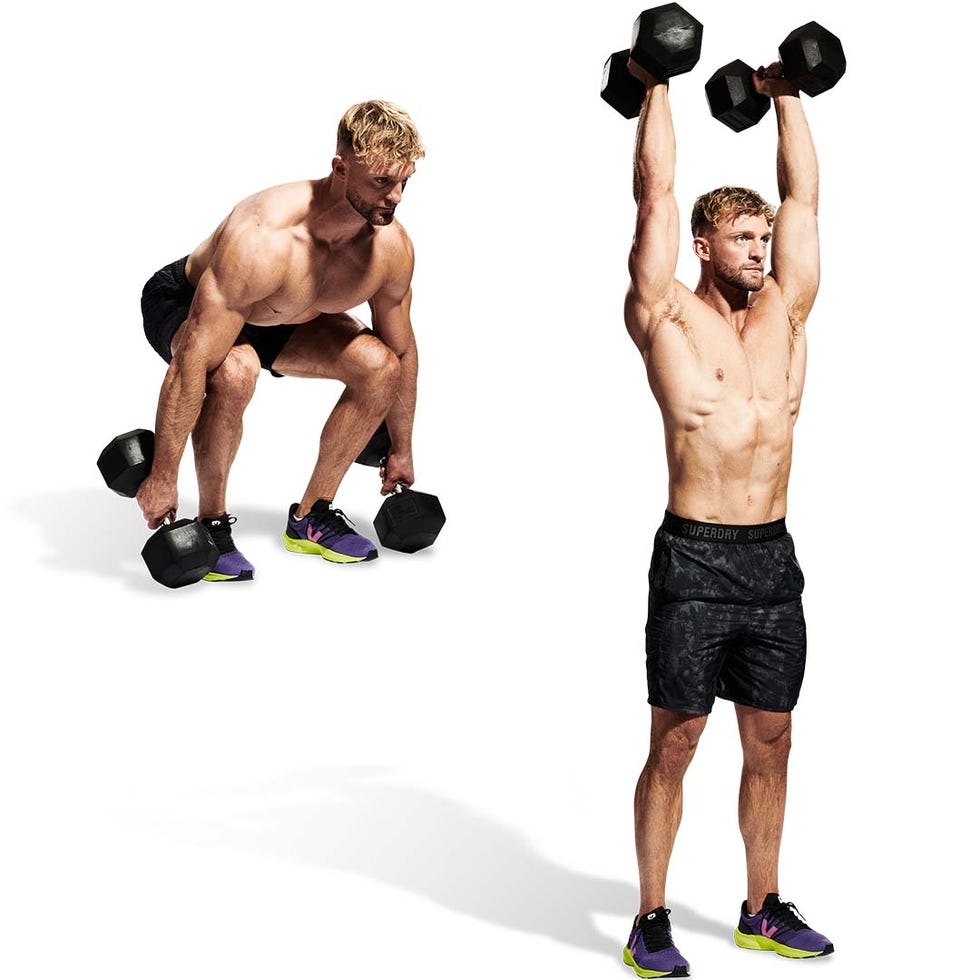
1. Dumbbell Clean and Press (5 reps)

    Squat down to grab your dumbbells from the ground, just outside of your feet (A). Stand up explosively with a slight jump, then use the momentum to pull the weights on to your shoulders. Dip at your knees and press your dumbbells overhead (B). Lower to your shoulders, then the ground and repeat.

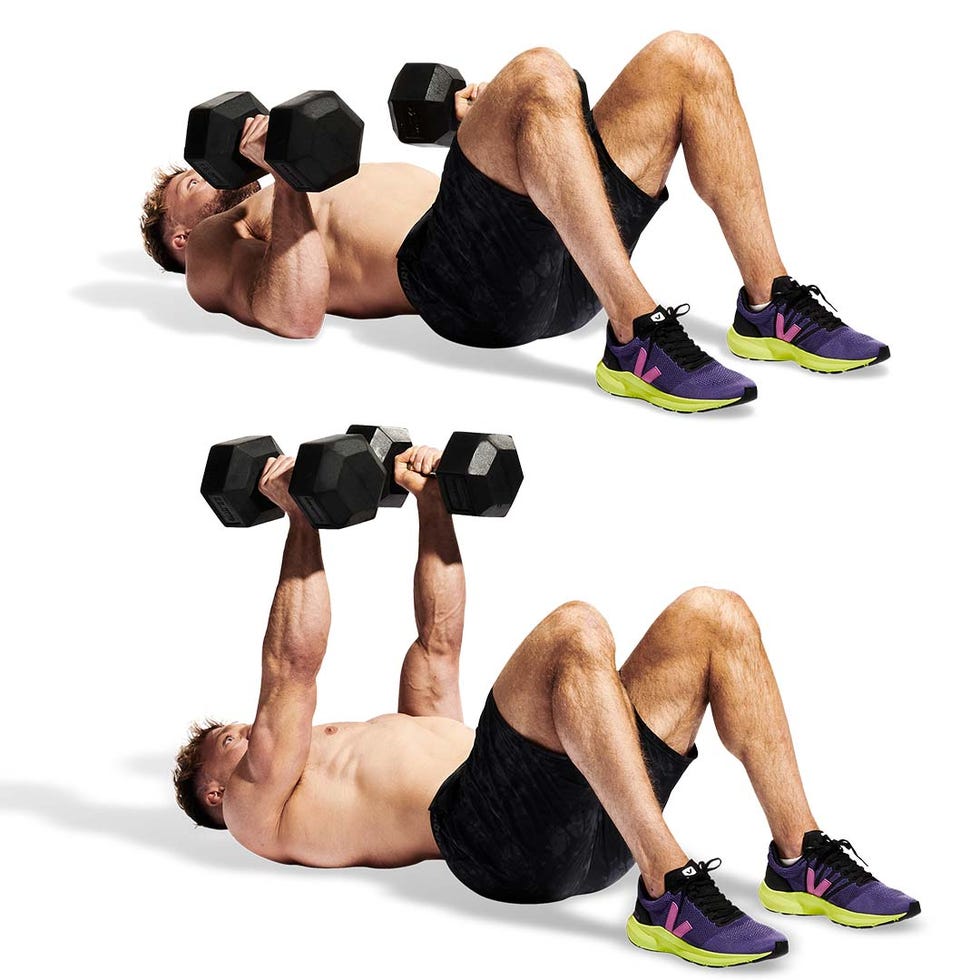
    2. Dumbbell Floor Press (10 reps)

    dumbbell floor press

    The bench press’s brutal, power-building brother. Lie flat on your back holding two dumbbells, your knees bent and your feet flat. Press the bells above you, locking your elbows (A). Lower the weights slowly until your upper arms are resting on the floor (B), pause here for a count before repeating.

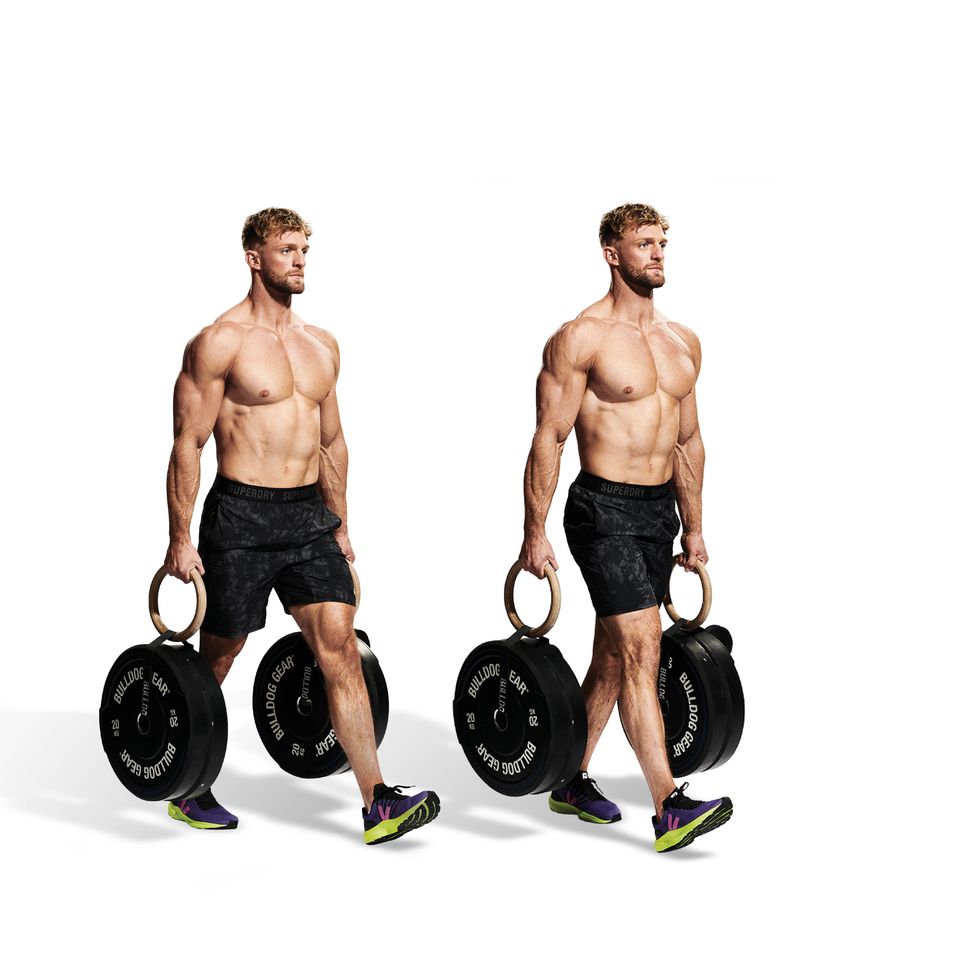
    3. Farmer’s Carry (30m)

    carry

    A little hack for big gains. Pass the strap of a gymnastic ring through a set of weight plates, attach your ring and pull tight. Repeat with another set. Grab the rings, stand tall and brace your core (A). Purposefully stride forwards (B). At the halfway mark, drop your weights, turn around, re-grip and return to the starting position.

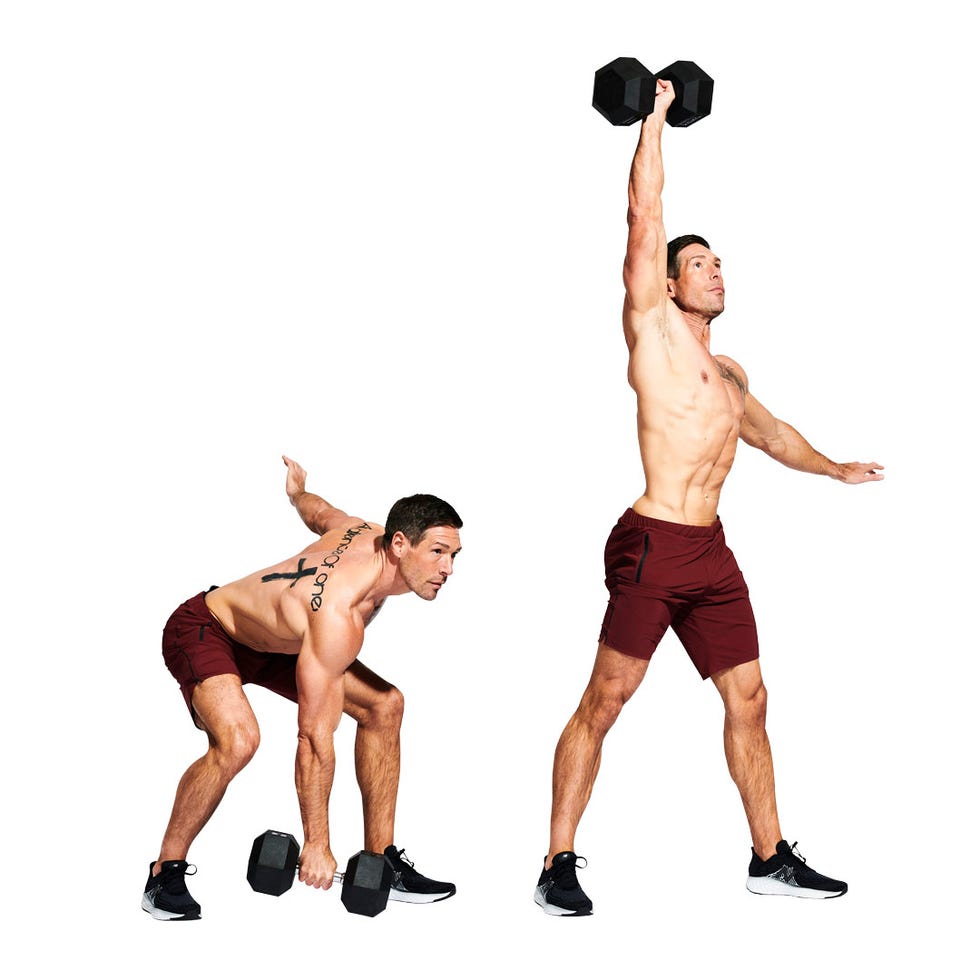
    4. Single-Arm Snatch (60 seconds max effort)

    dumbbell snatch

    Time to ramp up the effort. Hinge down and grip the dumbbell between your feet (A). Explosively stand up, pulling then punching the bell into the air overhead in one motion (B). Lock your arms, then lower back to the ground, switching hands mid-air. Repeat as many times as possible in 60 secs, then rest for 1 min.

    Workout Two – The Leg Work

    Now we’ll zoom in on your lower body, for what’s sure to be the toughest session of the week. But if you want to see results, don’t hold back. Follow the same EMOM format as used in the previous workout, completing all 4 moves then resting for 1 min, and repeating for 8 calorie-torching rounds in total. Steel yourself… it’s going to be a long 40 mins.

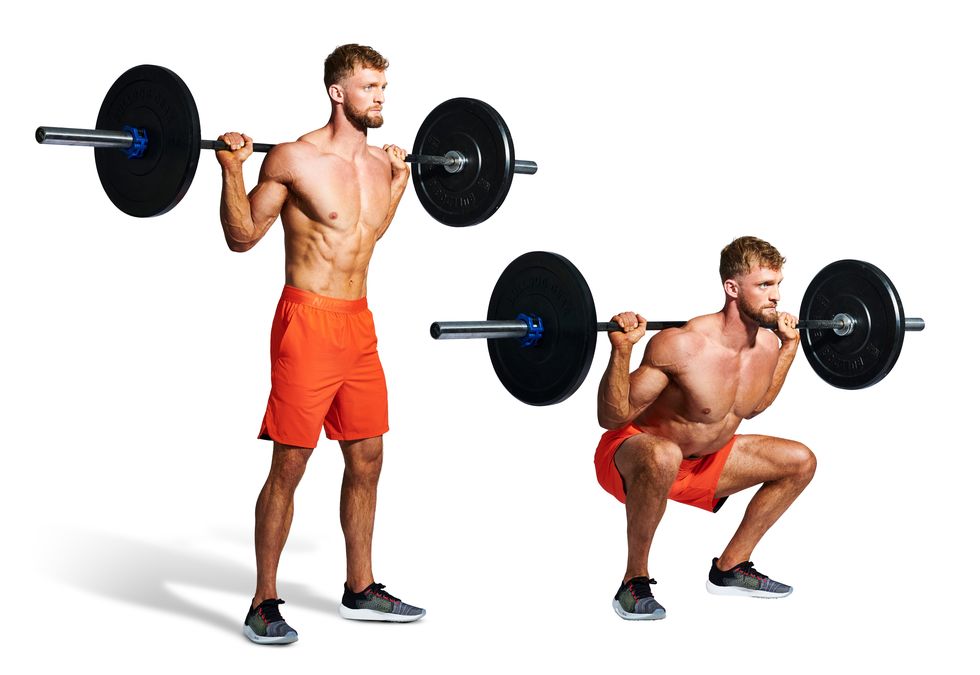
    1. Back Squat (5 reps)

    back squat tom kemp

    Bigger legs mean a bigger metabolism. That’s science. Take a barbell out of a rack, rest it securely across your traps and stand tall (A). Keeping your torso as upright as possible, squat down until the crease of your hip passes below your knee (B). Stand back up explosively, repeat.

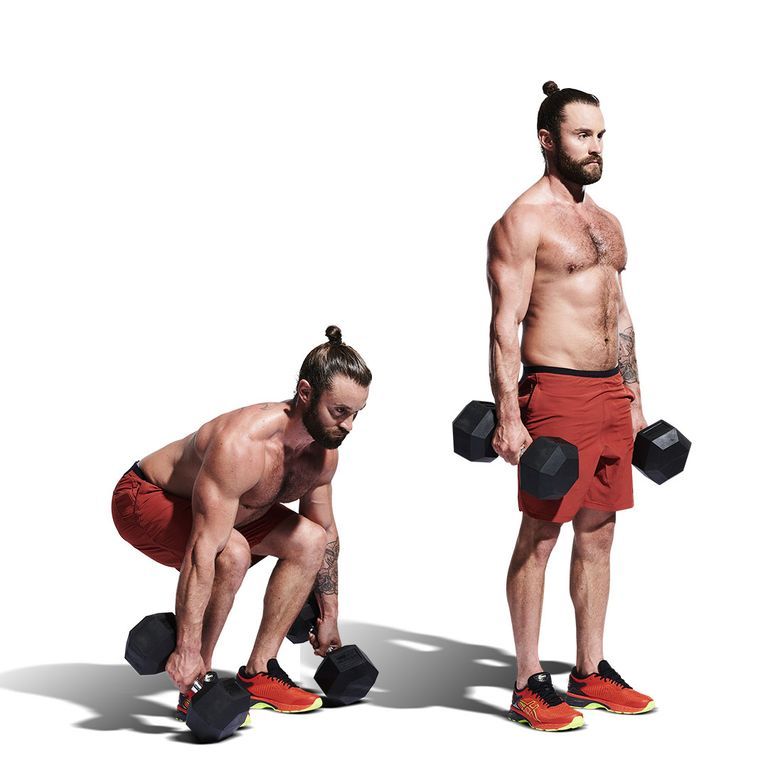
    2. Dumbbell Deadlift (10 reps)

    db dumbbell deadlift

    With your dumbbells on the floor just outside of your feet, hinge down and grip them with a flat back and neutral spine (A). Engage your lats and stand upright, pushing down with your feet and keeping your chest up (B). Lower to the ground and repeat. Avoid rounding your lower back, keeping your form tight throughout.

    3. Walking Lunge (20m)

    walking barbell lunge

    It’s like regular walking, but way worse. Re-rack your bar across your traps and stand tall (A). Keeping your chest up and back straight at all times, take a long step forwards with one leg, bending your front knee until the back knee touches the ground (B). Stand up explosively, pause and repeat with the other leg.

    4. Plate Push (60 seconds max effort)

    plate push

    We aren’t pushing away plates in the kitchen, but we are here. Place a heavy weight plate on the ground. Drop down on to all fours, hands on the plate. Lift your knees from the ground (A). Drive with your legs, pushing the plates away (B), close the gap and repeat. Turn around at the halfway mark and push back.

    Workout Three – Hang Tight

    Follow the exact same 8-round format as used for the previous two workouts and perform all 4 moves in the first 4 mins, followed by 1 min of rest. Your third and final metabolism-charging session promises to give your back and biceps a serious workout, while flambéing your core for a stronger set of abs, as a bonus. Now don’t hold back on that air bike…

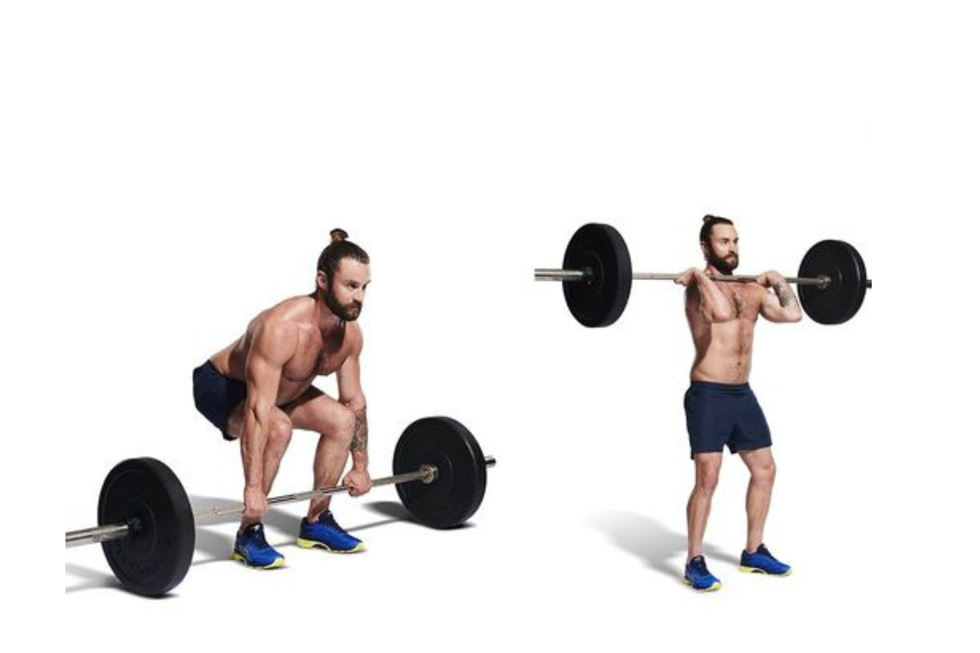
    1. Hang Clean (5 reps)

    barbell clean

    Lift your barbell up to waist height with an overhand grip. Hinge at the hips to lower it to just above your knees. Stand back up explosively with a slight jump (A), using the momentum to pull the bar on to the front of your shoulders (B). Stand up straight, then lower under control and repeat.

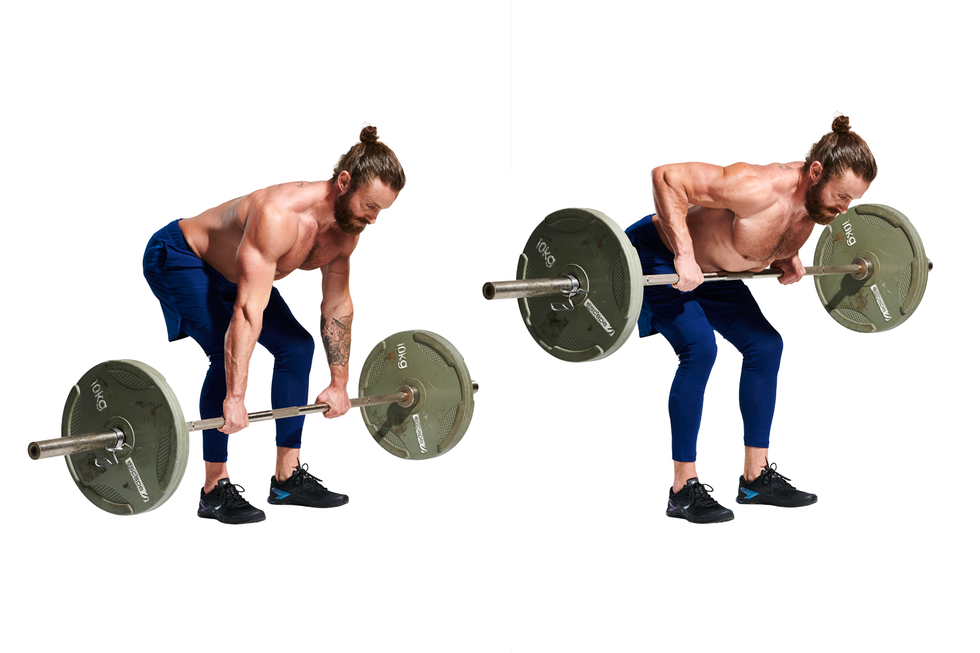
    2. Barbell Row (10 reps)

    barbell row

    With feet slightly wider than shoulder width, step underneath a barbell and hinge at the hips to grip the bar (A). Keeping your torso parallel to the ground, row the bar towards your hips (B), squeeze your shoulder blades together and lower under control to the start, then repeat. Control the bar and avoid moving your torso.

    3. Dumbbell Crawl (20m)

    dumbbell crawl

    Start on all fours, gripping a heavy dumbbell in each hand. Lift one dumbbell and reach forwards with that arm, advancing behind with your back leg on the opposite side (A). Repeat the move on your other side (B). Keep alternating sides, edging forwards as quickly as possible, while staying under control.

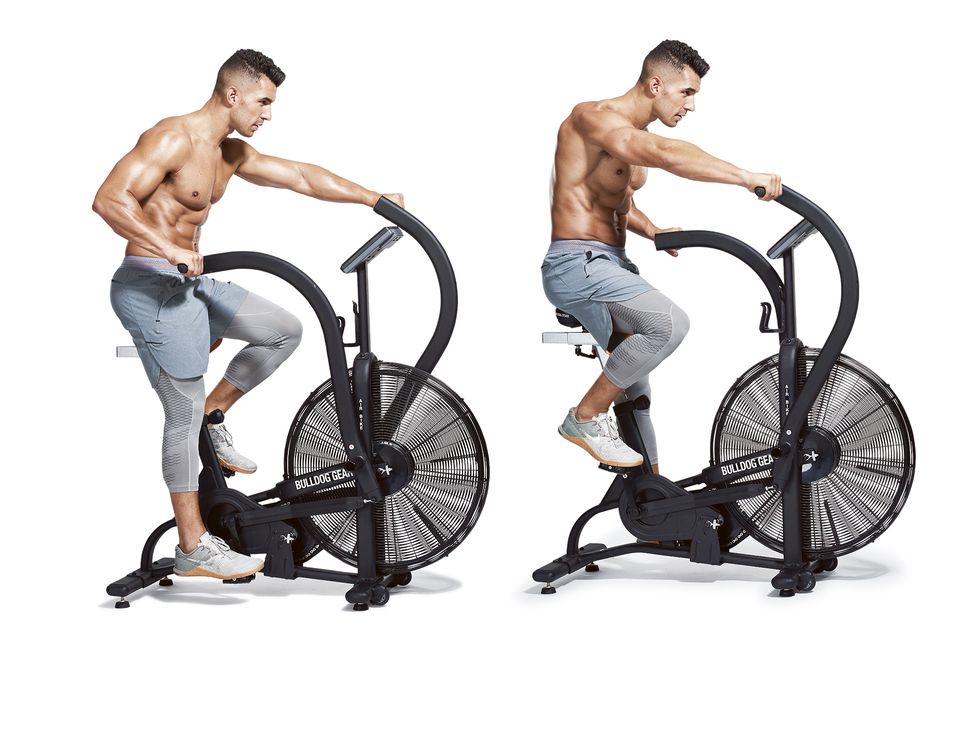
    4. Air Bike (60 seconds max effort)

    bicycle part, bicycle wheel, exercise machine, bicycle, bicycle trainer, bicycle accessory, exercise equipment, vehicle, bicycle tire, bicycle frame,

    Set up on an air bike, stationary bike, ski-erg or rowing machine. Whatever your cardio machine of choice, blast it hard and fast for the full 60 secs, aiming for maximum output. Don’t hold back on the first effort, and then endeavour to get as close as possible to your calories or metres in each subsequent round.

          Headshot of Andrew Tracey

          With almost 18 years in the health and fitness space as a personal trainer, nutritionist, breath coach and writer, Andrew has spent nearly half of his life exploring how to help people improve their bodies and minds.    

          As our fitness editor he prides himself on keeping Men’s Health at the forefront of reliable, relatable and credible fitness information, whether that’s through writing and testing thousands of workouts each year, taking deep dives into the science behind muscle building and fat loss or exploring the psychology of performance and recovery.   

          Whilst constantly updating his knowledge base with seminars and courses, Andrew is a lover of the practical as much as the theory and regularly puts his training to the test tackling everything from Crossfit and strongman competitions, to ultra marathons, to multiple 24 hour workout stints and (extremely unofficial) world record attempts.   

           You can find Andrew on Instagram at @theandrew.tracey, or simply hold up a sign for ‘free pizza’ and wait for him to appear.

Botanical Stores Introduces White Label Herbal Supplements Blended

0
Botanical Stores Introduces White Label Herbal Supplements Blended

Article content

Ben Lomond, California–(Newsfile Corp. – November 1, 2023) – Botanical Stores, a pioneering name in the herbal supplement industry, is thrilled to announce its latest offering: white label herbal supplements infused with high potency hemp gummies. This revolutionary product line is designed for businesses looking to brand their store or distribution outlet with a unique and potent product.

Advertisement 2

Article content

Article content

Founder Kirk Meyer, reflecting on the journey of Botanical Stores, remarked, “It was inevitable that our food scientist would start to blend CBD/hemp with our herbal supplements once it was federally legalized. These blends are taking the world by storm, receiving an overwhelming response from the public and helping entrepreneurs achieve success.”

The new product line is not just about business; it’s about providing solutions. These herbal supplements, blended with hemp, include potent ingredients like lions mane, turmeric, ginger, passion flower, Ashwagandha, lavender, white willow, and more. Each product is designed to address specific concerns such as anxiety, sleep, and pain. Moreover, every product undergoes rigorous 3rd party testing to ensure its quality and efficacy.

Article content

Advertisement 3

Article content

Historically, hemp has been a trusted solution for pain relief and various other ailments. Its use dates back to as early as 7000 BC by civilizations like the Egyptians, Asians, and Europeans. However, its potential was stifled in America when it was outlawed in 1937. With its recent federal legalization, Botanical Stores saw an opportunity to reintroduce this powerful ingredient to the modern world, blending it seamlessly with other potent herbs.

The target audience for these white label products is vast, encompassing dispensaries, smoke shop distributors, health and wellness centers, physical therapy clinics, subscription boxes, drug stores, and platforms like Weedmaps and Leafly. With the cannabis industry booming, Botanical Stores aims to provide businesses with a product that not only offers huge margins but also resonates with the needs and preferences of today’s consumers.

Advertisement 4

Article content

For a detailed look at the products and their specifications, interested businesses and distributors can visit www.Botanicalstores.com.

About Botanical Stores
Botanical Stores stands at the forefront of herbal innovation. With a deep-rooted belief in the power of nature and its healing properties, the company has consistently introduced products that resonate with the needs of modern consumers while drawing inspiration from ancient herbal remedies. Their latest white label herbal supplements blended with high potency hemp gummies are a testament to their commitment to quality, innovation, and the well-being of their customers.

Media Contact:
Botanical Stores (Wholesale Only)
Address: 305 Fritch Creek, Ben Lomond, CA 95005
Phone: 831.419.7875
Email: [email protected]
Website: www.Botanicalstores.com

Corporate Logo

To view the source version of this press release, please visit https://www.newsfilecorp.com/release/185823

#distro

Article content

Comments

Postmedia is committed to maintaining a lively but civil forum for discussion and encourage all readers to share their views on our articles. Comments may take up to an hour for moderation before appearing on the site. We ask you to keep your comments relevant and respectful. We have enabled email notifications—you will now receive an email if you receive a reply to your comment, there is an update to a comment thread you follow or if a user you follow comments. Visit our Community Guidelines for more information and details on how to adjust your email settings.

    Advertisement 1

How Sen. John Fetterman Recovered From Depression After a Stroke

0
How Sen. John Fetterman Recovered From Depression After a Stroke

Christaan Felber

Warning: This article discusses suicide and depression.


WASHINGTON, D.C.
RUSSELL SENATE OFFICE BUILDING
A HOT SUMMER DAY

JOHN FETTERMAN, the junior senator from Pennsylvania, is lumbering through the corridor that senators use to get from their offices to the Senate chamber, usually when it’s time to vote on a piece of legislation. You can get there by foot or ride a little trolley car, which he calls the subway. He is joined by four staff members, one of whom walks backward in front of him holding an iPad equipped with software that translates what people say to him—and what he himself says. After his stroke in May 2022, it became difficult for him to process language and to speak clearly. Even 14 months later, it’s hard to talk with him in the corridor above the noise of the trolleys and the background chatter.

“So you prefer to walk rather than take the subway?” I ask.

He looks at the iPad. The screen reads, “walk brother subway.” He looks at me curiously.

“Brother . . . ?”

His path to this moment has been both well-documented and little understood. He grew up in York, Pennsylvania, south of Harrisburg. He played football at a local college, then got his master’s degree in public policy from the Harvard Kennedy School. He returned to Pennsylvania, to a small, decrepit city called Braddock, and worked helping residents earn their GEDs. In 2005 he ran for mayor of Braddock and won. He has lived there for 22 years now. He and his wife, Gisele, made a home out of a converted car dealership with their three children. In 2019 he became the lieutenant governor, and in 2022 he ran for the United States Senate. His opponent was Mehmet Oz, the television doctor and longtime New Jersey resident. During the campaign, Fetterman suffered a stroke, stayed in the race, faced Oz in a disastrous debate, and won anyway.

This has all been well-documented and little understood.

When we arrive at the Senate chamber, Fetterman, 54, stands in the doorway and gives an “aye” vote. He is not allowed to actually step onto the floor, because he chooses not to wear a business suit, as required by the Senate dress code at the time. So he gives a thumbs-up. It’s just easier this way, and much more comfortable.

Back in his office, he sits behind his desk for our interview. He is wearing a black short-sleeved button-down, baggy black shorts, and black Hoka sneakers with black ankle socks. The lights are off, and sunlight fills the room.

A successful recovery from a stroke can take months or even years. During this healing process, the brain seeks pathways around damaged tissue to function properly. I will speak to Senator Fetterman several times over a period of months. At the beginning of our first interview, when I start talking, he looks at his iPad screen.

JOHN FETTERMAN: Please don’t take it personally. I’m reading off a screen to make sure I hear everything. I’m not ignoring you or checking my email or something.

RYAN D’AGOSTINO: The stroke itself. What do you remember about it?

JF: I was walking into my SUV after using the men’s room at a Sheetz, and my wife, Gisele, said, “My God, you’re having a stroke.” And I was like, “What the hell are you talking about?” This side of my face was drooping. My security detail turned on their lights and started driving to Lancaster General. I was arguing the whole way. I was like, “What are we doing? I’ve got to get to . . .” This was just a couple of days before the primary, and we had an event at Millersville University. I’m like, “We got to go. We got to go.” And my speech started to make—I was arguing all the way till we got there, but my brain was fighting to get—literally, I was in the process of dying.

I look back and I’m like, If all this would have happened when I was asleep, I never would have woken up. Or if we were in a remote part of Pennsylvania, I wouldn’t have made it.

RD: It’s not hard to find clips on Fox News, even now, where they grab a moment of you mushing words together.

JF: They love it. They’ve never lost their hard-on for trying to point out that I missed a word or two.

RD: Is it hurtful?

JF: It’s not that it’s hurtful, but it’s dismaying. I would never make fun of, be like, “Ha ha ha, you’ve got a limp!” I don’t understand anyone that gets their jollies off that, because it could be your brother, it could be your father, it could be your child. It’s almost like middle-school kind of obnoxious. Don’t you reach a certain age where you’re just like, Yeah, we don’t be like this?

RD: Do you hear it as it’s happening and you think, Shoot, I missed a word?

JF: Of course. I know when I’m missing words. It just doesn’t faze me anymore.

fetterman near his home in braddock pennsylvania this past october six months after receiving treatment for depression

Fetterman near his home in Braddock, Pennsylvania, this past October, six months after receiving treatment for depression.

Christaan Felber

After his stroke, compounding the agony of having private health struggles play out so publicly and in the inhuman forum that is contemporary partisan politics, Fetterman plunged into a deep and sudden depression. It was so severe that over time he began to contemplate suicide. In February, he checked himself into Walter Reed National Military Medical Center, where he received treatment for six weeks.

RD: You were the kind of person who could look at Braddock, Pennsylvania, and see beauty and potential—that suggests a positive, optimistic disposition. And yet you end up battling depression. At what point was it clear that something was really, deeply wrong?

JF: I made the decision to do the debate. And there was a lot of “Show us your medical records. Show your medical records.” I said, “You want to see my medical records? Okay. We’re going to do a debate. You’re going to see our ‘medical records’ right up there in front of you—in front of everybody.” You can’t show people much more about where you’re at than you can by just getting out there.

I knew it was going to be rough. I mean, like, no shit, guys. I have an overpolished TV guy like that—but I believed that people deserved to know this is where I’m at. This is what’s been done to me. So I did it, and I knew it was rough. And then I knew that’s when something broke, where I knew that the depression was a filled [free] fall. After that moment, that was all the tinder that was accumulating, accumulating, accumulating . . . .

RD: Yeah, but then you win.

JF: I did win! But I didn’t expect that I was going to win, to be honest, because we were getting—it was a blowtorch. “You’re a ‘retard.’” “You’re a vegetable.” Could you imagine if on the other end I was making fun of someone who had a stroke? What the fuck is—what the fuck is wrong with you? You know? And that was—at that point, I all but stopped eating. I was dehydrated.

We won by five points. The last time this seat went to Democrats was in the ’60s. But even then, it didn’t matter to me. I didn’t have any interest to be a senator after that. It was rough. You would think that, Hey, you won, and it was good. But it wasn’t. It was confusing and hurtful to my children, because they thought, You won. What’s wrong with you? What’s wrong with us?

I stopped getting out of bed. I stopped going on walks. I stopped listening to music. I stopped watching television. Thanksgiving is my favorite holiday, and I barely sat at the table. Christmas, of course, I love that, and I’m ashamed to say that I wasn’t part of the Christmas. It was my wife getting all—our youngest child still believes in Santa. I wasn’t a part of it in terms of doing up the decorations or helping her buy parents—excuse me, presents. In the middle of winter, I had comfort in knowing how it was dark early. I cringed whenever the clock said it was a time that most people would be out of bed.

if i hurt myself then i am leaving a blueprint of my children that in their life when things happen or things are bad that this is what dad did that's the blueprint so i can do it too

RD: And here you’ve been elected to the United States Senate.

JF: I was more preoccupied with the things closest to me, and that is my family. And I was a fame—excuse me, I was failing as a father and I was failing as a husband. And if I can’t deliver for my family, how the hell can I start delivering for the people in Pennsylvania?

Finally, I had an opportunity with Walter Reed. But for that kind of intervention, I don’t know where I would be at. And I am so grateful for that.

Fetterman’s father, Karl, suffered a near-fatal heart attack days before this interview. Fetterman has been visiting him every day in the hospital.

JF: I can’t imagine if my dad’s heart attack would have happened six months ago, what that would have done to me. So thankfully I’ve been able to be back to 100 percent, at least in terms of feeling good about everything. I’m able to pay it forward and to visit with my father all the time and be there and be there for the family of that.

Let me say this to anyone that’s thinking about this: There is a way out. There is a way out, and do not ever, ever, ever, ever hurt yourself. I considered that, because if I hurt myself, then I am leaving a blueprint of my children that in their life, when things happen or things are bad, that this is what Dad did. That’s the blueprint, so I can do it, too.

He is crying now, sitting at his Senate desk.

JF: Anyone reading this story: Don’t ever, ever, ever, ever consider hurting yourself. Get your help. I never thought it would work, and I was skeptical. But don’t ever give up. Get help.

We have all had times when we’ve had to muster some determination. Some strength. Some perseverance in the face of hardship. Those terrible months after a loved one dies. A polyp that might be benign but they don’t know. A downsizing that sends you hitting up LinkedIn in your 50s.

A massive stroke.

Now imagine you’re famous. And not only famous but a politician, and not only a politician but a politician in an era when if you suffer a stroke that affects your speech, people in the other party and on propaganda networks—who know nothing about you but feel that they have license to destroy you—call you some awful things. Do you persevere in the face of hardship? Do you soldier on, stay in the race, do the debate, serve your constituents? Or do you say—and who could blame you?—to hell with this.

RD: This is all kind of hard to imagine, because I’m looking at someone who has always looked great—he’s the mayor! He’s a senator!

JF: That’s what’s so fucked-up about depression. Even if you won, it convinces you that you’ve lost. I was on borrowed time from after the debate and the Election Day. Put together Scotch tape just to hold me together between the last couple of weeks.

fetterman arrives for a vote at the capitol a month after being discharged from walter reed in late march

Fetterman arrives for a vote at the Capitol a month after being discharged from Walter Reed in late March. 

AP/Francis Chung/POLITICO
fettermans tablet at his desk on the senate floor which has helped him process information since his stroke

Fetterman’s tablet at his desk on the Senate floor, which has helped him process information since his stroke.

AP/Francis Chung/POLITICO

RD: There was a sign in Braddock: DESTRUCTION BREEDS CREATION. Did you come up with that?

JF: Yeah. I use that as kind of—this was early on when you had a community that was genuinely torn apart, lost 90 percent of its population.

RD: The reason I ask about that phrase, “destruction breeds creation,” is that there’s a metaphor there. You were almost destroyed.

JF: Yeah. I didn’t have a near-death experience, because technically I had died. It wasn’t like seeing lights or whatever, but it was feeling that everything was being bounded up in things, all coming up through, and I was going to go up to a window into the sky. Then I was woken up by the doctor who was standing over me, and he had an X-ray of my clot here that technically killed me, saying, “We got this. You don’t have to worry about your stroke.” And if this doctor that cathetered it up my leg—I mean, it’s astonishing technology—if he was running late for work or if he was on vacation, I would be up there with the harps. People in their middle age talk about their mortality. I’ve experienced my mortality, so I’m not afraid of it anymore.

BRADDOCK, PENNSYLVANIA
THE FETTERMAN HOME
TEN WEEKS LATER

FETTERMAN SITS CROSS-LEGGED on the couch, looking at his phone. Gisele corrals their two dogs—Artie, a three-legged rescued pit bull, and Levi, another rescue—and tucks her legs underneath her on a chair by the window. Their cat, Potato, roams around the room, which feels big enough to play soccer in. (This was the showroom of the car dealership, after all.) There’s an indoor hot tub in one corner, and then a mile away, in the opposite corner, is the open kitchen, as well as two couches facing each other.

A year ago at this moment, Fetterman was in the fight of his life, campaigning against Oz, his speech severely impeded, political opponents calling him names. Today he is smirking at the news on his phone, much of which is about Republicans feigning disgust at his flaunting of the senatorial dress code.

RD: When we first met, your father had recently had a major heart attack. Your uncle had died the day before of stomach cancer. You’ve been severely tested. How’s your father doing?

JF: I am so happy to be able to share that he is almost back to 100 percent. He was clinically dead for about 20 minutes. It’s remarkable that he would have even survived. And yeah, the next test was with the whole dress-code thing, where there’s an undeniable fixation of Fox News and that whole universe trying to tear me apart. I just was able to laugh and observe it and not have to internalize a lot of that.

i didn't have a near death experience because technically i had died

RD: Do you think a year ago it would have been a different story?

JF: Oh, yeah. And I will never be arrogant and think that I’ve licked depression or I don’t have to be vigilant or there aren’t going to be tests. But I am so rooted in gratitude post that my father recovered, that I have a wonderful family, and I’ve been able to resist the dark conversation about finishing myself off.

RD: I’d love to talk about what this past year or so would have been like without the support of your wife, who I imagine was just—

GISELE FETTERMAN: The best!

JF: She is. Just ask her. But no, she was incredibly supportive.

GF: Even how I delivered the news to the kids was important. I was like, “Guys, family meeting. We have some amazing news to talk about. This is really exciting. Dad is getting help, and we’re so proud of him for that.”

RD: Did you hear from the Bidens through all this?

JF: He has been above and beyond kind, supportive, and decent. It would have been very easy for them to kind of quietly back away. But it was the opposite. He doubled down on me, and I’ll be forever grateful of that.

RD: I interviewed him while he was vice president, and about two weeks later, my younger son suffered a massive brain hemorrhage. He was seven. It was caused by cancer, which we didn’t know he had. And my cell phone rings the next day. “Ryan, it’s Joe Biden. God-dammit. I’m so sorry. What’s going on? Tell me. How’s your boy?”

Fetterman looks at me for a good minute, then out the window. Across the street, the smokestacks and refinery fires of a U.S. Steel plant cut into a blue sky. He looks back at me.

JF: The one thing that may put me beyond would be something happening to my child.

GF: At the airport last week, remember that woman came up to you, John? We were at the airport coming back from D. C., and a woman came up to sit with him and said that her 16-year-old tried to kill herself and agreed to get help only after John went public about it.

RD: Knowing the John that you’ve known for so long before the stroke, before all of this, was it hard to reconcile those two people in the same person?

GF: John always, I think, had some depression. So I read every book on depression 14 years ago, and I would bring it to him, like, “I think you’re depressed.” There are things that we can try, and he would say, “You’re just too happy, Gisele. I’m not depressed. You’re just too happy.”

RD: Do you think that as a younger man or even a boy you had depression that went undiagnosed?

JF: It did. I don’t even know if I’d call it depression, but melancholy. But my origin story is more complicated, because I was an unplanned and unwanted pregnancy to two teenagers that were just casually dating. And I always felt a sense of responsibility or ashamed, because I was essentially a mistake. So I’ve never been able to have anything but a low opinion of myself.

election night 2022 fox news calls pennsylvania for fetterman his opponent mehmet oz had savagely attacked fettermans health throughout the campaign

Election Night, 2022: Fox News calls Pennsylvania for Fetterman. His opponent, Mehmet Oz, had savagely attacked Fetterman’s health throughout the campaign.  

Alex Brandon/AP Photo
fetterman stands alongside his wife gisele their three children grace karl and august and vp kamala harris during his swearing in ceremony earlier this year

Fetterman stands alongside his wife, Gisele; their three children, Grace, Karl, and August; and VP Kamala Harris during his swearing-in ceremony earlier this year.

Jon Cherry/Reuters/Redux

GF: And I fight that so hard with him, because I want him to accept the love that he gives to everyone. Somehow everyone is deserving of it—but not John.

RD: Just from when we spoke in Washington to now, your speech seems so much better. I don’t know if it’s just different days, but—

GF: No, it’s healing.

RD: What’s the prognosis?

JF: I’m healing. The thing they’ve always said is, you’re never guaranteed to go back to be ing 100 percent. Nobody knows fully how the brain is, what’s the word—neuroplasticity. Your brain tries to find a way to deal with the fact that there is a mass of dead cells from the stroke. The brain finds a way to work around it, and the more time that goes on, your brain becomes more and more successful in getting better.

I feel better, and I’m able to have conversations where I’m not having to say, “What was that word?”

Now I’m giving interviews on the fly, which is part of the way of life in the Senate, where you’re walking down a hall, and that’s where reporters are waiting, and they’re like, “Hey, can we talk?

That was a major thing: I couldn’t talk to any of the reporters. I had this horrible paranoia that every time I spoke to somebody that’s recovering—or, excuse me, that was recording it—it’s going to end up on Fox News or on Twitter. Like, Bahahhhh, he’s Sling Blade!” It was like a narcotic for them. It’s such recreational cruelty for them.

GF: There are days now when he doesn’t use the translation software at all.

RD: How does listening to music work?

JF: Early after the stroke, it was like whwhhwhwh—I knew it was noise, but that’s it. And now I’m able to enjoy it so much.

RD: I would think sports would be easy to watch on TV.

JF: If I have a free Sunday, hey, I’d love to watch the Steelers. That might be fun—but I got three great kids that I love and that I want to hang out with! And the next day I’m going to have to get on a plane.

When Gisele and the kids were trying to schedule their first visit to Walter Reed—the kids’ first visit—I was objecting. I was thinking, No, the kids don’t want to see me. And there was a therapist there, she was younger—everyone there is in the Army. And finally she said something that changed my whole life, probably the trajectory of my whole life. She said—and kind of seemed like she dropped out of character—she said, “Kids always need hugs from their daddy.”

I’m going to get emotional just talking about it, because that just shattered my whole—I was like, Oh my God, it’s true. I immediately agreed to schedule the visit. That changed everything. It was freeing, because it allowed me to accept love.

a wall of family photos inside the fetterman home

A wall of family photos inside the Fetterman home.

Christaan Felber

As Fetterman was talking, Gisele had disappeared in silence—I didn’t realize she’d gone—and reappeared behind me holding a frame, two feet by three, containing yellow and pink Post-it notes on which the Fetterman children had written notes to their father. “Best Dad Ever” . . . “YOU SHINE” . . . “Hey!! Dad just to let you know I am always in your hart, Love You” . . . “Happy You Are Becoming Happier”…“You INSPIRE”…“You are amazing”…

GF: During our visit, the kids stayed in the room and I went for a walk with him—there was a healing garden. When we came back to the room, the kids were all over the floor, making these notes.

JF: Walter Reed is on a base, and I was desolate. I was being observed 24/7. And there is a Wendy’s on the base that you can walk to. And I took everybody to Wendy’s—Wendy’s!—and it was the first time we were able to be together again. And we had this amazing meal there.

GF: The kids had garlic fries.

Fetterman looks off, lost in his own incredulity at sharing a meaningful family meal of garlic fries and Baconators. One of the dogs curls into a sunbeam on the floor.

RD: When do you have to start thinking about reelection?

JF: Well, that’s kind of well into the horizon. Now it’s just being the kind of senator that Pennsylvania deserves. And I’m grateful for the choice that they made to give me the ability to serve, and I think the depression has made me a much more effective and empathetic senator. After kind of dying, I’m just grateful for any time, whatever that is. I think about that if things would have been different, myself and my father’s circumstances, I’d be gone and then my father would be dead, and what our families would look like, and it would be profound.

My dad, he’s 73, but now hugging my father is so special. Now when I go visiting him, it’s a religious experience. It really is. It’s profound.

RD: Kids need hugs from their daddy.

Fetterman smiles at this and points at me.

JF: Right after that happened to my dad, I put this picture on my phone: It’s my dad holding me when I was not even a year old. From that moment up till the time where he was on a ventilator, I’ve never seen him as anything other than the guy holding me. Strong. Talk about winning the lottery. That one of the people that I love most ever, to get him back is remarkable.

My poor mother, too. Talk about the commitment of marriage and having kids, as if once kids are 18, they’re over with.

my god i don't want anybody else to suffer isn't that what any politician should really want out of his or her career to reduce suffering and make things better

RD: The commitment to a marriage is so important, and hard. The night my son got sick, he’s in the operating room for six hours having brain surgery. And my wife took my hand and said, “No matter what happens, this can either break us apart or bring us closer.”

JF: I wish I had that exact quote [said] to me after I had my stroke. So succinct and profound and critical.

GF: And emotionally mature, too.

JF: I want to needlepoint that onto a pillow. Because of the viciousness and the stress of the campaign, I was able to slide back into that kind of bickering and that kind of pettiness, too, because I wasn’t able to process the kinds of craziness and be the kind of more grateful, loving husband or dad.

GF [smiles, sighs elaborately]: It’s okay. I always spread love.

Fetterman looks down at his phone screen to see what she said.

JF: That didn’t come through. So I guess I’m okay with whatever you said. Sometimes it’s better if I don’t hear some of her, ah, comments.

RD: Is talking about all of this sort of a form of therapy?

JF: It’s more like affirming gratitude. It’s like, my God, I don’t want anybody else to suffer. Isn’t that what any politician should really want out of his or her career, to reduce suffering and make things better?

RD: For people out there who are struggling and wanting to know: Once you go through intensive treatment like you did at Walter Reed, what does the other side look like? What do you have to do?

GF: He meets with his doctor weekly. That counts as therapy. And you eat really well. I’m a natural nutritionist. He eats a ton of greens. He doesn’t eat any sweets at all. I’m the one who eats a pint of ice cream every night before bed.

RD: The role that you’re finding yourself in, as advocates for mental health, seems natural.

GF: We’ve become like a little suicide hotline. I get so many messages on Twitter. He’s Zoomed with folks. Complete strangers. It happens every week, either someone who decided to go get help or finally decided to go to therapy. We had a dad reach out about their 12-year-old daughter, who was trying to get into treatment and showed videos of John. What a privilege. To be allowed into this very vulnerable space.

JF: And I try to process what my son August would think about if I’d have done the same thing as another dad I heard about who made the opposite decision I did. For the rest of that son’s life, he will always wonder why Dad wouldn’t stay.

Fetterman starts to cry and can’t speak for a long moment. When he finally does, he is barely audible.

JF: I’m so sorry that he wasn’t able to overcome the darkness, and I’m so grateful that I did.

He puts his thumb and forefinger into his eyes, as if to try to dam the tears.

JF: Excuse me. Saying something could break the chain that leads you to taking your life. I changed my mind.

fetterman at his home a former car dealership reflecting on the past year and a half of his life grateful to be alive

Fetterman at his home, a former car dealership, reflecting on the past year and a half of his life, grateful to be alive.

Christaan Felber

It’s hard to overstate the power of this moment. It wasn’t long ago that an American in high office showing such vulnerability in public wouldn’t have been allowed or tolerated. We have been terrible at dealing with mental health in this country until very recently. Now we’re merely bad at it. But this determined public passion play of Fetterman’s—his willingness not to hide behind opaque, lying statements crafted by Washington flacks but rather to show himself, sometimes painfully, as a flawed and healing human—has already made the junior senator from Pennsylvania a consequential figure in history. In a single year, he’s done more to destigmatize stroke and depression than any of the ancients on Capitol Hill have in a lifetime.

He could have succumbed to the disease that came after him. He could have run from public life. But he did neither. He’s here, getting steadily better, showing us how it’s done.

The midafternoon sun warms the dogs by his feet, warms Gisele’s shoulders as she watches her husband. She untucks her feet and walks over to show me a long wall of family photos—the kids on Halloween, the kids at the beach, the couple in Washington. There’s one of Fetterman as a child with his father.

Fetterman walks over to the kitchen, frowning at some piece of news on his phone, his six-foot-eight frame silhouetted against giant plate-glass windows. The kids will be home from school soon, and then it’s the weekend. I’m down the hall, lost in the illustrated story of his life, when he calls out:

JF: You’ve been here for quite a while. Want an Almond Joy?


If you or someone you know is having suicidal thoughts, contact the Suicide & Crisis Lifeline by dialing 988 for free and confidential support.

This article appears in the December 2023 issue of Men’s Health.

Headshot of Ryan D'Agostino

Ryan D’Agostino is Editorial Director, Projects at Hearst, and previously served as Editor-in-Chief at Popular Mechanics and Articles Editor at Esquire.