Home Blog Page 43

Are frozen foods really unhealthy? | Health and Wellness News

0
Are frozen foods really unhealthy? | Health and Wellness News

In our quest for a healthy diet, we are always told that fresh fruits and vegetables are healthier than frozen food. But convenience and all-season availability mean that we tend to use the latter as smart hacks in the rush of daily living. However, not all frozen foods are necessarily unhealthy, and a certain category can actually be nutrient-dense. It all depends on the type of vegetable, the time it takes to get from harvest to consumption and the specific freezing and storage methods employed.

What matters is the preservation methods used for these essential food groups, be it freezing or canning. First, let’s define frozen foods. These are vegetables and fruits whose temperature is reduced and maintained below the freezing point for storage and transportation purposes.

What kind of freezing is healthy?

The common process used is flash freezing, which retains all the nutrients with minimal loss of some water-soluble vitamins, especially vitamin C. “Speed is of utmost importance in the frozen food industry. As soon as produce (fruits and vegetables) are picked from farms, it becomes a nutritional race against time,” says Ritika Samaddar, Regional Head, Nutrition And Dietetics, Max Super Speciality Hospital, Saket, New Delhi.

Freezing fruits and vegetables make them more convenient, easily available and safe for consumption, provided they have been stored at freezing temperatures and thawed appropriately.

“Advances in food technology mean that much of the fresh food, like frozen peas for example, have been harvested at peak ripeness and snap frozen and processed within hours, preserving much of the nutrition. So, spinach stored at room temperature can lose up to 100 per cent of its vitamin C content within seven days as there is more oxidative damage. But frozen spinach that is snap frozen immediately after harvest will retain its vitamin content until it is cooked. So, you get a nutrient-dense food,” says Samaddar.

Festive offer

The rapid freezing process helps to lock in nutrients, preventing the degradation that occurs over time in fresh vegetables. Says Bhakti Samant, Chief Dietician at Kokilaben Dhirubhai Ambani Hospital, Mumbai, “Frozen vegetables have a significantly longer shelf life than fresh ones. Their availability throughout the year also ensures a consistent source of nutrition. High-quality frozen vegetables usually do not contain added preservatives, salt, or sugars, so you have more control over your dietary choices.” She even lists frozen vegetables that can be used on a regular basis. Frozen spinach is typically blanched and quickly frozen, preserving most of its nutrients, including vitamin K, vitamin A, iron, and folate. Frozen peas are often harvested at their peak ripeness and quickly frozen. They retain a high level of nutrients, including vitamin C, vitamin K, vitamin A, and fiber. Frozen corn is harvested and frozen at its peak, preserving its vitamin C, vitamin B, and dietary fiber content.

However, it’s essential to be aware that some frozen fruits and vegetables may have significant amounts of salt, sugar and fats added as preservatives, and these should be avoided.

What we need to watch out for in canned foods?

Most Read

1
Australia vs South Africa Highlights, World Cup 2023: Kagiso Rabada scalps three as SA blow AUS by 134 runs
2
Israel-Hamas War News Live Updates: Dropped 6,000 bombs on Gaza since start of war, says Israeli military; Blinken meets Netanyahu, assures US support

Canning is a method of preserving fruits and vegetables for an extended period in airtight containers. This process usually retains proteins, carbohydrates and fat-soluble vitamins with minimal loss. However, there may be a loss of water-soluble vitamins like vitamin B and C. Sometimes, salt, sugar, or preservatives are added to canned foods to improve color and texture. “Hence, it’s crucial to read labels and choose accordingly,” says Samaddar.

Frozen vs canned

One advantage that frozen vegetables and fruits have over canned ones is that they contain little or no added salt or sugar because the freezing process itself can stop bacterial growth. Canned fruits and vegetables benefit from the sterilization process used, making them safe and free of microorganisms.

When it comes to fresh fruits and vegetables, the time taken from the farm to your home is vital, as well as how well they were stored. Proper washing and storage are essential to maximize nutritional value and protect against infestation by microbes and pesticides. Fresh fruits are often the best source of vitamin C, as this vitamin can be easily destroyed by heat and air. What’s most crucial is to maintain a diverse diet, which means consuming a variety of fresh, frozen and canned fruits and vegetables.

Cronkite News: Millions of Americans lose Medicaid insurance due to ‘unwinding’

0
Cronkite News: Millions of Americans lose Medicaid insurance due to ‘unwinding’
Indianz.Com > News > Cronkite News: Millions of Americans lose Medicaid insurance due to ‘unwinding’


National Indian Health Board: Medicaid Unwinding Webinar: Updates and Best Practices for Tribal Enrollment Assisters

AHCCCS reaches out to recipients, community to help with Medicaid ‘unwinding’

Thursday, October 12, 2023

By Oakley Seiter

Cronkite News

PHOENIX, Arizona — For the past six months, the nation has been undergoing a Medicaid “unwinding,” wherein millions of individuals who were enrolled in Medicaid health insurance during the COVID-19 pandemic are being disenrolled because their current income makes them ineligible.
States are now removing people from their enrollment systems because the enhanced federal funding that paid for expanding Medicaid during the COVID-19 pandemic, is ending.
The state agency that handles Medicaid payments to Arizona residents is the Arizona Healthcare Cost Containment System (AHCCCS). On April 1, AHCCCS began the process of running all 2.5 million Arizonans enrolled on Medicaid through federal databases that verified a certain number of people were still eligible to stay on Medicaid automatically.
AHCCCS sent renewal forms to those who were not automatically eligible, to either check their information for errors or verify that they are, in fact, over the income limit.

Heidi Capriotti, communication administrator for AHCCCS, said they have been reevaluating and redetermining the eligibility of enrollees by looking at income and medical criteria, and reaching out to members for additional information if needed.
“As of September 8 of this year, we have initiated renewals for approximately 1.5 million people, and we have about 1 million people left to go,” Capriotti said.
Capriotti said the main cause for disenrollments is people not responding when additional information is needed.

So far, 32% of renewals have been approved and 11% have been discontinued. A third of those who have been disenrolled from Medicaid in Arizona are children.
“People need to respond,” Capriotti said. “We also encourage people to respond even if they think they are no longer eligible. Especially parents because children may be able to move to CHIP, the Children’s Health Insurance Program (KidsCare), even if parents don’t meet Medicaid eligibility criteria.”
In some states, children have been removed from Medicaid coverage because their parents exceeded the adult eligibility limit, even though the children still met the qualifying criteria.


On August 30, the Centers for Medicare & Medicaid Services issued a call to action about these state system issues. According to the agency, “nearly 500,000 children and other individuals who were improperly disenrolled from Medicaid or CHIP will regain their coverage.”
Arizona has been evaluating family members on an individual basis. This means that even if a parent doesn’t meet Medicaid qualifications, their children could still meet the criteria and be transitioned to CHIP.
Matt Jewett, director of health policy for Children’s Action Alliance, said this approach of automatically renewing eligible children even when their parents are ineligible is the right way to do it.
Another call to action came on September 29 from the U.S. Department of Health and Human Services, which sent a letter to state health officials reinforcing that states “must provide 12 months of continuous coverage for children under the age of 19 on Medicaid and the Children’s Health Insurance Program (CHIP) beginning January 1, 2024.”

Nurse Diana Weaselboy performs a checkup at Patina Wellness Center in Phoenix, part of Native American Connections, in this 2019 file photo. Photo by Ricky Cornish / Cronkite News
AHCCCS is increasing the eligibility limit for CHIP on Nov. 1 and as a result, Jewett predicts 12,000 new kids will be enrolled.
Jewett said if people are over the income limit, AHCCCS sends the application to the health insurance marketplace and someone will reach out to the family about alternative health coverage.
“If they go over to the health insurance marketplace, they may pay very expensive copays or have high deductibles,” Jewett said. “So we want to keep them in AHCCCS and get care if possible, but the marketplace is much more affordable than it used to be.”
Claudia Maldonado, director of outreach and enrollment for the nonprofit organization Arizona Alliance for Community Health Centers, said she’s witnessed families who lost Medicaid coverage but found affordable alternatives through the marketplace.
“There’s a lot going on,” Maldonado said. “So just the fact that we have a whole community in this state that is dedicated to helping people go through this renewal process or applying for marketplace health insurance is really critical to make sure that we are keeping people enrolled, and most importantly guiding them through these changes.”
She said her organization’s goal is to keep community members from going without health insurance.
“We are linking arms with our Medicaid program, all the health plans, and the community at large to help as many people as possible,” Maldonado said.
To aid in navigating both the Medicaid system and the health care marketplace, the statewide coalition Cover Arizona provides assistance through this website. It matches individuals based on their ZIP codes with organizations that can offer support in-person or by phone or virtually.
An automated communication service called AHCCCS Connect was launched this year to make it easier for Arizonans to find out more information about their enrollment. People can visit Health-e-Arizona PLUS to sign up for email and text alerts to be notified about their application status, if they were approved or denied, their renewal dates and if any action is needed on their account.
“The ability to text and email people has really helped the responsiveness. I think that’s why we’re seeing, in August, the highest percentage of people remain eligible because they either respond, they’re automatically determined to be eligible, or they’re getting the message and responding to our requests for information,” Capriotti said.
For more stories from Cronkite News, visit cronkitenews.azpbs.org.


Note: This story originally appeared on Cronkite News. It is published via a Creative Commons license. Cronkite News is produced by the Walter Cronkite School of Journalism and Mass Communication at Arizona State University.


Related Stories

4 important ways to boost your cat’s gut health

0
4 important ways to boost your cat’s gut health

As anyone with one eye on the world of health and wellness will know, gut health is having a moment. And rightly so, when we consider the role our gut plays in keeping us happy and healthy. The big news for cat owners is that your cat’s gut is just as important for their overall wellbeing, too.

‘We’re increasingly recognising the role of the gut’s microbiome, a collection of organisms (mostly bacteria) that reside in the gut of people and pets like cats,’ explains Purina vet Libby Sheridan. ‘It plays a major part in a cat’s metabolism, protecting against potential pathogenic organisms (aka harmful germs) and boosting and strengthening the immune system — 80% of which is in the gut.’

So next time you’re stocking your fridge with some kefir or kimchi for yourself, consider these simple ways to care for your furry friend’s health, too.

1. Keep an eye on their diet

        miniseries//Getty Images

        Cats are carnivores, which means they can only get particular essential nutrients through meat-based ingredients. To ensure your pet gets what they need, and to support metabolic pathways that help them stay healthy, Libby recommends feeding them a ‘complete’ diet, specially formulated for cats. ‘Complete diets provide all the nutrients that a pet needs, developed following guidelines from FEDIAF, to ensure foods are balanced and able to support cats through various life stages,’ Libby says.

        So the good news, is that you don’t need to start monitoring your cat’s protein levels, because Purina ONE’s advanced nutrition range of wet and dry food does the hard work for you. A complete and balanced cat food, it includes everything your cat needs to maintain their gut health, plus additional ingredients that help to support vital functions.

        2. It’s all about the nutrients

        three colored calico cat licking her nose after eating

        Svetlana Popova//Getty Images

        While all ‘complete’ pet food diets will give your cat the total nutrients they need day to day, you can boost their gut health even further with some extra gut-supportive nutrients. Libby recommends functional ingredients like probiotics and prebiotics, both found in the Purina ONE range.

        ‘The BIFENSIS formula contains a unique nutritional blend with beneficial functional bacteria scientifically proven to strengthen the cat’s natural defences starting within the gut,’ Libby says. ‘The probiotic lactobacillus (thought of as a ‘good’ bacteria) helps to maintain a healthy balanced microbiome. And the addition of the prebiotic, chicory, helps to support this good bacteria in the gut, so they can out-compete the bad potentially disease-causing bacteria.’

        3. Give them plenty of protein

        african american young woman enjoying at home with her cat

        blackCAT//Getty Images

        No, we’re not suggesting your cat needs to work on their gains. As a carnivore, a cat’s physiology has evolved to require high amounts of protein — it’s how they get a major part of their daily energy and nitrogen needs.

        ‘It’s not just only the overall amount of protein that’s important, the quality is important too,’ says Libby. ‘A good quality protein, like chicken or salmon, will be more digestible,’ she recommends, adding that, ‘good digestibility will help to ensure that the amino acids within the protein are accessible.’ These amino acids include glutamine, which feeds the cell lining in the gut; gut lymphocytes, a type of white blood cell important in defence; and taurine, important for eye and heart health.

        4. Watch their weight

          young attractive smiling woman practicing yoga, stretching in scorpion exercise, variation of vrischikasana pose, working out, wearing sportswear, grey pants, bra, indoor full length, home interior

          Kseniya Ovchinnikova//Getty Images

          ‘Cats have an increased risk of particular diseases that are obesity related,’ Libby explains. ‘They have a 4-fold risk of developing diabetes mellitus through being obese, as well as a higher risk of lower urinary tract disease, such as feline cystitis.’ But don’t fret! There are some simple ways to keep your cat at a healthy weight, such as interactive feeders or cat climbing trees, to help them stay active.

          If your cat prefers grazing over regular meal times, measure out the correct portion of food at the beginning of the day to avoid overfeeding (dry food works best here, as it can be left out for the day without spoiling), allowing your feline friend to come and go as they please. If your cat is prone to weight gain, Purina ONE BIFENSIS Light is a great healthy option that will satisfy their appetite, but contains 30% less fat.

          Discover more about supporting your cat’s health from the inside out with Purina ONE

4 Brands Disrupting The Oral Care Industry: Ojook, Burst, PopGel, Frost

0
4 Brands Disrupting The Oral Care Industry: Ojook, Burst, PopGel, Frost

The global oral care market grew 7.7 percent from $41 to $44.5 billion in the last year. Recently, startups have taken a bite out of that market, disrupting the larger, better-established oral care brands such as Crest and Colgate. These new companies provide innovative products that are not only effective but also eco-friendly, socially responsible, and more fun. Additionally, by adopting a direct-to-consumer approach, they’re able to offer their products at affordable prices.

Meet four brands disrupting the oral care industry – Ojook, Burst, PopGel, and Frost – and their founders.

1. Ojook

Ojook aims to turn personal care into a wellness ritual by bringing an Eastern philosophy and sustainability to the industry. The company’s signature product – a toothpaste made with nano-hydroxyapatite (nHA) and bamboo salt – retails for just $18 and sells out regularly at Nordstrom and on the company website. Korea’s treasured bamboo salt, called jukyeom, is oral microbiome-friendly and a respected natural treatment for mouth sores and gum inflammation.

Founder and CEO Youn Chang is a former Glossier and Apple executive. She created Ojook with a team of dental experts. On average, Ojook products use 30 to 50 percent fewer ingredients when compared to conventional products on the market. They are free of additives such as flavors, colorings, and sweeteners. All Ojook packaging is made to be reused, refilled, or recycled.

Educating people about Ojook’s innovative new ingredients has proven challenging. “The oral care market is mass brand-driven, and the communication surrounding these topics is fear-based,” Chang said in a exclusive Forbes interview. “Most bigger retailers and investors still think of Eastern wellness-driven oral care as a niche market. It has been hard to get the resources Ojook deserves. But I am excited to keep tackling these challenges.”

“Scratch that itch! Life is too short to sit on ideas,” Chang says to aspiring entrepreneurs. “Move forward at your own speed; as long as you keep going, you are progressing. Remember that you don’t have to quit your day job to start your own business in the beginning. In fact, you probably shouldn’t. It might be a lot to balance at first, but it will give you the financial freedom to give your business a chance to succeed.”

2. Burst

Founded in 2017, Burst Oral Care has experienced a meteoric rise, and is currently one of the fastest-growing e-commerce companies in the U.S. This is thanks in part to collaborations with business experts Kylie Jenner, Christian Siriano and Marshawn Lynch, a children’s toothbrush collaboration with CoComelon, and support from a community of over 40,000 professional dental ambassadors who have shared in over $13 million in profit. In addition, in 2022, Burst expanded into retail, launching in 650 Bed Bath and Beyond stores and nearly 2,000 Walmart locations nationwide, as well as at a chain of stores in Ireland.

President and COO Brittany Stewart cofounded Burst with CEO Hamish Khayat with the intention of making an otherwise outdated industry more whimsical. Their first release was a top-selling sonic toothbrush that recharges by USB and has replaceable heads. It now comes in a variety of bright colors, as well as black and white. In addition, the company sells rechargeable, portable water flossers, toothpaste, floss that comes in refillable containers, and whitening kits.

“Hamish and I started Burst because we wanted to see more innovation and more affordability in the oral care industry, and we didn’t understand why dental professionals weren’t included in the product development process,” said Stewart in an exclusive interview for Forbes.

In celebration of the Walmart launch, Burst partnered with Baby2Baby, an organization that provides children living in poverty with diapers, clothing and other basic necessities. The donation included 1,000 tubes of BurstKids toothpaste and money that can provide half a million diapers to families in need across the country.

Stewart advises aspiring entrepreneurs to think big and then work towards the goal. Also, she says, “Listen to what your consumers want. Our ambassadors have amazing insights into what patients want, and we work to develop our products to serve their needs.”

3. PopGel

PopGel, which uses metal toothpaste tubes, was created to help solve the problem of plastic waste. 1.5 billion plastic toothpaste tubes – which are made of a particularly damaging form of multi-layer plastic that can’t be recycled – are dumped in landfills and oceans every year. It takes them up to 500 years to biodegrade. Designed by a dentist and FDA approved, PopGel whitening toothpaste gels are also free of SLS, triclosan, artificial preservatives, parabens and microplastics.

Wayne Solan is the founder of PopGel. He started the company for because he always has had a burning desire to leave the world a better place than he found it. This he feels he is doing by eliminating plastic waste from the planet.

About a decade ago, Solan was cleaning up the mess of toothpaste from his guest bathroom after friends with kids had stayed here. “Don’t get me started on the nasty rolled up tube with paste all over it,” he said in a Forbes exclusive interview. “As I was throwing the tube in the rubbish bin, I was thinking, There’s got to be a better way to deliver toothpaste. This is just too wasteful and messy.”

Solan teamed up with a former schoolmate to develop the aluminum tubes used by PopGel today. They knew they wouldn’t get everyone to change from holding a tube, so they figured they could simply change the material away from plastic. So far, the brand’s toothpaste has been a big hit, and Solan says more products are coming soon.

“Don’t give up,” Solan advises aspiring entrepreneurs. “If you think you’ve got a great idea and you truly believe in it, stick with it.”

4. Frost

Frost Oral Care aims to make all-natural, healthier-for-you oral care products that appeal to kids. The company’s dentist-approved oral hygiene products are free of toxic chemicals, plant-based, and antibacterial. They’re also available in delicious flavors designed to get kids excited to brush their teeth, including birthday cake toothpaste, bubblegum mouthwash, and chocolate milk flossers.

“I didn’t have much access to dental care growing up,” said Josh Snow, Founder and CEO of Snow and Frost by Snow in a Forbes exclusive interview. “My family was rebuilding and had moved here from Spain, and going to the dentist was expensive at the time.” He ended up needing jaw surgeries after college. Later, he decided to whiten his teeth, but discovered that all the whitening strips hurt his sensitive teeth. “That was the moment Snow Teeth Whitening was born,” he says.

Early on, Snow says the company made the mistake of offering a “try before you buy” campaign. It was a disaster and nearly wiped out Snow completely. Many people never paid for the products. However, the team rallied and built the business back up through influencer marketing. Today, the company has made over $100 million in sales.

Snow tells aspiring entrepreneurs to “remember that you have unique skills and perspectives that can make a positive impact on the world. A lot of people will tell you that you should do things like everyone else, but those people don’t have the same vision as you. If you see an opportunity to make a difference, don’t hesitate to take it. Don’t be afraid to make mistakes.”

How to Understand and Use the Nutrition Facts Label

0
How to Understand and Use the Nutrition Facts Label

People look at food labels for a variety of reasons. But whatever the reason, many consumers would like to know how to use this information more effectively and easily. The following label-reading skills are intended to make it easier for you to use the Nutrition Facts labels to make quick, informed food decisions to help you choose a healthy diet.

Overview | Serving Information | Calories | Nutrients | The Percent Daily Value (%DV) | Nutrition Facts Label Variations

For additional resources on the Nutrition Facts label, visit www.fda.gov/NutritionFactsLabel.


Overview

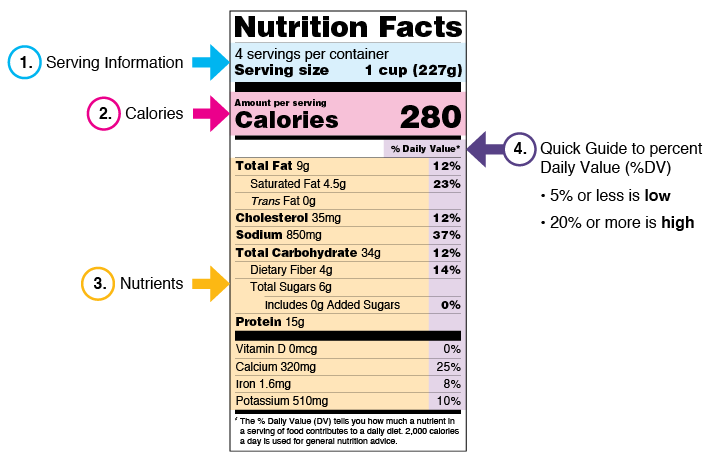
The information in the main or top section (see #1-4) of the sample nutrition label (below) can vary with each food and beverage product; it contains product-specific information (serving size, calories, and nutrient information). The bottom section contains a footnote that explains the % Daily Value and gives the number of calories used for general nutrition advice.

In the Nutrition Facts label below we have colored certain sections to help you focus on those areas that will be explained in detail. Note that these colored sections are not on the actual food labels of products you purchase.

Sample Label for Frozen Lasagna

back to top


1. Serving Information

(#1 on sample label)

Serving Size Sample Label

When looking at the Nutrition Facts label, first take a look at the number of servings in the package (servings per container) and the serving size. Serving sizes are standardized to make it easier to compare similar foods; they are provided in familiar units, such as cups or pieces, followed by the metric amount, e.g., the number of grams (g). The serving size reflects the amount that people typically eat or drink. It is not a recommendation of how much you should eat or drink.

It’s important to realize that all the nutrient amounts shown on the label, including the number of calories, refer to the size of the serving. Pay attention to the serving size, especially how many servings there are in the food package. For example, you might ask yourself if you are consuming ½ serving, 1 serving, or more. In the sample label, one serving of lasagna equals 1 cup. If you ate two cups, you would be consuming two servings. That is two times the calories and nutrients shown in the sample label, so you would need to double the nutrient and calorie amounts, as well as the %DVs, to see what you are getting in two servings.

Example

  One Serving of Lasagna

%DV

Two Serving of Lasagna

%DV

Serving Size 1 cup   2 cups  
Calories 280   560  
Total Fat 9g 12% 18g 24%
Saturated Fat 4.5g 23% 9g 46%
Trans Fat 0g   0g  
Cholesterol 35mg 12% 70mg 24%
Sodium 850mg 37% 1700mg 74%
Total Carbohydrate 34g 12% 68g 24%
Dietary Fiber 4g 14% 8g 29%
Total Sugars 6g   12g  
Added Sugars 0g 0% 0g 0%
Protein 15g   30g  
Vitamin D 0mcg 0% 0mcg 0%
Calcium 320mg 25% 640mg 50%
Iron 1.6mg 8% 3.2mg 20%
Potassium 510mg 10% 1020mg 20%

back to top


2. Calories

(#2 on sample label)

Calories Sample Label

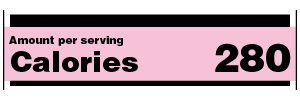
Calories provide a measure of how much energy you get from a serving of this food. In the example, there are 280 calories in one serving of lasagna. What if you ate the entire package? Then, you would consume 4 servings, or 1,120 calories.

To achieve or maintain a healthy body weight, balance the number of calories you eat and drink with the number of calories your body uses. 2,000 calories a day is used as a general guide for nutrition advice. Your calorie needs may be higher or lower and vary depending on your age, sex, height, weight, and physical activity level. Learn your estimated calorie needs at https://www.myplate.gov/myplate-plan.

Remember: The number of servings you consume determines the number of calories you actually eat. Eating too many calories per day is linked to overweight and obesity.

back to top


3. Nutrients

(#3 on sample label)

Nutrients on Sample Label

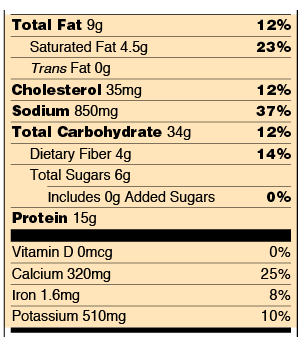
Look at section 3 in the sample label. It shows you some key nutrients that impact your health. You can use the label to support your personal dietary needs – look for foods that contain more of the nutrients you want to get more of and less of the nutrients you may want to limit.

  • Nutrients to get less of: Saturated Fat, Sodium, and Added Sugars.

Saturated fat, sodium, and added sugars are nutrients listed on the label that may be associated with adverse health effects – and Americans generally consume too much of them. They are identified as nutrients to get less of. Eating too much saturated fat and sodium, for example, is associated with an increased risk of developing some health conditions, like cardiovascular disease and high blood pressure. Consuming too much added sugars can make it hard to meet important nutrient needs while staying within calorie limits.

What are Added Sugars and How are they Different from Total Sugars?

Total Sugars on the Nutrition Facts label includes sugars naturally present in many nutritious foods and beverages, such as sugar in milk and fruit as well as any added sugars that may be present in the product. No Daily Reference Value has been established for total sugars because no recommendation has been made for the total amount to eat in a day.

Added Sugars on the Nutrition Facts label include sugars that are added during the processing of foods (such as sucrose or dextrose), foods packaged as sweeteners (such as table sugar), sugars from syrups and honey, and sugars from concentrated fruit or vegetable juices. Diets high in calories from added sugars can make it difficult to meet daily recommended levels of important nutrients while staying within calorie limits.

Note: Having the word “includes” before Added Sugars on the label indicates that Added Sugars are included in the number of grams of Total Sugars in the product.

For example, a container of yogurt with added sweeteners, might list:

Total Sugars on Sample Label

This means that the product has 7 grams of Added Sugars and 8 grams of naturally occurring sugars – for a total of 15 grams of sugar.

  • Nutrients to get more of: Dietary Fiber, Vitamin D, Calcium, Iron, and Potassium.

Dietary fiber, vitamin D, calcium, iron and potassium are nutrients on the label that Americans generally do not get the recommended amount of. They are identified as nutrients to get more of. Eating a diet high in dietary fiber can increase the frequency of bowel movements, lower blood glucose and cholesterol levels, and reduce calorie intake. Diets higher in vitamin D, calcium, iron, and potassium can reduce the risk of developing osteoporosis, anemia, and high blood pressure.

Remember: You can use the label to support your personal dietary needs—choose foods that contain more of the nutrients you want to get more of and less of the nutrients you may want to limit.

back to top


4. The Percent Daily Value (%DV)

(#4 on sample label)

Percent Daily Value on Sample Label

The % Daily Value (%DV) is the percentage of the Daily Value for each nutrient in a serving of the food. The Daily Values are reference amounts (expressed in grams, milligrams, or micrograms) of nutrients to consume or not to exceed each day.

The %DV shows how much a nutrient in a serving of a food contributes to a total daily diet.

The %DV helps you determine if a serving of food is high or low in a nutrient.

Do you need to know how to calculate percentages to use the %DV? No, because the label (the %DV) does the math for you! It helps you interpret the nutrient numbers (grams, milligrams, or micrograms) by putting them all on the same scale for the day (0-100%DV). The %DV column doesn’t add up vertically to 100%. Instead, the %DV is the percentage of the Daily Value for each nutrient in a serving of the food. It can tell you if a serving of food is high or low in a nutrient and whether a serving of the food contributes a lot, or a little, to your daily diet for each nutrient.

Note: some nutrients on the Nutrition Facts label, like total sugars and trans fat, do not have a %DV – they will be discussed later.

General Guide to %DV

  • 5% DV or less of a nutrient per serving is considered low
  • 20% DV or more of a nutrient per serving is considered high

More often, choose foods that are:

  • Higher in %DV for Dietary Fiber, Vitamin D, Calcium, Iron, and Potassium
  • Lower in %DV for Saturated Fat, Sodium, and Added Sugars

Example: Look at the amount of sodium in one serving listed on the sample nutrition label. Is %DV of 37% contributing a lot or a little to your diet? Check the General Guide to %DV. This product contains 37% DV for sodium, which shows that this is a HIGH sodium product (it has more than 20% DV for sodium). If you consumed 2 servings, that would provide 74% of the DV for sodium – nearly three-quarters of an entire day’s worth of sodium.

Sodium Bar

Compare Foods: Use %DV to compare food products (remember to make sure the serving size is the same) and more often choose products that are higher in nutrients you want to get more of and lower in nutrients you want to get less of.

Understand Nutrient Content Claims: Use %DV to help distinguish one claim from another, such as “light,” “low,” and “reduced.” Simply compare %DVs in each food product to see which one is higher or lower in a particular nutrient. There is no need to memorize definitions.

Dietary Trade-Offs: You can use the %DV to help you make dietary trade-offs with other foods throughout the day. You don’t have to give up a favorite food to eat a healthy diet. When a food you like is high in saturated fat, balance it with foods that are low in saturated fat at other times of the day. Also, pay attention to how much you eat during the entire day, so that the total amount of saturated fat, as well as other nutrients you want to limit, stays below 100%DV.

How the Daily Values Relate to the %DVs

Look at the example below for another way to see how the Daily Values (DVs) relate to the %DVs and dietary guidance. For each nutrient listed in the table, there is a DV, a %DV, and dietary advice or a goal. If you follow this dietary advice, you will stay within public health experts’ recommended upper or lower limits for the nutrients listed, based on a 2,000-calorie daily diet.

Examples of DVs versus %DVs

Based on a 2,000 Calorie Diet

Nutrient DV %DV Goal
Saturated Fat 20g =100% DV Less than
Sodium 2,300mg =100% DV Less than
Dietary Fiber 28g =100% DV At least
Added Sugars 50g =100% DV Less than
Vitamin D 20mcg =100% DV At least
Calcium 1,300mg =100% DV At least
Iron 18mg =100% DV At least
Potassium 4,700mg =100% DV At least

Upper Limit – Eat “Less than”…

Upper limit means it is recommended that you stay below or eat “less than” the Daily Value nutrient amounts listed per day. For example, the DV for saturated fat is 20g. This amount is 100% DV for this nutrient. What is the goal or dietary advice? To eat “less than” 20 g or 100%DV each day.

Lower Limit – Eat “At least”…

The DV for dietary fiber is 28g, which is 100% DV. This means it is recommended that you eat “at least” this amount of dietary fiber on most days.

Nutrients Without a %DV: Trans Fats, Protein, and Total Sugars:

Note that Trans fat and Total Sugars do not list a %DV on the Nutrition Facts label. Protein only lists a %DV in specific situations listed below.

Trans Fat: Experts could not provide a reference value for trans fat nor any other information that FDA believes is sufficient to establish a Daily Value.

According to the Dietary Guidelines for Americans, there is evidence that diets higher in trans fat are associated with increased blood levels of low-density lipoprotein (LDL or “bad”) cholesterol—which, in turn, are associated with an increased risk of developing cardiovascular disease. Note: most uses of artificial trans fat in the U.S. food supply have been phased out as of 2018.

Protein: A %DV is required to be listed if a claim is made for protein, such as “high in protein.” The %DV for protein must also be listed on the label if the product is intended for infants and children under 4 years of age. However, if the product is intended for the general population 4 years of age and older and a claim is not made about protein on the label, the %DV for protein is not required.

Current scientific evidence indicates that protein intake is not a public health concern for adults and children over 4 years of age in the United States.

Total Sugars: No Daily Reference Value has been established for Total Sugars because no recommendations have been made for the total amount to eat in a day. Keep in mind that the Total Sugars listed on the Nutrition Facts label include naturally occurring sugars (like those in fruit and milk) as well as Added Sugars.

Nutrition Facts Label Variations

Many Nutrition Facts labels on the market will be formatted in the same way as the lasagna label that has been used as an example throughout this page, but there are other formats of the label that food manufacturers are permitted to use. This final section will present two alternate formats: the dual-column label and the single-ingredient sugar label.

In addition to dual-column labeling and single-ingredient sugar labels, there are other label formats which you can explore here.

Dual-Column Labels

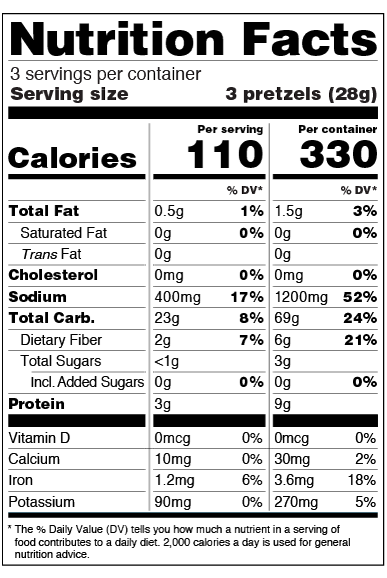
For certain products that are larger than a single serving but that could be consumed in one sitting or multiple sittings, manufacturers will have to provide “dual column” labels to indicate the amounts of calories and nutrients on both a “per serving” and “per package” or “per unit” basis. The purpose of this type of dual-column labeling is to allow people to easily identify how many calories and nutrients they are getting if they eat or drink the entire package/unit at one time. For example, a bag of pretzels with 3 servings per container might have a label that looks like this to show you how many calories and other nutrients would be in one serving and in one package (3 servings).

Pretzels

Sample Dual-Column Label for Pretzels

Single-Ingredient Sugar labels

Packages and containers of products such as pure honey, pure maple syrup, or packages of pure sugar are not required to include a declaration of the number of grams of Added Sugars in a serving of the product but must still include a declaration of the percent Daily Value for Added Sugars. Manufacturers are encouraged, but not required, to use the “†” symbol immediately following the Added Sugars percent Daily Value on single-ingredient sugars, which would lead to a footnote explaining the amount of added sugars that one serving of the product contributes to the diet as well as the contribution of a serving of the product toward the percent Daily Value for Added Sugars. Single-ingredient sugars and syrups are labeled in this way so that it does not look like more sugars have been added to the product and to ensure that consumers have information about how a serving of these products contributes to the Daily Value for added sugars and to their total diet.

Here is an example of how a label on a single-ingredient sugar, such as honey, could look.

Honey

Single-Ingredient Sugar Label for Honey

back to top

Why One Nostril Gets More Clogged and Congested Than the Other

0
Why One Nostril Gets More Clogged and Congested Than the Other

When you’re stuffed up and miserable, sometimes it seems that for a little while, your right nostril is clear. No, wait, it’s the left. But you swore it was the right one a little while ago. It’s not just you: Sometimes one nostril feels way more clogged than the other, and there’s a scientific reason behind it.

Credit a physiological response called the nasal cycle, a process where your nostrils take turns sucking in more air, says Rachel Roditi, M.D., a surgeon in the division of otolaryngology at Brigham and Women’s Hospital.

“Our noses have a natural cycle such that we are breathing through only one side at any given moment, and this alternates every few hours,” explains Urjeet Patel, M.D., chair of the division of otolaryngology at Cook County Health in Chicago. When we’re sick and have nasal congestion, we tend to notice the obstruction much more, he says.

Here’s why your nostrils play tag team—and what you can do when one side’s all jammed up.

Why One Nostril Gets More Congested

Structures in both sides of your nose called inferior turbinates are responsible for warming and humidifying air before it reaches your lungs, says Dr. Roditi. This protects your lungs by reducing dryness and irritation.

That process is a lot of work. So your nose funnels its resources more to one side than the other to make the process more efficient.

It sends more blood flow to one nostril, which warms the air coming in through there, but also causes the turbinate on that side to swell. “That larger turbinate also functions better to humidify the air that you’re breathing,” says Jose Ting, M.D., an otolaryngologist at Texas ENT & Allergy in College Station, Texas.

That swelling means there’s less room for air to make its way in. It’s pretty subtle, though—unless you have a cold, infection, allergies, or a structural problem like a deviated septum, you probably won’t notice it going on.

But when you are sick, blood flow to your nose increases even more, sparking more swelling and greater mucus production in your nasal region, says Dr. Roditi.

Even though you’re congested throughout your entire nose, you feel it more strongly in the one nostril where the turbinate is already swollen as part of the normal nasal cycle.

“It’s also very common for patients to experience more congestion on the side of the nose that they are laying on when they are reclined, as venous congestion [blood backing up in the veins because it’s working against gravity] will cause minor enlargement of the inferior turbinates,” says Dr. Ting.

How to Treat Your Congestion

There’s really nothing you can do to shut off the nasal cycle, says Dr. Roditi. It’s likely that one nostril will always feel more stuffed up than the other when you’re sick. It’s not always the same one, of course: After about 90 minutes to 4 hours, your nose switches sides. When that occurs, you’ll probably feel some relief when the swelling in the one nostril goes down—but then the other side will start to feel clogged instead.

Your best bet is to work on easing the congestion overall. Steam from a hot shower or humidifier can help open the floodgates, says Dr. Roditi.

Drinking hot liquids can increase the rate at which the little hairs in your nose sweep mucus out of it. Some experts think that’s the mechanism by which chicken soup could help your congestion clear up.

Nasal decongestants and salt water nasal rinses or sprays are very helpful for flushing out mucus when you’re sick or just very congested, Dr. Patel adds. “Saline sprays are a great solution,” explains Lakiea Wright, M.D., an allergist at Brigham and Women’s Hospital. “You’re essentially helping your body wash out allergens or viruses,” she says. “Two other popular ways to do that are with a neti pot, or with a squeeze bottle kit from the drugstore,” she explains. Both are ways to rinse the nasal passages with saline and distilled water. Most people use the neti pot with their heads tilted over the sink, “and some people like to use the squeeze bottle in the shower,” Dr. Wright says. “Either way, they’re very effective.”

Just be aware that saline rinses can do their jobs too well sometimes. “They can make the lining tissue too dry by washing away the mucus layer, much like licking chapped lips makes them dryer,” says John D. Burgoyne, M.D., an otolaryngologist at Austin ENT & Allergy in Austin, Texas. “Make sure and back off on irrigation if you have dryness or bleeding.”

What about classic nose drops (medicated ones containing oxymetazoline)? Only use them as a last resort. “These sprays can cause rebound congestion,” says Jonathan A. Bernstein, M.D., an associate professor at the University of Cincinnati and editor-in-chief of the Journal of Asthma. They clear congestion for a while, but when the effect wears off, stuffiness rebounds right away, so you need another dose in a never-ending cycle. It’s like your nose becomes addicted to them, and relies on them to open up. If you must use these sprays, stick to two puffs a day for no more than five to seven days, he says.

“The one time that oxymetazoline drops can be very helpful is if you have to fly when your nose is stuffy from allergies,” adds Dr. Burgoyne. “Spraying the nose prior to takeoff and again as the plane starts to descend will minimize the chances that your sinuses or ears will become blocked.”

If your stuffed-up symptoms persist beyond 10 to 14 days, or you notice nasal congestion at times other than when you’re sick, check in with your doctor to make sure that something bigger—like a deviated septum—isn’t at play, says Dr. Roditi. And if your symptoms include facial pain or thick, colored mucus, check in with a doctor, adds Dr. Burgoyne.

Also consider that you might not have a cold at all; it might be seasonal allergies. Here’s how to know the difference between colds and allergies. To clear congestion in the case of allergies, you’d want to find the root of the problem—work with a doctor to find out exactly what is making you sneeze. Then you can strategize on how to avoid the allergen and also see if you need something like an antihistamine or a nasal steroid spray.

Finally, if you’ve tried everything and your nose is still stuffy and is compromising the quality of your life, ask a doctor about non-surgical treatments for inferior turbinate enlargement or other issues that might be behind your chronic half-stuffiness, says Paul Schalch Lepe, M.D., a board-certified otolaryngologist and sleep medicine specialist with Silenso Clinic and UC San Diego Health.

Headshot of Cassie Shortsleeve

Freelance Writer

Cassie Shortsleeve is a skilled freelance writer and editor with almost a decade of experience reporting on all things health, fitness, and travel. A former Shape and Men’s Health editor, her work has also been published in Women’s Health, SELF, Runner’s World, Men’s Journal, CNTraveler.com, and other national print and digital publications. When she’s not writing, you’ll find her drinking coffee or running around her hometown of Boston.

Headshot of Marty Munson

Marty Munson, currently the health director of Men’s Health, has been a health editor at properties including Marie Claire, Prevention, Shape and RealAge. She’s also certified as a swim and triathlon coach.

Headshot of Emilia Benton

Contributing Writer

Emilia Benton is a Houston-based freelance writer and editor. In addition to Runner’s World, she has contributed health, fitness and wellness content to Women’s Health, SELF, Prevention, Healthline, and the Houston Chronicle, among other publications. She is also an 11-time marathoner, a USATF Level 1-certified running coach, and an avid traveler.

All About Joey King’s Go-To Workouts And Exercise Routines

0
All About Joey King’s Go-To Workouts And Exercise Routines

Joey King, 24, has the perfect hack for getting herself out of bed each morning: She just thinks about her two beloved dogs, Fable and Jesse.

“The best part about having animals in your home is that they need exercise,” she tells Women’s Health. “Even when you’re feeling groggy and don’t want to get up, you have to take the dogs for a walk.”

The actress’s past few months have been surprisingly busy. She reprised her role as Taylor Swift’s muse in the “I Can See You (Taylor’s Version)” music video in July, picketed in the SAG-AFTRA strike, and then got married to her partner of four years, Steven Piet, in September.

Oh, and she also adopted a new puppy named Fable.

The actress sat down with Women’s Health to discuss her daily wellness habits, and how her furry friends improve her overall health.

She starts and ends each day with a 30 minute walk.

Joey has had a dog her whole life, so her pets are integral to her daily habits. The very first thing the actress does when she gets out of bed is take her dogs for a walk.

“It’s such a nice way to start the day,” she says. “It forces you to get your legs moving and get some Vitamin D.”

Each day also ends with another 30-minute walk with her pups. “I love taking them for hikes because it’s just so cute to watch them sniff everything,” Joey jokes. “I could sit for hours watching them sniff.”

The actress rescued both of her dogs. And they don’t just get her out of bed, they also help boost her mental health and keep her super active.

In fact, Joey had such a positive experience with pet adoption that she was inspired to partner with Hill’s Pet Nutrition to encourage other people to do the same. “It’s the most rewarding feeling in the world to watch [my dogs] transform before your eyes into these beautiful, happy, funny animals,” she says.

She loves weight training.

When it comes to workouts, Joey is really into lifting heavy. She says it helps stabilize her back and builds strength.

Weights have always been my favorite because I find it to be the most enjoyable and I see the most change in my body,” Joey says. “If I had to choose one workout for the rest of my life, I think it would be deadlifts.”

And her workouts are no joke. You can catch a peek of the actress crushing some sets on her IG.

Joey also has a super-accessible “personal trainer.”

The actress doesn’t like to stick to any one routine.

“I get bored really easily if I do the same thing over and over again,” Joey says. “I’m not one of those people who can go to a class and have that be my workout four times a week.”

So, instead of relying on her own creativity when she’s pumping iron, Joey prefers to look up workout videos on YouTube. That way, she can easily switch up her routine.

“I’ll literally just Google a workout, and [do] the first thing that comes up,” she says. “There’s this 30 minute kettlebell workout I love that gets me sweating.”

And she’s not kidding. If you’re up for a quick sweat, you can follow along yourself. No expensive personal trainer required. Here’s the vid:

This content is imported from youTube. You may be able to find the same content in another format, or you may be able to find more information, at their web site.

Joey’s go-to video is great for beginners. In the video, the trainers start with some warm-ups before gradually working kettlebells into a series of squats, lifts, and lunges. Plus, the weight’s shape provides a very unique and targeted exercise for your entire body, experts previously told Women’s Health.

Happy kettlebell swinging, Joey!

News Editorial Assistant

Olivia Evans (she/her) is an editorial assistant at Women’s Health. Her work has previously appeared in The Cut and Teen Vogue. She loves covering topics where culture and wellness intersect. In her free time, she enjoys cooking, running, and watching rom-coms. 

Best toothbrushes, optimal teeth-cleaning: Experts offer dental advice

0
Best toothbrushes, optimal teeth-cleaning: Experts offer dental advice

Consumer Reports has no financial relationship with any advertisers on this site.

The advice from dental experts for keeping your teeth clean sounds simple enough: Brush twice a day and floss. But choosing among the many products available to help you do this can be daunting. Electric toothbrush or manual? Soft or hard bristles? String floss or water flosser?

The right answers depend partly on your preferences. “Hopefully what you experience with any toothbrush is that you’re getting your teeth clean, and then you’re going to want to use it again,” says Edmond R. Hewlett, a professor at the UCLA School of Dentistry in Los Angeles and a consumer adviser for the American Dental Association (ADA).

But there are tooth-care products with clear advantages. We explain which dental hygiene strategies work best and what to consider when picking products.

Q: Are electric toothbrushes better for your teeth?

A: Most evidence suggests that they are, at least a little. A 2014 analysis of previously published studies by Cochrane, an independent, London-based panel of experts, found that over several months, powered brushes removed 21 percent more plaque and reduced gum inflammation by 11 percent more than manual brushes. Two more recent studies, by scientists who had funding from companies that make toothbrushes, found similar results.

But the real-life significance of that research might not mean much for your overall oral health. Electric brushes might be better for some people, says Olivia Sheridan, a professor of clinical restorative dentistry at the University of Pennsylvania, because they can be easier to use for those who lack manual dexterity or have braces or permanent retainers, or those who care for someone who needs help brushing their teeth. But your technique may matter more than whether you use a manual or electric brush. Both types of brushes can be “completely effective in plaque removal” and in helping to prevent gum disease, says Sheridan.

What features should you look for? Cleaning ability is key, and it’s the most significant factor in Consumer Reports’ electric toothbrush scores. You should also seek out brushes with features such as a two-minute timer and a pressure sensor. The ADA says that most people brush their teeth for less than a minute, so a built-in timer can help. A pressure sensor can warn you if you’re pressing too hard with your brush, which can damage gums and enamel. Sheridan also recommends looking for brushes that pause when it’s time to move from one section of your mouth to the next.

Q: What kind of bristles are ideal?

A: Although you’ll find manual toothbrushes with bristles ranging from extra-soft to hard, medium- or hard-bristle brushes are best reserved for tasks such as cleaning the grout in your kitchen or bathroom tile. For your teeth, dental experts say you should use a soft- or extra-soft-bristle brush.

That’s because harder bristles can injure your delicate gum tissue. They can also potentially damage your teeth, says Clifton Carey, a professor at the University of Colorado School of Dental Medicine at Anschutz Medical Campus.

Q: Which is better, a rotating or a sonic electric toothbrush?

A: Both kinds can do a great job of cleaning your teeth. Rotating toothbrushes have a round head that rotates or oscillates. Sonic brushes have a more typical elongated head shape resembling a manual brush, with bristles that move side to side so quickly they produce an audible hum.

Some research suggests that rotating toothbrushes may have a slight edge over sonic types. But a 2021 analysis in the Journal of the American Dental Association designed to assess real-world effectiveness concluded there wasn’t enough evidence to pick a winner. And testing by Consumer Reports concurs: We found models of both types that performed well.

If you’re not sure which type of electric brush you’ll like, check to make sure that you can return it if you decide it’s not right for you.

Q: Do you really need to floss?

A: Yes. You may have rejoiced over headlines a few years back that claimed there’s not much evidence supporting flossing. And in 2019, even the Cochrane panel characterized the evidence showing that flossing helps reduce gum disease as “low certainty,” with inconsistent results.

But don’t toss out your dental floss yet. Although the evidence might not be especially rigorous, regular flossing is supported by basic biology, experts say. When done correctly, flossing removes bacteria in parts of your mouth that brushing can’t get to. Good flossing technique generally involves gently rubbing the floss strand in a C-shape against both sides of each tooth and at the gumline.

Q: Which toothpaste should you use?

A: Any toothpaste that has fluoride should do the trick. That’s the most important ingredient because it prevents cavities and helps you avoid tooth decay by strengthening the enamel. Fluoride is so important that the ADA doesn’t provide its Seal of Acceptance to fluoride-free toothpastes.

There are other ingredients in some toothpastes that you may want to stay away from. For example, research has found that people who frequently get canker sores may get fewer ones when they avoid toothpastes that contain sodium lauryl sulfate.

Various toothpaste ingredients fall in and out of fashion. “We have to be very careful of those fads,” says Dawn Smith, chair of the Department of Dental Hygiene at Howard University’s College of Dentistry in D.C. That’s because it can take a while for researchers to discern whether a particular ingredient is safe and effective.

One newer trend has little evidence to support it: activated charcoal toothpastes, which are often marketed as whiteners. But some could cause damage, according to a 2019 paper in the British Dental Journal. Charcoal can be abrasive, which can wear down your enamel, damage your gums, and lead to tooth sensitivity. And many charcoal toothpastes don’t contain fluoride.

Q: Should you use mouthwash?

A: It’s fine to use mouthwash, says Smith, but it’s not strictly necessary and can’t take the place of brushing and flossing.

Certain types of mouthwash can help with specific conditions. For example, prescription rinses with chlorhexidine, an antimicrobial, can help people who have periodontal disease or are at high risk for tooth decay, Hewlett says.

And if you live in an area where your water isn’t fluoridated (or you don’t drink tap water), you may want to consider adding a fluoridated mouth rinse to your family’s daily dental care routine, Smith suggests. That’s especially true if you have kids, and it’s something that can be helpful even if there’s fluoride in your toothpaste.

Q: Are teeth whiteners worth trying?

A: Some of the stains on the outside of your teeth can be removed during a typical dental cleaning. But you might wonder about bleaching your teeth, either at your dentist’s office or by using an at-home kit.

The active ingredient in most tooth bleaching products isn’t the household bleach you use for laundry but hydrogen peroxide (or a related compound).

At-home bleaching, which can involve products such as bleaching strips or gels and trays, can be effective, says Kenneth Markowitz, an associate professor at the Rutgers School of Dental Medicine in Newark. But it generally takes longer to see results with those treatments than with professional whitening, because in-office treatments are done with higher concentrations of peroxide.

Still, it’s best to avoid trying to whiten your teeth quickly, he says. That’s because the higher the concentration of bleaching agents used, the more likely you are to experience the main side effects of whitening: gum irritation and tooth sensitivity (which often involves a tingly feeling of pain). High concentrations could even damage teeth.

Instead, bleaching is best if done slowly over time, using low concentrations of bleaching agents. Carey recommends that people who bleach at home read the product’s directions and follow them exactly.

Q: How often do you need a teeth cleaning?

A: You’ve probably heard you should get cleanings every six months. But a 2020 Cochrane review found that adults who timed their visits based on their risk factors (which you can discuss with your dentist) did no worse than people who followed the six-months rule.

The ADA says tailoring your visits to your individual health risks is a good one.

If you’re not at high risk for cavities — your teeth are otherwise healthy and you don’t eat a lot of sweets, for example — seeing a dentist once a year may be sufficient for you, Carey says.

On the other hand, people at higher risk may need to go in more often. If you struggle with a dry mouth, for instance, a common occurrence for people who are taking multiple medications, Carey says you may need to see your dentist more frequently, because saliva is one of the biggest protectors of teeth.

Copyright 2022, Consumer Reports Inc.

Consumer Reports is an independent, nonprofit organization that works side by side with consumers to create a fairer, safer, and healthier world. CR does not endorse products or services, and does not accept advertising. Read more at ConsumerReports.org.