Home Blog Page 46

Use Density Blocks To Track Your Gains and Ensure a Massive Pump

0
Use Density Blocks To Track Your Gains and Ensure a Massive Pump

Welcome to the Men’s Health Dumbbell Club, your weekly plan for a fitter, stronger body, using just two dumbbells. With workouts lasting from 20-40 minutes, and designed to add lean muscle, build fitness and increase strength, your weekly dose of dumbbell goodness drops every Monday.

New This Week…

After a month of high-intensity, full-body training, we’re switching things up in this phase by shifting to an upper-body/lower-body split and employing ‘density training’ blocks. By working circuit style and avoiding muscular failure in early rounds we’ll be able to push ourselves hard, while focusing on high-quality movements. We’ll gradually up the intensity as each blocks ticks on until our muscles are screaming from fatigue, promoting fresh new growth.

After an initial two weeks containing six-unique training sessions — in which we’ll be taking meticulous notes — we’ll be repeating each session, taking heed of our notebooks and aiming to beat our scores for each movement, provoking progressive overload and ensuring gains aren’t far behind.

We’ll continue on in this phase for six weeks, given you ample opportunity to repeat, retest and beat each workout.

How To Perform Density Blocks

Each 10-minute ‘density block’ consists of two back-to-back movements, designed to compliment each other. Your goal is to perform as many rounds as possible (with perfect form). Suggested rep ranges are given, choose your weights accordingly if you have access to a selection of dumbbells. If not, begin each block by ensuring you have around 3-5 reps still left in the tank, but keep your rest to a minimum until it becomes increasingly difficult to hit your target reps, eventually you may have to drop the reps, but keep moving. Keep grinding way, resting just long enough to make a note of how many reps you achieve in each set, creating a total for each movement, at the end of each block.

Rest for 3-4 minutes between blocks — changing weights if necessary — before attacking each new block following the above guidelines.

Day One (W29/D1)

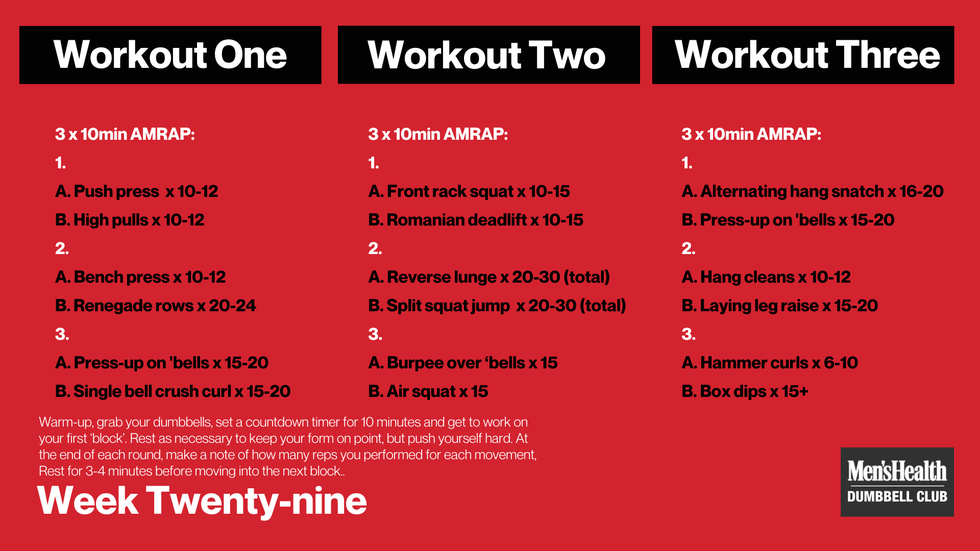
Warm-up, grab your dumbbells, set a countdown timer for 10 minutes and get to work on your first ‘block’. Rest as necessary to keep your form on point, but push yourself hard. At the end of each round, make a note of how many reps you performed for each movement,

Rest for 3-4 minutes before moving into the next block.

1A. Push Press x 10-12

Clean your dumbbells onto your shoulders, palms facing in. Take a breath and create tension in your core. (A) Dip at the knees and use your legs to help (B) press your dumbbells overhead. Lower with a controlled tempo to your shoulders and repeat. If your weights feel a little too light, don’t use any drive from the legs and focus on a strict press from the shoulders.

dumbbell high pull

1B. High Pull x 10-12

Stand tall with your dumbbells at your waist, in front of your body. (A) Keeping your core tight, hinge forward slightly before explosively standing back upright and pulling the dumbbells up towards your chin, driving your elbows up and back (B). Slowly lower back down to your waist under complete control. Avoid simply dropping your dumbbells back to your waist to build more muscle and avoid injury. If your dumbbells feel light, avoid the help from your hips and simply stand tall and pull the weights up by driving your elbows to the back of the room.

weights, arm, shoulder, muscle, leg, abdomen, joint, exercise equipment, dumbbell, physical fitness,

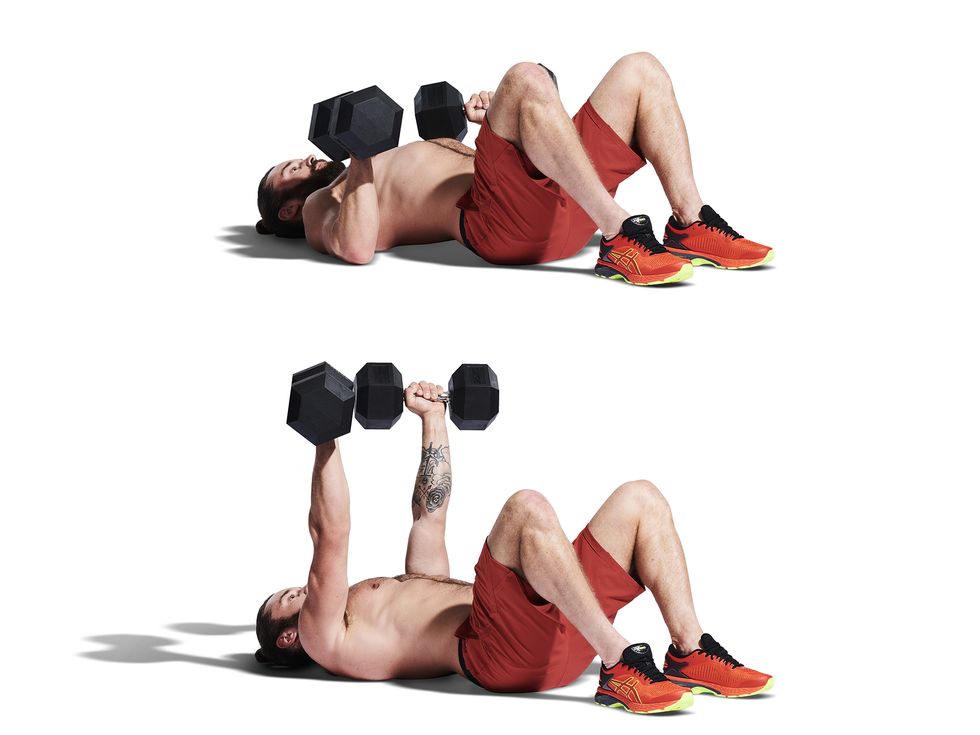
2A. Dumbbell Floor (or Bench) Press x 10-12

Lay flat on your back with your knees bent and your feet flat on the ground. Press the weights above you, locking out your elbows (A). Lower them slowly until your upper arms are resting on the floor (B), close to your body, pause here before explosively pressing back up. If you have a bench, use it.

weights, press up, arm, exercise equipment, kettlebell, muscle, physical fitness, chest, dumbbell, fitness professional,

2B. Renegade Row x 20-24 (total)

Drop into a press-up position with your hands on your ‘bells and midline tight (A). Shifting your weight onto your left hand, row the right dumbbell towards your hip (B). Pause briefly, then lower the weight under control. Repeat on your left side (each row equals one rep).

press up, weights, arm, exercise equipment, kettlebell, muscle, chest, dumbbell, joint, physical fitness,

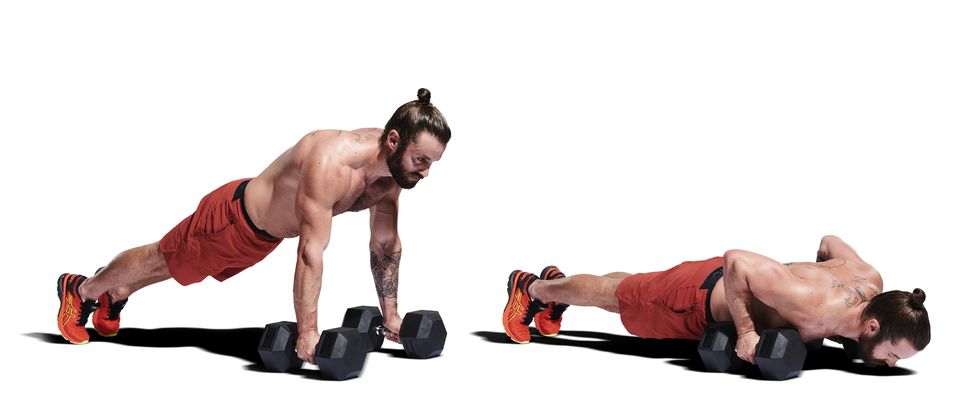
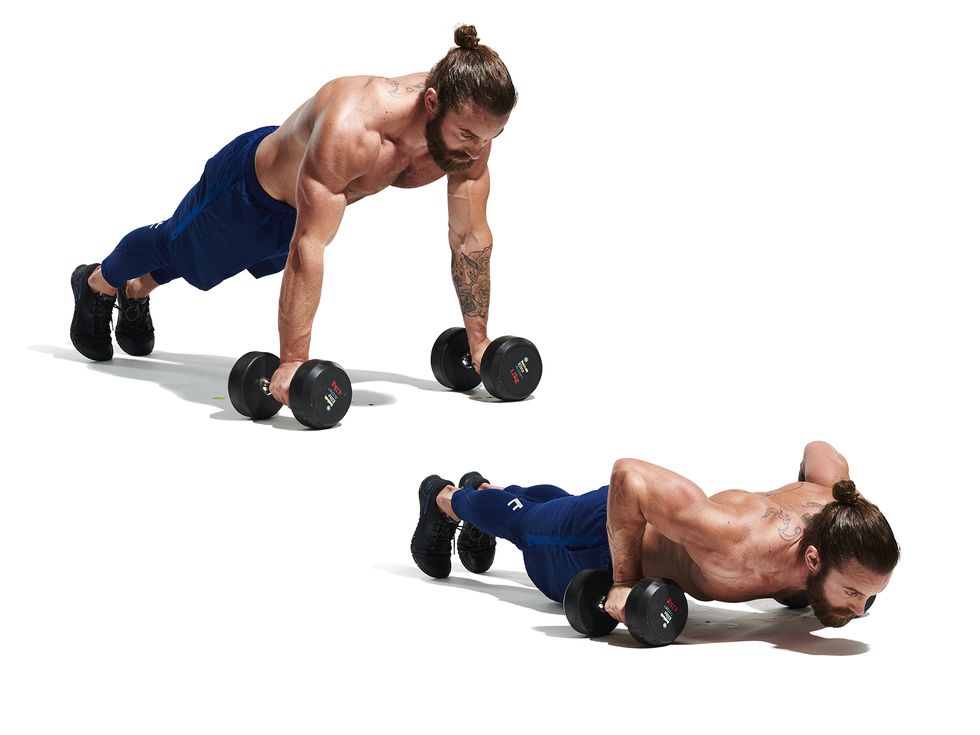
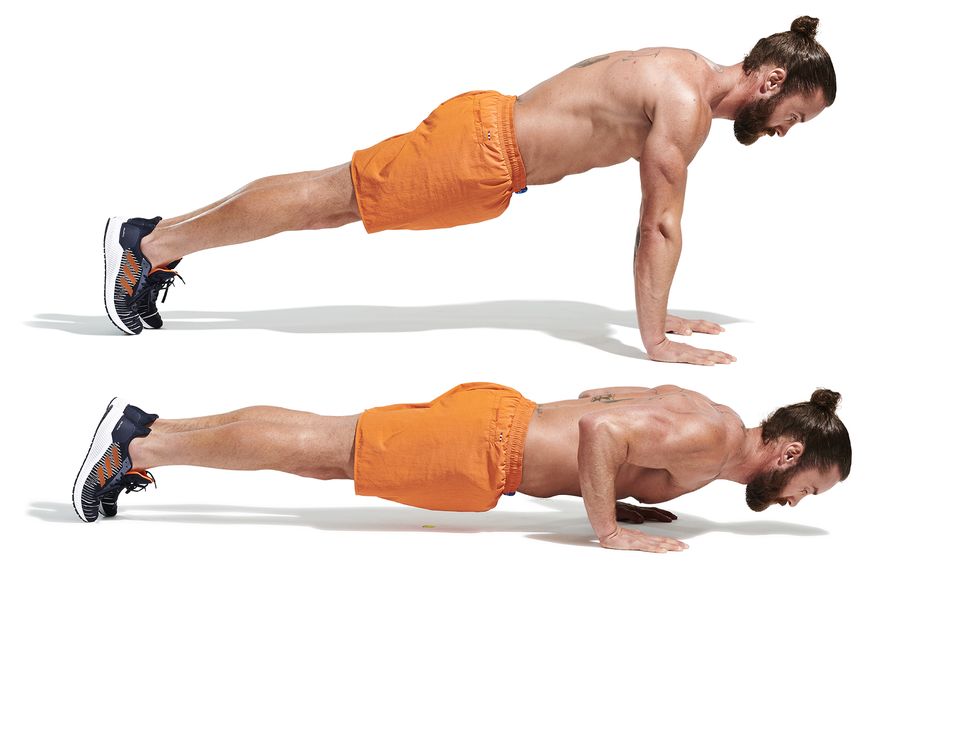
3A. Tempo Press-ups on Dumbbells x 15-20

Drop your ‘bells to the ground and assume a long-armed plank position, with your core tight and hands gripping your dumbbells (A), bend your elbows and slowly lower your chest to the floor over a strict count of three seconds (B). Keep your elbows close to your body and pause for one second, feeling the deep stretch through your chest as you push back up explosively. Break your set when you can no longer control your descent or explode back up.

single dumbbell bicep crush curl

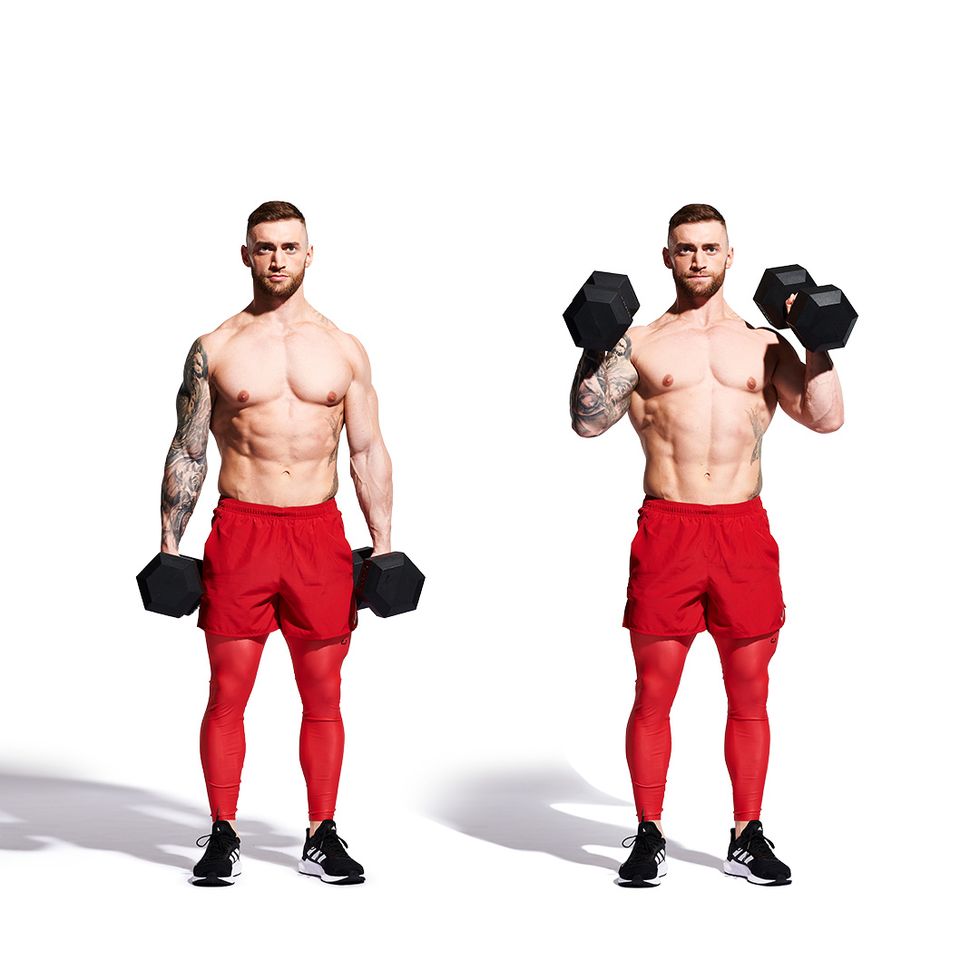
3B. Single ‘Bell Crush Curl x 15-20

Stand upright leaving one of your ‘bells on the ground, grip the remaining ‘bell with both hands, holding the outer ‘heads’ palms facing each other (A). With minimal momentum, curl the dumbbell upwards until it’s beneath your chin (B). Squeeze here and lower the weight under control, fighting it all of the way.

Day Two (W29/D2)

dumbbell front squat

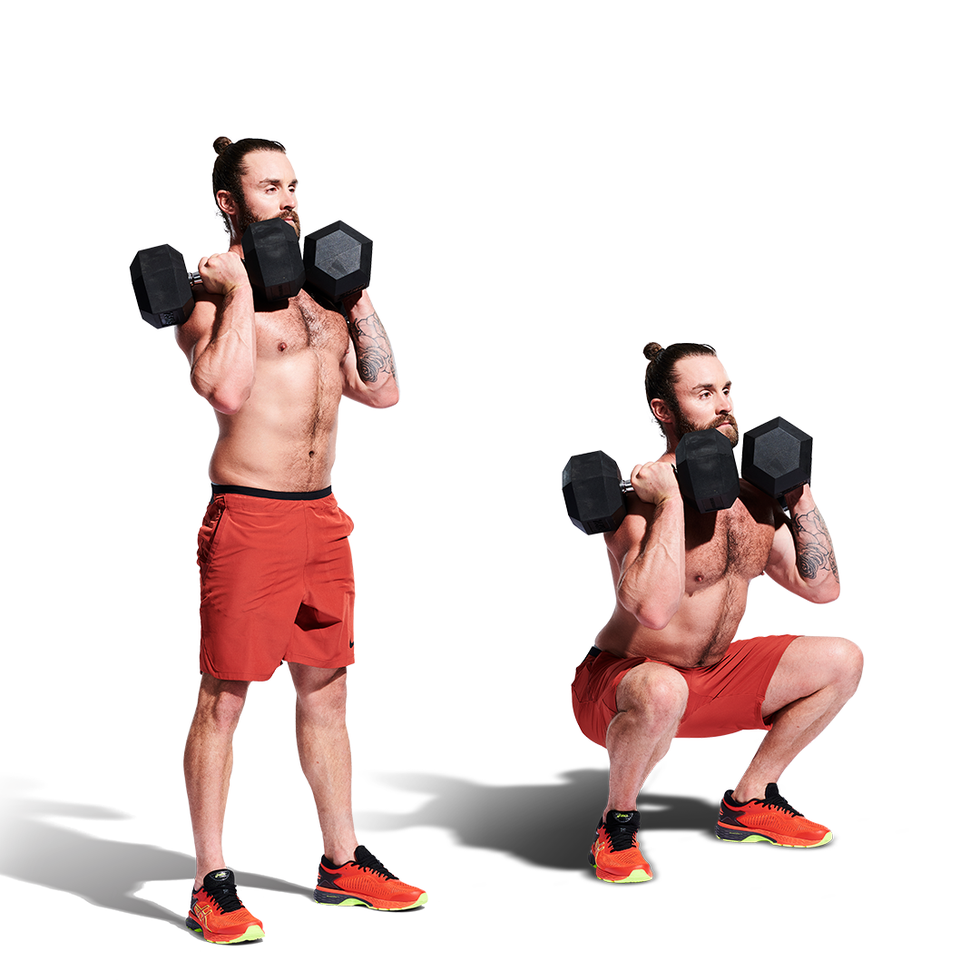
1A. Front Squat x 10-15

Clean your dumbbells onto the front of your shoulders (A). From here, drop into a front squat, by pushing your hips back and bending at the knees until your thighs pass parallel to the ground (B), before driving back up explosively. Keep those dumbbells secured high, with a strong, upright torso throughout.

romanian deadlift

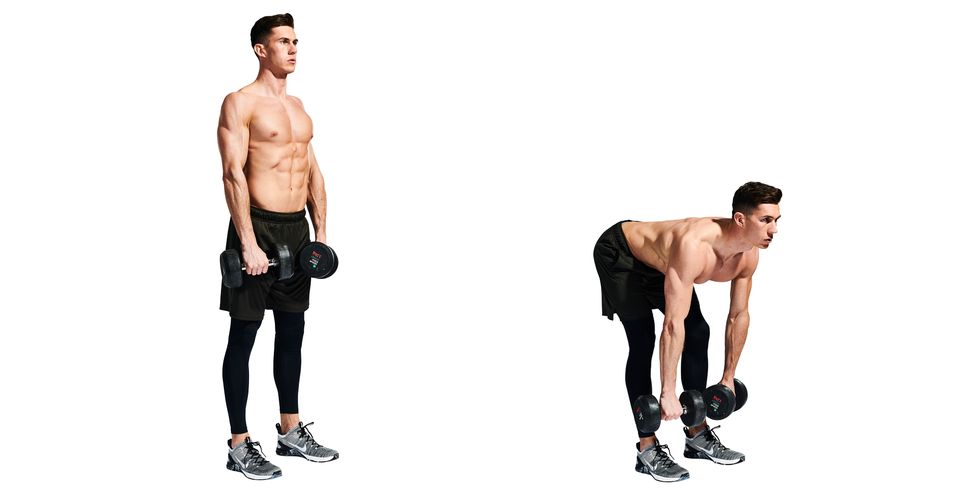
1B. Romanian Deadlift x 10-15

Stand tall with your dumbbells at your sides, feet at shoulder width (A). With a slight bend in the knees, push your hips back and slowly lower the bells towards the ground (B), pinching your shoulders back and maintaining a flat back. When you feel a deep stretch in your hamstrings, pause and explosively return to an upright position.

leg, human body, shoulder, human leg, elbow, standing, joint, chest, knee, facial hair,

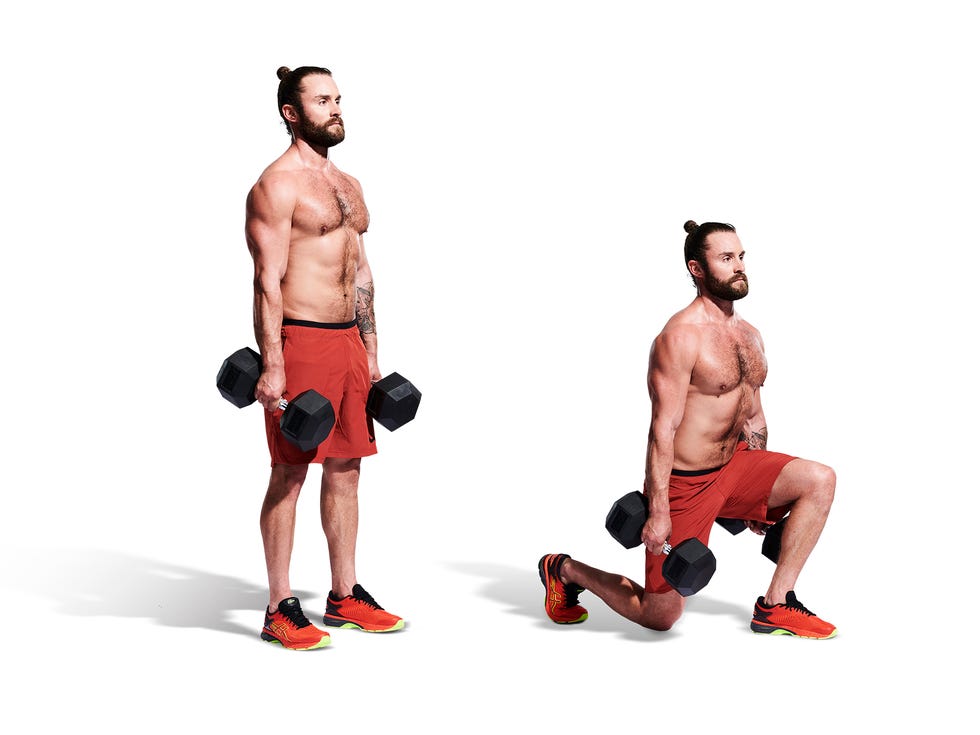
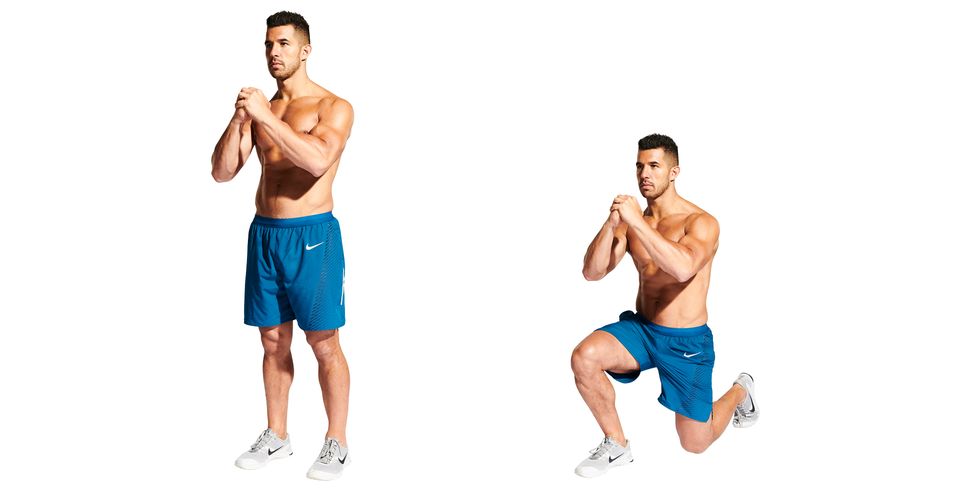
2A. Reverse Lunge x 20-30 (total)

Drop your dumbbells to your sides (A). Keeping your chest up at all times, take a step backward with one leg, bending your front knee until the back knee touches the ground (B). Stand up explosively, pause and repeat with the other leg. Alternate back and forth. Each step equals one rep.

split squat jump jumping lunge

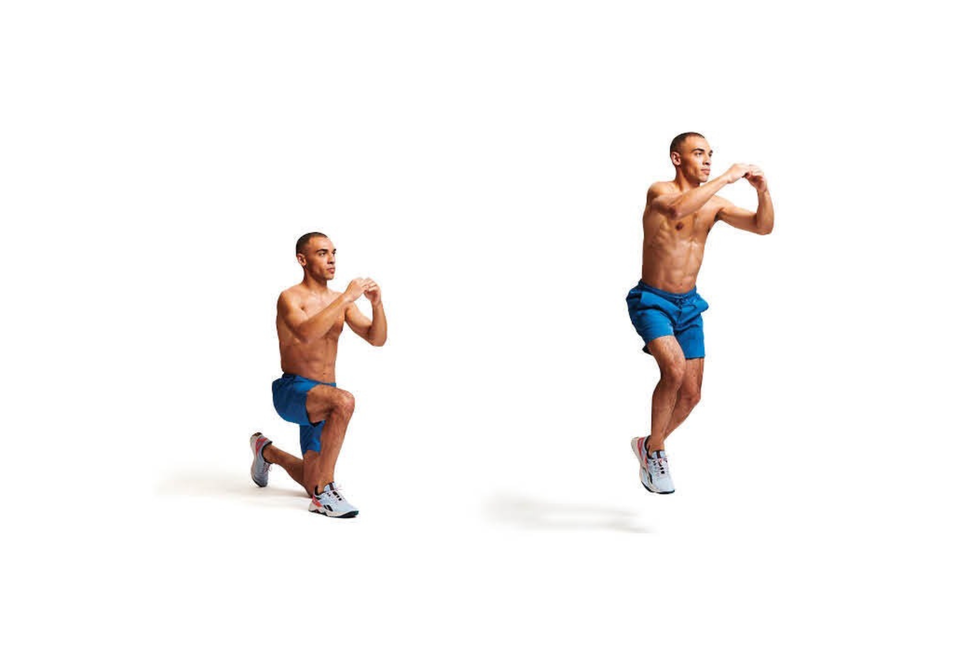
2B. Split Squat Jump x 20-30 (total)

Step one foot backward and sink into a deep lunge, with your rear knee lightly touching the floor (A). Next, explode upward, jumping into the air and switching legs mid jump (B) to land in a lunge position with the opposite leg forward. Repeat the movement, alternating legs each rep. Keep this movement as fast paced as possible, focussing on maximising the height of each jump.

arm, human leg, joint, elbow, knee, shorts, wrist, thigh, trunk, muscle,

3A. Burpee over ‘Bells x 15

No rep range here, just aim to perform exactly 15 reps, as quickly as possible, with good form. With both dumbbells on the floor next to you step back and hit the deck into a press-up position. Lower your body until your chest touches the floor (A). Stand back up and jump powerfully over the dumbbells (B) – driving through your hips when you take off. Land and immediately drop to the floor and repeat. The dumbbells keep you accountable for the height of each jump.

standing, weights, kettlebell, arm, shoulder, exercise equipment, muscle, human body, leg, photography,

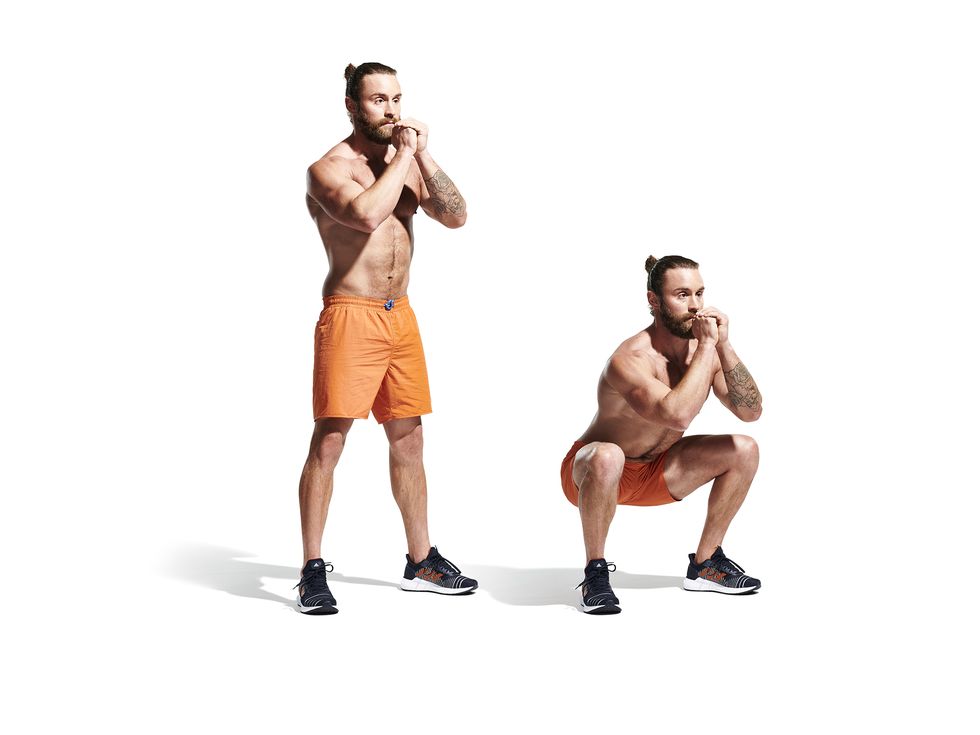
3B. Air Squat x 25

Again, no rep range, just go for 15 and get stuck back into those burpees. Bet you can’t wait? Standing tall with your chest up (A), sink your hips back, bending your knees to drop your thighs until you reach a deep squat (B). Drive back up explosively and repeat. Keep a controlled tempo and tight form, but don’t dawdle. These may be simple, but they shouldn’t be easy.

Day Three (W29/D3)

dumbbell hang snatch

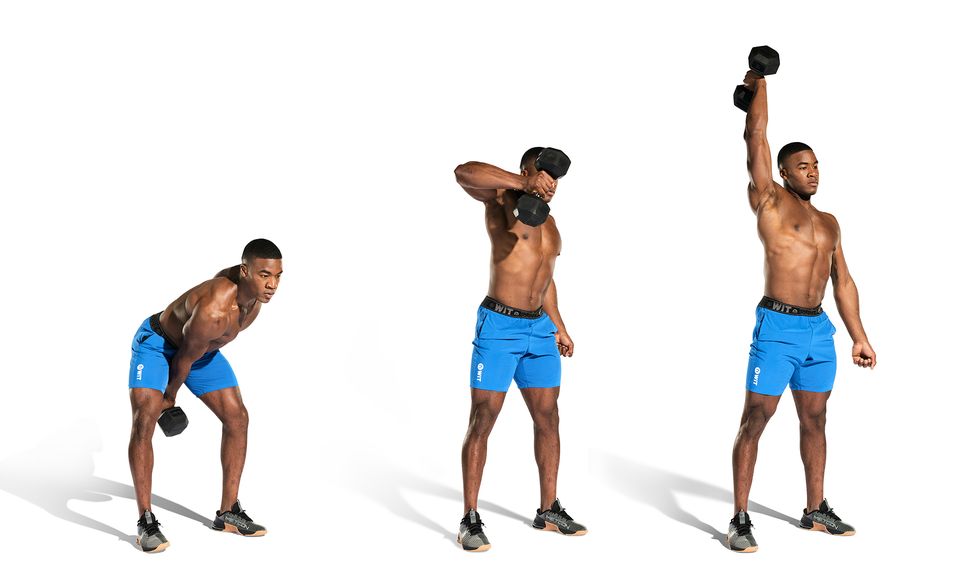
1A. Alternating Hang Snatch x 16-20 (total)

Hinge down and grab your dumbbell from on the ground between your legs, keep your knees soft and back flat (A). Explosively drive up through your hips and knees, generating momentum to help pull the dumbbell directly overhead in one fluid movement (B). Once locked out overhead, lower the dumbbell to between your legs, switching hands on the way down and repeating with the other arm. Alternate back and forth in this fashion, each arm equals one rep. Aim for 16-20 total.

weights, press up, exercise equipment, arm, muscle, chest, physical fitness, dumbbell, kettlebell, sports equipment,

1B. Tempo Push-ups on dumbbells x 15-20

Drop your ‘bells to the ground and assume a long-armed plank position, with your core tight and hands gripping your dumbbells (A), bend your elbows and slowly lower your chest to the floor over a strict count of three seconds (B). Keep your elbows close to your body and pause for one second, feeling the deep stretch through your chest as you push back up explosively. Break your set when you can no longer control your descent or explode back up.

weights, exercise equipment, muscle, shoulder, arm, dumbbell, standing, kettlebell, sports equipment, bodybuilding,

2A. Hang Cleans x 10-12

Stand up and hold your dumbbells at your side. Hinge at the hips to lower them to your knees (A). Stand back up with a slight jump, using the momentum to pull the dumbbells on to your shoulders (B). Stand up straight, then lower under control to your sides and repeat.

laying leg raise

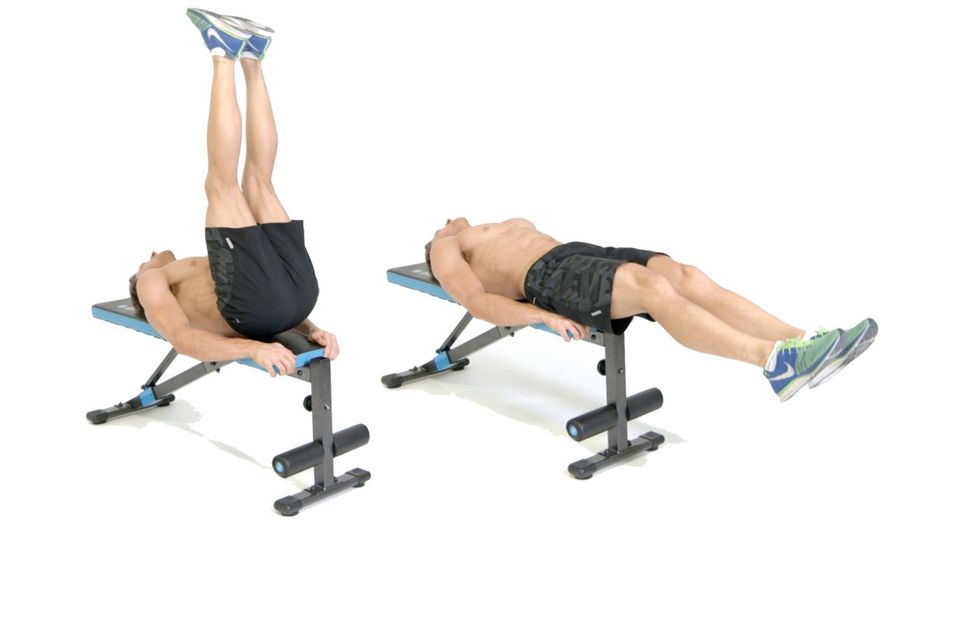
2B. Laying (or Hanging) Leg Raises x 15-20

Lay flat on your back, with your heels just off of the ground, your dumbbells behind your head- gripping them as an anchor (A). Keeping your feet together, curl at the stomach – lifting your legs towards the ceiling until your hips peel from the floor (B). Pause here for a second before slowly lowering. Once you start, try to keep your feet off of the ground throughout. If you have a bar to hang from to perform these, use it.

hammer curl

3A. Hammer Curl x 6-10

Go slightly heavier here if you have a selection of dumbbells, if your dumbbells are heavy, drop the reps but keep your form sharp. Stand tall holding a pair of dumbbells at your sides (A), with minimal momentum and keeping your upper arms tight to your body, curl both dumbbells upwards, making sure your palms facing each other throughout (B). Lower both ‘bells and immediately repeat.

best chest exercises

3B. Bench/Box Dip x 15+

Aim to max out on each set of these. Sit on the edge of a box or bench, with your legs outstretched. With your hands next to your hips, support your weight with your arms as you shift off the edge of the box (A). Flex at the elbows to lower your body until you feel a stretch across your chest (B). Straighten your arms explosively to push back up. Elevate your feet and put your dumbbells in your lap to increase the difficulty.

mens health dumbbell club training plan
Headshot of Andrew Tracey

With almost 18 years in the health and fitness space as a personal trainer, nutritionist, breath coach and writer, Andrew has spent nearly half of his life exploring how to help people improve their bodies and minds.    

As our fitness editor he prides himself on keeping Men’s Health at the forefront of reliable, relatable and credible fitness information, whether that’s through writing and testing thousands of workouts each year, taking deep dives into the science behind muscle building and fat loss or exploring the psychology of performance and recovery.   

Whilst constantly updating his knowledge base with seminars and courses, Andrew is a lover of the practical as much as the theory and regularly puts his training to the test tackling everything from Crossfit and strongman competitions, to ultra marathons, to multiple 24 hour workout stints and (extremely unofficial) world record attempts.   

 You can find Andrew on Instagram at @theandrew.tracey, or simply hold up a sign for ‘free pizza’ and wait for him to appear.

14 Expert-Backed Healthy Beverages To Try

0
14 Expert-Backed Healthy Beverages To Try

When you’re trying to get into a calorie deficit, you are most likely thinking about eating fewer calories at every meal and snack, and fitting in more daily movement through walks and workouts. But what you drink (and don’t drink) can also make a big impact on your overall weight loss goals.

“Weight loss ultimately comes down to burning more calories than you eat, so to maximize calories from food, we want to minimize our calories from drinks,” says registered dietitian and certified personal trainer Gabbi Berkow, RD, CDN, CPT. That means avoiding or limiting beverages like alcohol and soda, which contain empty calories, but ultimately no real beneficial nutrients.

Unlike food, most beverages do not contain any fiber, which helps you feel fuller longer. This is why you most likely feel peckish soon after drinking a sugar-laden beverage and find yourself reaching for a snack, essentially leading to more calories consumed that day.

In addition to water and zero-calorie beverages, there are a variety of low-calorie options that come with some extra health benefits. Here are 14 dietitian-approved weight loss drinks to add to your shopping list.

Meet the experts: Gabbi Berkow, RD, CDN, CPT, is a nutritionist who specializes in weight loss and weight management, building muscle and losing fat, sports nutrition, and eating disorder treatment.

Jesse Feder, RDN, is a contributor to My Crohn’s and Colitis Team.

Katherine Donelan, RD, is a registered dietitian with Stanford Health Care.

Sheri Berger, RDN, CDCES, is the owner of The Plant Strong Dietitian.

Marissa Meshulam, RD, is based in New York City and specializes in helping patients with chronic diseases manage their conditions through nutrition.

Audra Wilson, RD, CSCS, is a clinical bariatric dietitian who has a master of science degree in applied exercise science and sports nutrition.

d3sign//Getty Images

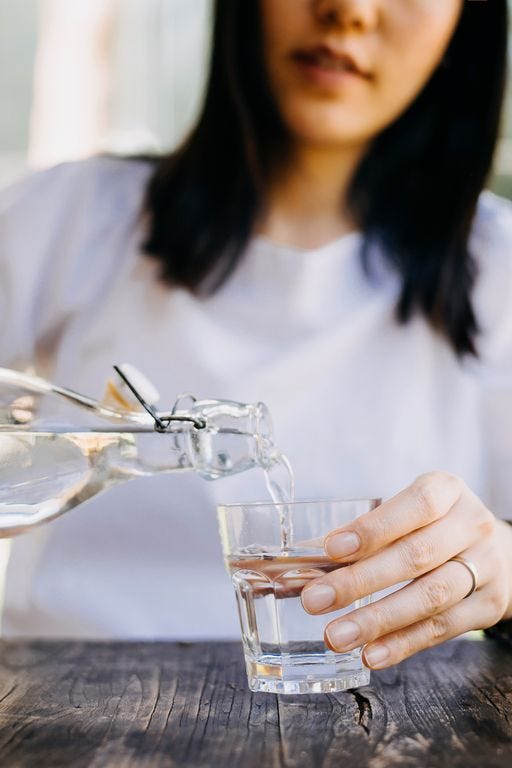
1. Water

        Eh, a little boring right? Not so fast. Water is imperative for losing weight, according to Berkow. “Staying hydrated is really key for weight loss—and of course health in general,” she explains. “Water is needed for metabolism, circulation, energy, digestion, and every function in your body.”

        In fact, several studies found a significant weight reduction associated with increased water intake, according to a 2019 ​​systematic review (although more research is needed to support evidence-based water intake recommendations). “The most effective type of study were the ones that had participants replace their caloric beverages with water,” notes Jesse Feder, RDN, a contributor to My Crohn’s and Colitis Team.

        This content is imported from poll. You may be able to find the same content in another format, or you may be able to find more information, at their web site.

        Plus, you’ve probably heard that it’s easy to scramble hunger and thirst signals, and that’s true. You might actually be thirsty if you feel hungry. Berkow recommends drinking a full glass of water before eating to properly gauge your appetite. Aim for at least eight cups (64 ounces) a day, and even more if you’ve been super active or sweat a lot. To make it fun, add any sliced fruit you have in the fridge.
        green tea on bamboo

        ATU Images//Getty Images

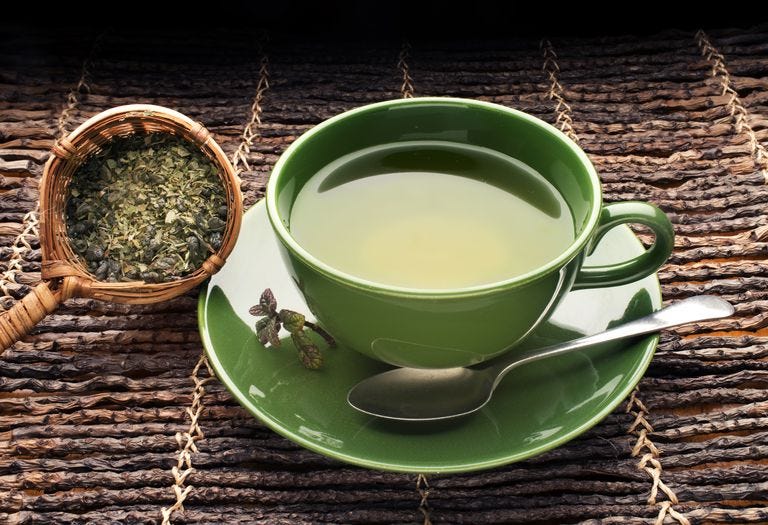
        2. Green Tea

        Green tea extract is linked to a lower weight, BMI, and body fat percentage, a 2019 study in the British Journal of Clinical Pharmacology found. “That’s not to suggest there are no benefits in drinking green tea itself,” says Katherine Donelan, RD, of Stanford Health Care. “On the contrary, the American Institute of Cancer Research recommends drinking one to four cups of green tea a day as part of a cancer risk reduction diet.”

        Green tea itself contains caffeine and catechins, which are antioxidants that can support fat burning, says Berkow. Though, some perspective here: You need a calorie deficit to lose weight, so you can’t rely on catechin-containing beverages to majorly increase your metabolic rate.
        blueberry smoothie in glass

        Arx0nt//Getty Images

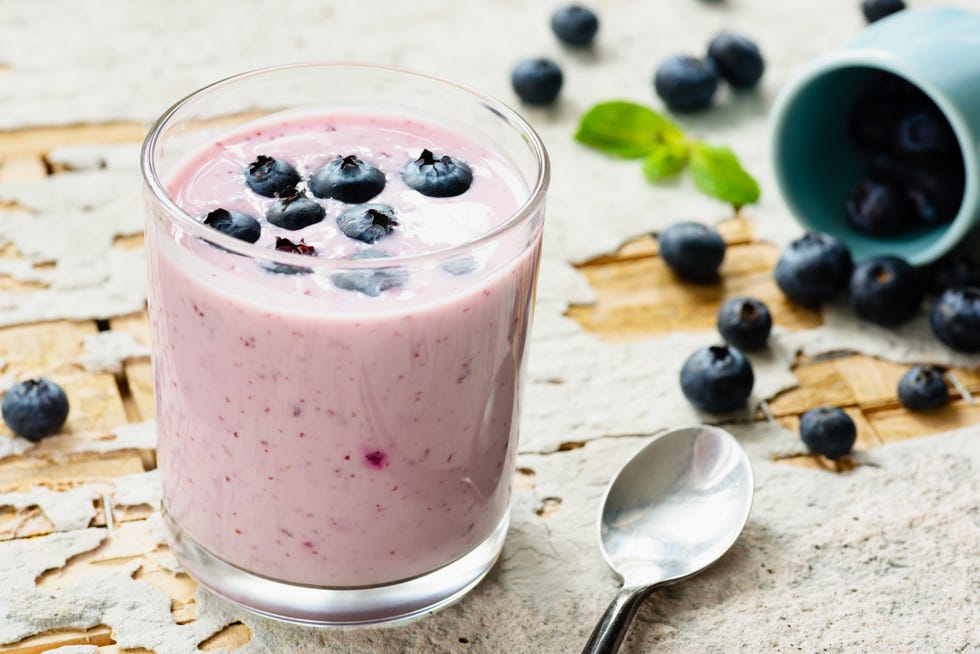
        3. Smoothies

        “Smoothies, when done right, are a great option for weight loss, but you have to make sure they are filling enough to be used as a meal or snack replacement,” explains Berkow. “You should also remember they will not keep you as full as solid food would, so be careful not to overdo fruits and sugars.”

        Berkow suggests using her formula to create filling and balanced smoothies that have plenty of protein, fiber, unsaturated fat, vitamins, and minerals: Combine at least 20 grams of protein (from protein powder or plain 0 percent Greek yogurt), one or two fruit servings (e.g., bananas and berries), a handful of spinach or another green of choice, one serving of unsaturated fat (such as one to two level tablespoons of nut butter, ¼ avocado, or one tablespoon of chia seeds), and one cup of water or non-dairy milk/skim milk for liquid.

        Another option would be to take a low-carb, pre-made protein shake or powder and add ½ cup fruit and a few tablespoons of low-carb yogurt or powdered peanut butter, says Audra Wilson, RD, CSCS, a bariatric dietitian at Northwestern Medicine Delnor Hospital. “This way you get some taste variation without all of the carbs and calories [some] add-ins provide,” she adds.

        While there is no research to support that drinking smoothies can help you lose weight, there is no denying that a smoothie is one way to introduce healthier foods to your diet. “If we would typically eat a sausage and egg sandwich for breakfast and now we are opting for a fruit- and veggie-based smoothie, then that is a great choice because we do know that an increase in fruit and vegetable consumption is more closely aligned with weight reduction,” says Donelan.
        herbal tea in kettle on table

        Shinya Kumamaru / EyeEm//Getty Images

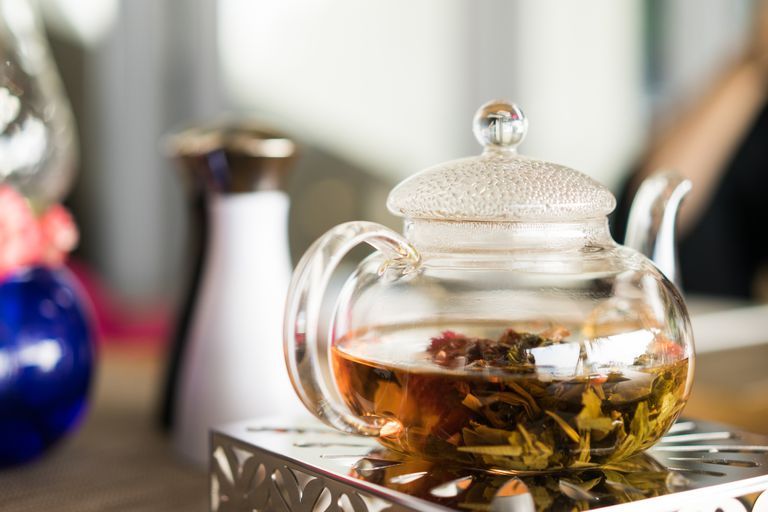
        4. Herbal Tea

        “People love herbal teas for a bit of flavor and a non-caffeinated break in the middle of the day,” says Berkow. Depending on the type of tea you choose, it can have different benefits: For instance, lavender and chamomile teas are useful for relaxation or peppermint tea may help with digestion. Other perks include being low-calorie and hydrating.
        green vegetable juice on rustic wood table

        fcafotodigital//Getty Images

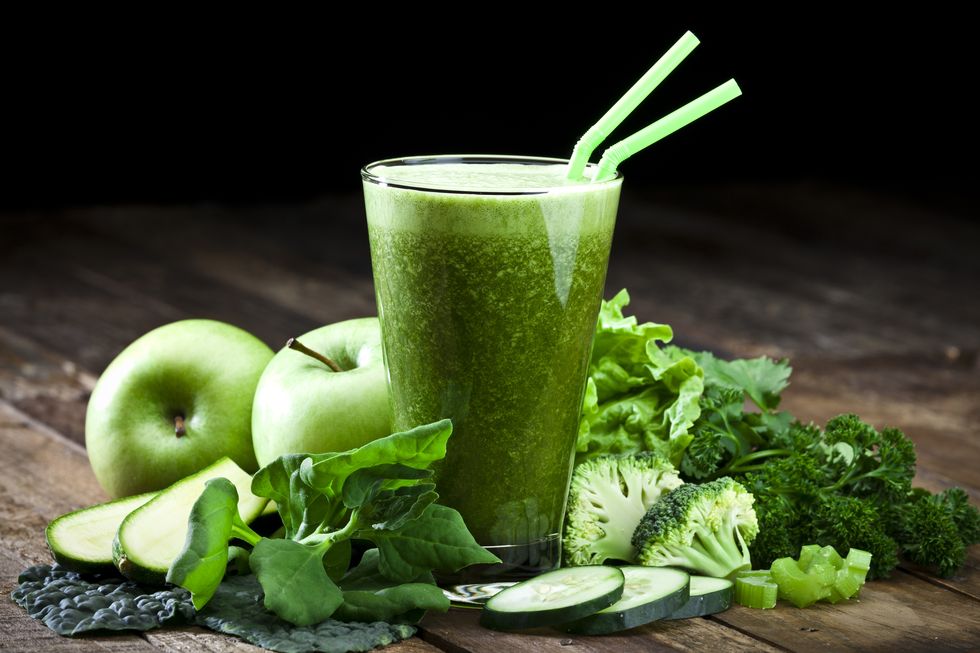
        5. Green Juice

        Green juice can pack in the vitamins, minerals, and antioxidants, but it doesn’t have the same fiber as eating the vegetables whole, which is why you need to be mindful of the kinds of juices you consume, according to Berkow. That said, a green juice can be a refreshing and hydrating drink when you’re aiming to lose weight.

        “When selecting a green juice, make sure to get ones that contain only vegetables, or are made with one fruit like an apple,” Berkow says. “Those with too many fruits can be really high in sugar and calories, and can actually leave you craving more sugar later on.”

        book and cup of black coffee on a bed

        Westend61//Getty Images

        6. Coffee

        Coffee, luckily, is an expert-approved bev, according to Berkow. “Black coffee would be ideal because it doesn’t contain any calories, and caffeine can speed your metabolism a bit,” she says. (Although this metabolic bump isn’t enough to cause weight loss on its own.)

        Indeed, researchers found that drinking four cups of coffee per day could possibly reduce body fat, in a 2020 study conducted by the Harvard T.H. Chan School of Public Health. Just note that four cups is quite a bit, so don’t all of the sudden start downing that amount in the name of weight loss. It’s also important to note that since coffee is a diuretic, drinking four cups a day will send you to the bathroom frequently,” says Sheri Berger, RDN, CDCES, owner of The Plant Strong Dietitian.

        But coffee and tea become high in calories and problematic when tons of sugar and cream or milk are added, says Berkow. She recommends a plant-based sugar substitute like stevia or monk fruit, as these won’t raise your blood sugar. Stick with a small portion of milk or cream.

        Oh, and don’t forget to drink water too. It can be easy to sip coffee throughout the day and forget to hydrate with plain H20.
        apple vinegar, fermented foods

        Yulia Naumenko//Getty Images

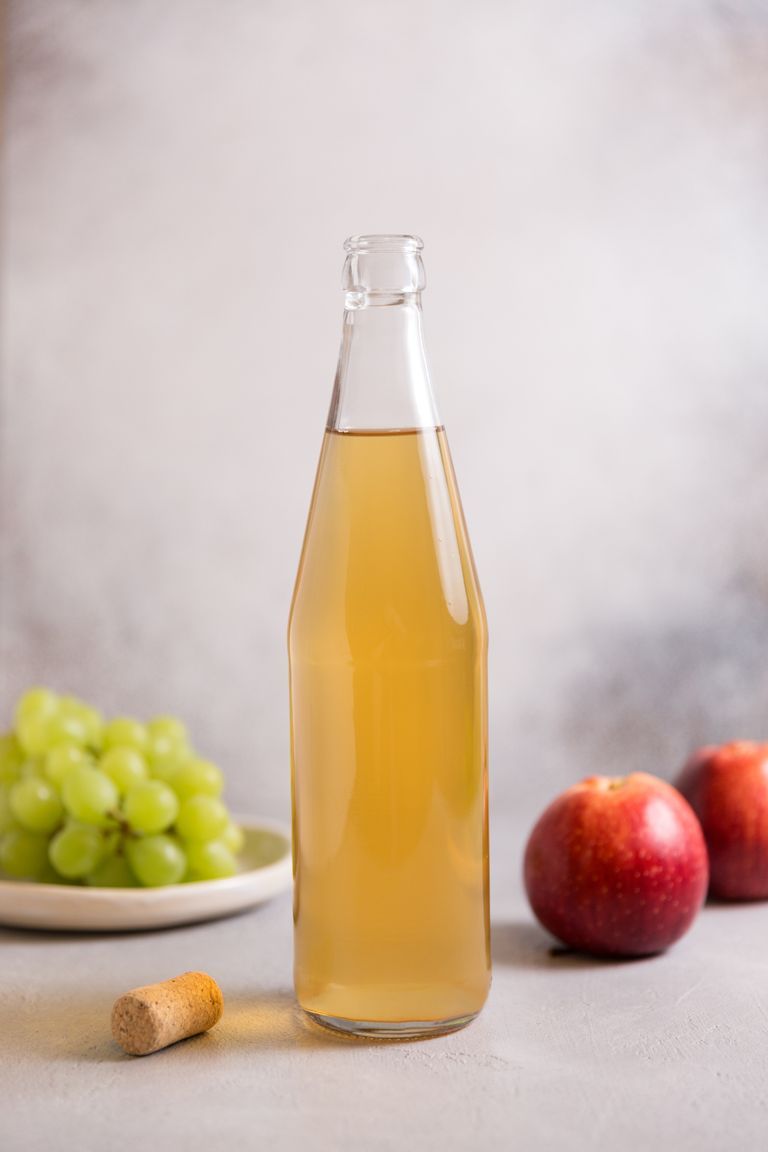
        7. Apple Cider Vinegar Drinks

        It’s tangy and puckery, but many people like to incorporate a little apple cider vinegar (ACV) into a daily drink or sip on a ready-made bottled version, which are easier to find in grocery stores now. “ACV is linked to many health benefits, such as aiding in blood sugar regulation and helping with weight management by enhancing fullness,” explains Marissa Meshulam, RD, who is based in New York City. In addition, raw, unfiltered ACV (the kind where you can see the cloudy-looking “mother” in the bottle) is a source of probiotics, which can benefit immune and gut health, she says.

        In fact, ACV along with a restricted calorie diet can be considered an effective strategy for reducing appetite in overweight or obese individuals, per a 2018 study published in the Journal of Functional Foods.

        However, Donelan notes the key is the amount of ACV you use. “Studies have shown that taking two tablespoons daily is necessary to get the benefits, but it is difficult to know if these marketed apple cider drinks have enough apple cider in them, and even if they did, you would need to have one a day to get the benefits,” she adds.

        A more cost-effective approach would be to buy the apple cider vinegar itself and take it as a shot or a shooter with a splash of juice. You could also mix it into a smoothie to soften the taste.

        Whichever way you decide to enjoy ACV, it is always best to dilute it with something. “Apple cider vinegar (ACV) is very acidic; if it is not diluted, it may erode tooth enamel or cause stomach distress for some people,” says Berger.
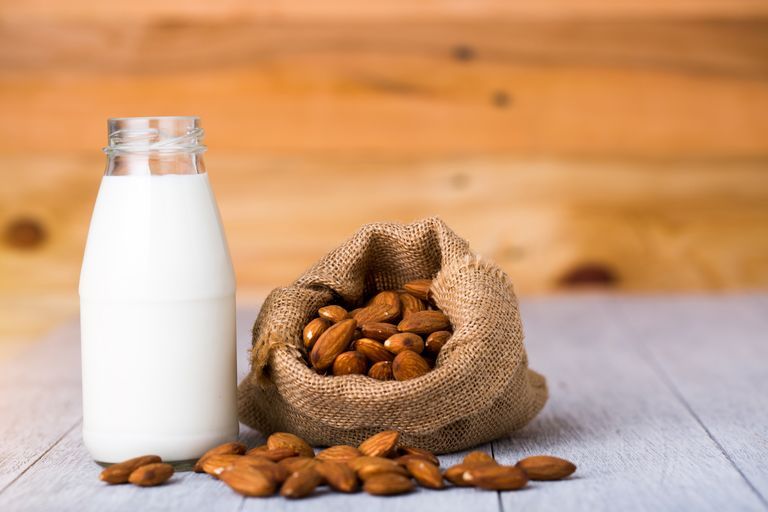
        almonds and milk bottle on table

        Ittipol Nampochai / EyeEm//Getty Images

        8. Nut Milk

        Nut milks are low calorie and depending on the milk you choose, can be a great source of iron, vitamin E, and antioxidants, says Berkow. If fortified, nut milks also provide calcium and vitamin D. “They’re also lactose-free, gluten-free, and vegan.” Your best option is unsweetened nut milks.

        Plant-based beverages generally contain fewer calories than regular dairy milk, according to a 2020 study, so for people aiming to reduce their calorie intake, switching to nut-based milk, like almond milk, may support that overall goal of weight loss. For instance, just one cup of whole milk contains 149 calories, while only one cup of almond milk has 60 calories.
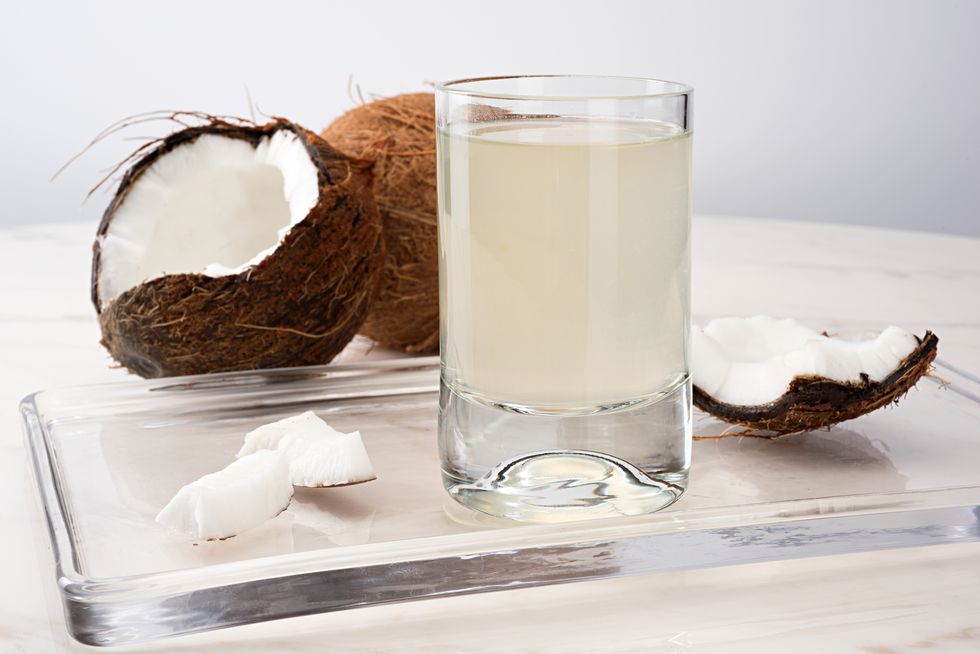
        coconut water

        Burcu Atalay Tankut//Getty Images

        9. Coconut Water

        There’s nothing like sipping a fresh coconut on a beach somewhere, right? Okay, you’re probably sipping yours from a single-serve box you bought at the store, but that can be just as refreshing, too.

        Coconut water is full of electrolytes, which is great for rehydrating the body, says Meshulam. “Coconut water is a good source of vitamin C, magnesium, manganese, and potassium,” she explains. These vitamins and minerals play a role in immunity and collagen production in the skin (vitamin C, we’re looking at you), manage blood pressure (hats off you to, potassium), and provide disease-fighting antioxidants (thanks, manganese). Coconut water does contain some sugar though, so be sure to balance out coconut water consumption with regular plain water.

        “Overall if you are looking for something different than water to stay hydrated throughout the day coconut water could be a good choice in comparison to higher calorie juice and sports drinks,” says Wilson. “Just be careful to read labels and find the option with the lowest sugar content.”
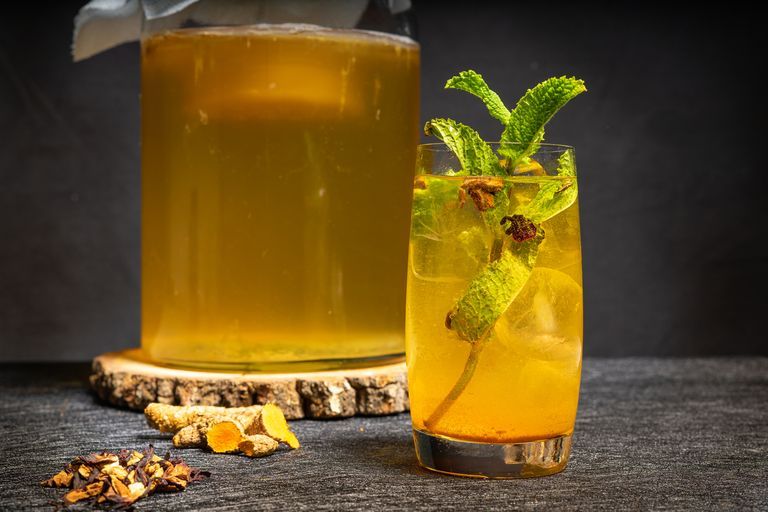
        homemade fermented kombucha tea

        juan antonio barrio miguel//Getty Images

        10. Kombucha

        “Kombucha is a fermented tea,” explains Meshulam. “During the fermentation process, health-promoting probiotics are formed, plus it’s made from tea, so it contains antioxidants from the tea leaves.”

        Kombucha consumption led to a decrease in overall caloric and macronutrient intake, per a 2021 article published in Current Developments in Nutrition. This may be because kombucha suppressed appetite or helped make participants feel fuller due to the fluid volume, says Donelan.

        However, kombucha naturally contains sugar, so read the label and purchase those that have less than 15 grams of sugar per bottle. When poured into a fancy glass, it can make a nice substitute for an alcoholic bev.
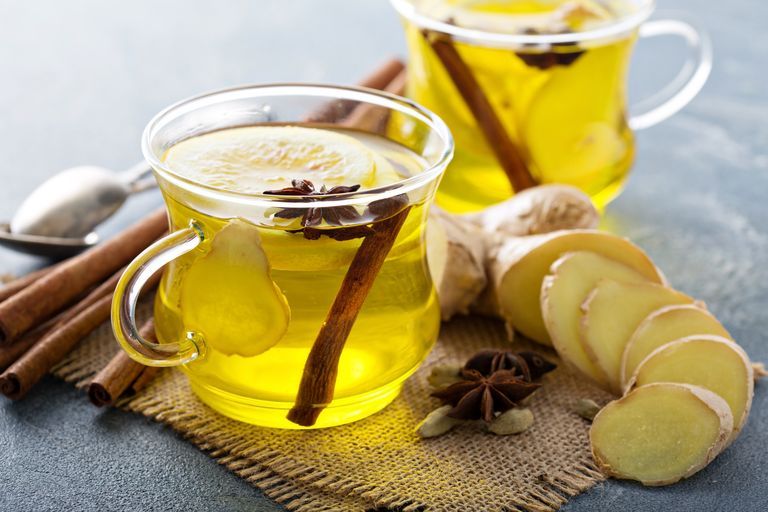
        ginger and lemon drink

        by Elena Veselova//Getty Images

        11. Ginger Tea

        Ginger tea is one of several teas that show up on this list. “Ginger is known to ease stomach upset, specifically nausea, and reduce gas [and] bloating,” says Meshulam. That can help you feel good throughout the day. Ginger tea contains almost no calories and can add variety to your drink rotation. And ginger intake reduced body weight and waist-to-hip ratio, in a 2018 meta-analysis.

        Try it as a mid-day sip instead of running out to get a sugary coffee drink as a pick-me-up. However, it is important to remember no one drink or food item is going to make or break your weight loss.
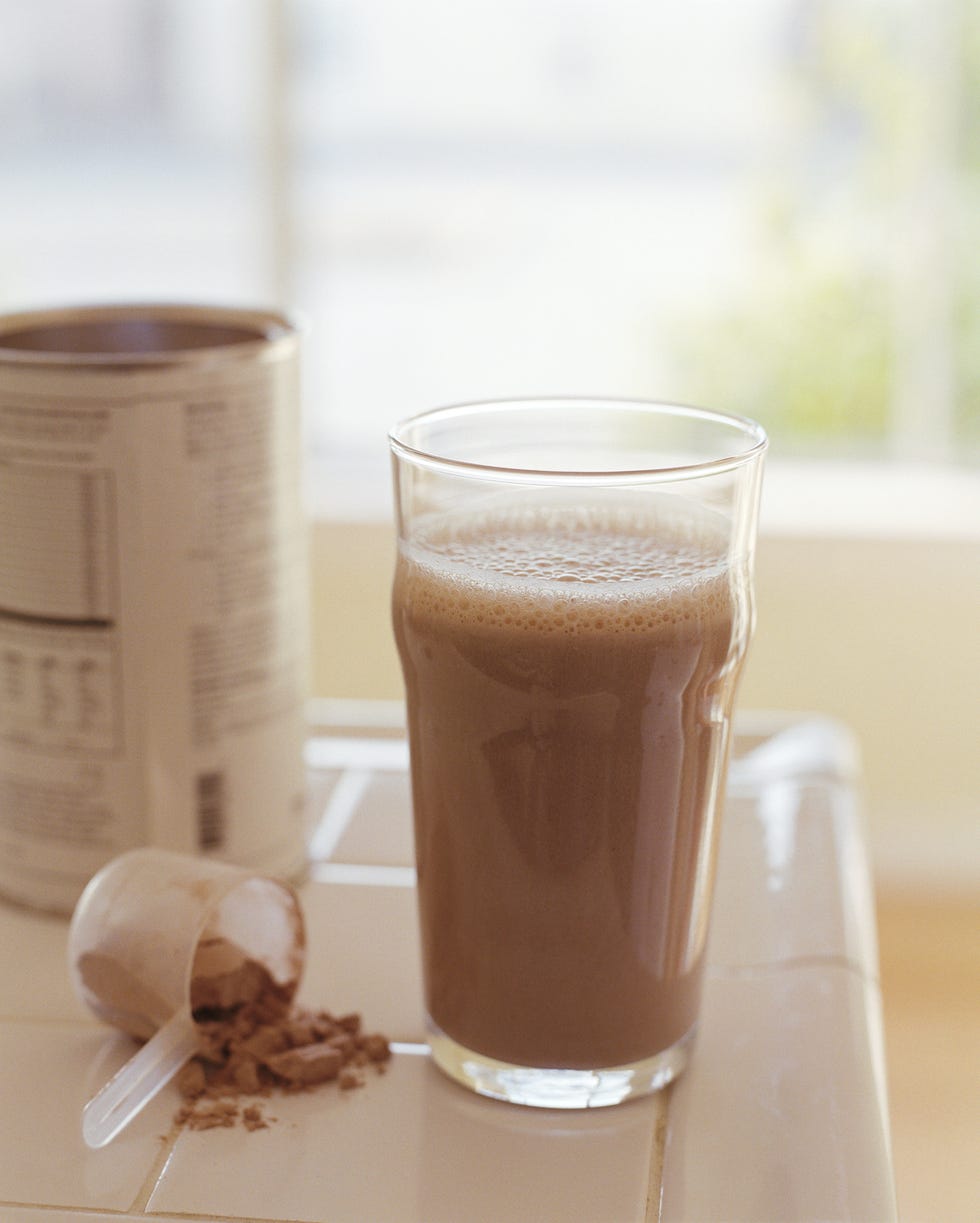
        protein drink with can and measuring cup on counter

        Julie Toy//Getty Images

        12. Protein Shakes

        For weight loss, Berkow recommends consuming at least one gram of protein per pound of body weight. That can be a tall order for the day, but protein shakes can help you get there. (Or, at the very least, get your protein intake up if it’s lagging.) She recommends a protein drink made from a protein powder (supplying 20 grams of protein) mixed with water, a non-dairy milk, or skim/low-fat milk. However, pre-made protein shakes can also work, provided you examine their calorie and sugar content before sipping. Berkow recommends Core Power Fusion for a dairy option, and Owyn for a non-dairy option.

        A multi-ingredient high-protein, high-fiber nutritional supplement shake consumed as a preload before breakfast and lunch positively influenced weight management in overweight adults compared with a placebo, in a 2022 study published in The Journal of Nutrition.

        “The benefits of protein in weight loss are best seen when the drink is also high in fiber,” notes Donelan. “You can add a supplement alongside your shake, such as psyllium husk, or you can use whole foods that add minimal flavor while bulking up the fiber, such as avocados, cauliflower, chia seeds, prunes, tofu, and white beans.”
        sparkling seltzer water

        Juj Winn//Getty Images

        13. Naturally Flavored Carbonated Water

        When looking for something more interesting than still water, Berger says carbonated water with a splash of natural flavoring or fruit juice is a no- to low-calorie way to quench your thirst with some bubbles.
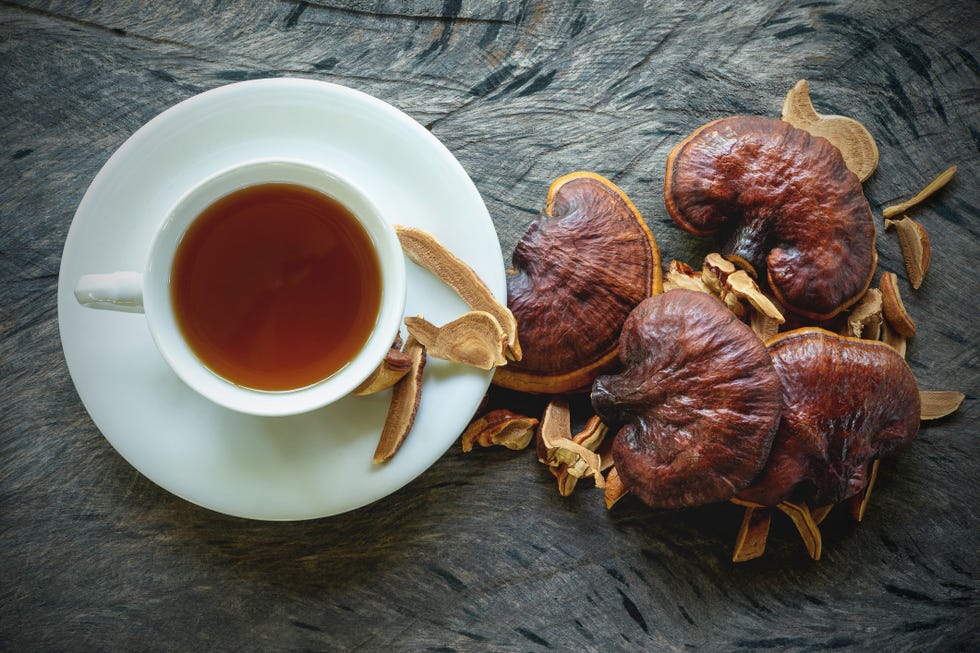
        cup of reishi tea and fresh lingzhi mushroom

        krungchingpixs//Getty Images

        14. Mushroom Tea

        Mushroom tea is another low-calorie tea option, notes Berger. “Studies show it has effective antiviral, antibacterial, antifungal, and anti-inflammatory properties,” she says.

        Looking for some options to try? Berger suggests a few brands of mushroom tea including Teecino, Buddha Teas, and Traditional Medicinals. You can find these teas in some grocery stores or on Amazon.

        The bottom line: “Many people are not aware of the extra calories that are sliding into their day when reaching for a coffeehouse beverage, boba tea, or fruit juice,” says Berger. This is why choosing beverages wisely can save hundreds of calories per day.

        Headshot of Nikhita Mahtani

        Nikhita Mahtani is an NYC-based freelance journalist covering primarily health and design. She graduated with an M.A in Magazine Journalism from New York University and loves to debunk popular health myths. Her idea of wellness includes a sweaty spin class, wine with loved ones, and experimenting with new recipes in the kitchen.

        Headshot of Ashley Martens

        Journalist

        Ashley Martens is a wellness writer based in Chicago. With a lifelong passion for all things health and wellness, Ashley enjoys writing about topics to help people live happier and healthier lives. With a foundation in fitness, food, and nutrition, Ashley covers it all including sexual health and travel topics. Ashley is also a NASM-certified personal trainer and group fitness instructor.
Overuse of devices and social media top parent concerns

0
Overuse of devices and social media top parent concerns

The C.S. Mott Children’s Hospital National Poll on Children’s Health asked a national sample of parents to rate their level of concern about a variety of health topics. Parents rated each topic as a big problem, somewhat of a problem, or not a problem for children and teens in the United States. The leading concerns rated by parents as a big problem for children and teens are presented below.

2023 Top 10 Child Health Concerns for Parents:

  1. Overuse of devices/screen time (67%)
  2. Social media (66%)
  3. Internet safety (62%)
  4. Depression/suicide (57%)
  5. Bullying (53%)
  6. Stress/anxiety (52%)
  7. Unhealthy diet (52%)
  8. Costs of healthcare/health insurance (50%)
  9. School violence (49%)
  10. Smoking/vaping (48%)

Falling just outside the Top 10 are obesity (48%), guns/gun injuries (47%), lack of mental health services (47%), poverty (45%), drinking/using drugs (44%), child abuse/neglect (42%), followed by unequal access to health care (35%), parental stress (35%), inaccurate/misleading health information (31%), teen pregnancy/sexual activity (31%), discrimination (31%), unsafe neighborhoods (30%), gay/gender issues (LGBTQ) (29%), and health risks from polluted water and air (23%). At the bottom of the list are safety of vaccines (16%), over-involved parents/parents doing too much (13%) and COVID (12%).

Several issues are viewed as a big problem by a higher proportion of parents in low-income (<$50,000) households; these include depression/suicide, bullying, school violence, unsafe neighborhoods, drinking/drugs, smoking/vaping, teen pregnancy/sexual activity, child abuse/neglect, parental stress, discrimination, COVID, and health risks from pollution. In contrast, overuse of devices and social media are viewed as big problems by a higher proportion of parents in middle- ($50,000-$99,999) and high-income (≥$100,000) households. Parents across income groups have similar ratings for unhealthy diet, obesity, costs of healthcare, and lack of mental health services.

Highlights

  • Top parental concerns center on children’s and teens’ use of devices and social media.
  • Over half of parents rate mental health issues as a big problem.
  • Parents in low-income households rate more issues as a big problem for children and teens.

Implications

Since 2007, the Mott Poll has released periodic reports on parents’ level of concern about a variety of health-related issues for US children and teens. The top issues centered around the role of social media and the internet in children’s lives, with two-thirds of parents expressing concerns about children’s increased use of social media, as well as overall screen time. These topics became more prominent during the pandemic, and this report shows that parent concerns have not faded. As shown in prior Mott Poll Reports, children are using social media at younger ages, and parents struggle with how to appropriately monitor this area and help their children avoid the negative aspects of its use.

Poll results also demonstrate parents’ continued concern about children’s mental health. Over half of parents cited mental health topics as big problems of US children, such as depression/suicide, and stress/anxiety, and related topics like bullying. Notably, nearly half of parents cited lack of mental health services as a big problem. The mismatch between the growing number of youth with mental health concerns and the limited access to mental health services has short and long-term implications for children’s well-being.

Parents also expressed a high level of concern about violence in school, which may reflect direct experience with school shootings or fights as well as media coverage about such events. In addition, changes to the school environment (e.g., metal detectors, armed guards, locked doors) and active shooter drills may remind children and parents about the potential for school violence. Parents may struggle with how to manage their own stress and anxiety while they try to reassure their child. They may want to talk with their child periodically about how they perceive their safety in school and their emotions regarding unsafe school incidents. Parents can talk with their child’s teacher or principal to make sure adequate protocols are in place if an unsafe situation arises.

New to the Top 10 is concern about the costs of healthcare for children, including costs of getting health insurance. In recent years, federal policies required states to maintain Medicaid enrollment through the duration of the pandemic. As these requirements are ending, families that no longer qualify will face the challenge of finding affordable coverage for their children.

Unhealthy eating and obesity continue to rate as important issues, but have been overtaken by concerns about mental health and social media/screen time. For both ongoing and emerging concerns, parents may find their child’s health care provider can serve as an effective partner to help address these problems.

This Mott Poll also highlights the greater level of concern about a host of issues among parents from lower-income households. This may reflect their day-to-day experiences dealing with environmental challenges such as unsafe neighborhoods, as well as bullying or discrimination that may be more frequently experienced by children from low-income families. In addition, low-income parents reported higher levels of concern about mental health and substance use; while these problems affect children and teens across the income spectrum, it’s possible that low-income parents feel more vulnerable about these problems. Overall, parents from low-income households rated a higher number of topics as big problems; concern about a greater number of child health issues may contribute to their higher reports of parental stress as a big problem.

Arnold Schwarzenegger’s 30-30 Dumbbell Pump Challenge

0
Arnold Schwarzenegger’s 30-30 Dumbbell Pump Challenge

Schwarzenegger’s workouts may make you think of old school grunting under heavy barbells at Muscle Beach, but this latest workout published in his Pump Club Newsletter takes influence from CrossFit AMRAPs to deliver an insane pump without all the equipment.

‘Ready to join the 30-30 club?’ asks Arnie. ‘While it might feel different, timed sets allow you to get in a lot of reps in a short period of time, making for an intense workout that gives you a great pump and cardio benefits.’

The workout will test your muscular endurance, and as you aim to beat your reps from the previous set, your cardio will be pushed to the limit. No equipment? No worries, as Arnie eliminates our ‘excuses’ by offering a bodyweight version and a dumbbell version.

If your workout goal is to get Schwarzenegger swole, then look no further.

The Workout

Schwarzenegger recommends: ‘Grab a stopwatch (or your phone), set a timer for 30 seconds, and do as many reps as possible. Then, rest for 30 seconds and move on to the next exercise. Two rounds of this workout will take you just 10 minutes. And if you’re more advanced, try to perform four rounds, which will only be 20 minutes.’

Bodyweight Version

Alternating Lunges

Stand tall. Keeping your chest up at all times, take a step backward with one leg, bending your front knee until the back knee touches the ground. Stand up explosively, pause and repeat with the other leg.

press up, arm, abdomen, joint, physical fitness, chest, muscle, trunk, shoulder, human body,

Press-Ups

Hit a strong plank position, with your core tight and hands under your shoulders. Bend your elbows to bring your chest to the floor. Keep your elbows close to your body as you push back up explosively.

inverted row

Pull-Ups, Inverted Rows or Supermans

Pull-up: Grasp a pull-up bar with an overhand grip over shoulder-width apart, lift your feet from the floor, hanging freely with straight arms. Pull yourself up by flexing the elbows while pinching your shoulder blades together. When your chin passes the bar, pause before lowering to the starting position.

Inverted row: Grab a set of rings or a bar at hip height, walk your feet forward until you’re hanging with straight arms, keeping your elbows close to your body row yourself up towards the rings, pause here for a second, before lowering yourself under control back to a full hang, repeat.

Supermans: Begin lying on the floor, face down with your arms straight overhead. Squeeze the shoulder blades back and away from your ears, and use your back muscles to lift your upper body and legs off the floor. Hold here for a second before you release slowly back to the floor, ready to repeat.

standing, weights, kettlebell, arm, shoulder, exercise equipment, muscle, human body, leg, photography,

Squats

Standing tall, keep your chest up and sink your hips back, before bending your knees to drop your thighs until they are at least parallel to the floor. Drive up back to standing, ready to repeat.

press up, arm, knee, fitness professional, leg, joint, flip acrobatic, chest, exercise, muscle,

Mountain climbers

Start in the high plank position with your head in line and core engaged. Take one knee towards the opposite elbow. Replace the leg back to the starting position ready to begin on the opposite side. Complete at a fast tempo to push your cardio, or slow and sustained to improve your core strength.

Dumbbell Version

paul rudd muscle workout

Dumbbell Lunges

Stand tall with your dumbbells in each hand. Keeping your chest up at all times, take a step backward with one leg, bending your front knee until the back knee touches the ground. Stand up explosively, pause and repeat with the other leg.

dumbbell chest press

Dumbbell Chest Press

Lie on a flat bench with the dumbbells up above your chest with your arms straight and your palms facing away from you. Lower the dumbbells either side of your chest, at 45 degrees below your shoulders. Feel a stretch across your chest before pushing the dumbells away from you, ready to repeat.

weights, exercise equipment, shoulder, overhead press, kettlebell, arm, dumbbell, physical fitness, standing, muscle,

Dumbbell Bent-Over Row

Hinge at the hips with a flat back, your hips behind your heels, your dumbbells hanging by your thighs. Row the dumbbells up to your hips while squeezing the shoulder blades together and keeping them away from your ears. Slowly lower the dumbbells, ready to repeat.

dumbbell front squat

Dumbbell Front Squats

Hold the dumbbells at your collarbone with your palms facing inwards, elbows in tight to your waist. Send your hips back with your chest upright into a squat. Once you break parallel, push through the heels back to standing, ready to repeat.

leg, human leg, elbow, shoulder, wrist, joint, knee, exercise, physical fitness, muscle,

Dumbbell Weighted Crunch

Begin lying on you back with your legs bent and feet planted on the floor. Hold a dumbbell over your chest, or for more difficulty, above your head. Push your back into the floor and lift your upper body. Squeeze your abs, when your upper body is off the floor, slowly release back to your starting position.

Headshot of Kate Neudecker

Kate is a fitness writer for Men’s Health UK where she contributes regular workouts, training tips and nutrition guides. She has a post graduate diploma in Sports Performance Nutrition and before joining Men’s Health she was a nutritionist, fitness writer and personal trainer with over 5k hours coaching on the gym floor. Kate has a keen interest in volunteering for animal shelters and when she isn’t lifting weights in her garden, she can be found walking her rescue dog.

From Zendaya To Olivia Jade

0
From Zendaya To Olivia Jade

If you’ve been keeping tabs on the latest film releases, odds are you’ve heard plenty of buzz about Priscilla. The movie, which stars Cailee Spaeny and Jacob Elordi, follows the life of Pricilla Presley as she begins her relationship with rock n’ roll star Elvis Presley.

Of course, with the November 3 premiere date approaching quickly, it’s no surprise that fans are already dying to learn more about the cast and their lives off-screen. And when it comes to Euphoria heartthrob Jacob Elordi, fans are curious to know all about his relationship history. If you’re reading this, odds are you’re also interested in it, too (no shame!).

From co-stars to models and influencers, Jacob has definitely caught the eye of a few leading ladies in Hollywood. And while he tends to keep his dating life on the D.L., there are still plenty of details out there about his love interests.

Read on for all the details about the actor’s dating history.

Joey King

Jacob started dating his The Kissing Booth co-star Joey King back in 2017.

Nothing like a good co-star-turned-relationship moment, am I right? Back in 2017, the two played love interests in the hit Netflix rom-com, which seemed to transfer to an IRL dynamic.

Dating rumors first started swirling during filming, and Joey even opened up about what it was like having him by her side on set.

“It helps to have somebody by your side, cheering you on, who knows what you’re going through and who’s been through it themselves,” she told US Weekly in 2018.

Joey King and Jacob Elordi at Variety’s Power of Young Hollywood event in 2018.

Variety//Getty Images

Unfortunately, their relationship ended that same year, which coincided with his role in HBO’s Euphoria. Fans were quick to notice that something seemed off when Jacob announced he was taking a break from social media, and Joey scrapped photos of the two of them from her IG feed. But even after their breakup, the duo continued to be an on-screen couple in The Kissing Booth 2 (2020) and The Kissing Booth 3 (2021).

During a 2020 interview with Howard Stern, Joey revealed that she didn’t regret the relationship despite having to work together after their split.

“I think it’s a good thing we dated in the first place. I learned the most I’ve ever learned in my life from him,” she told Stern. “I think that it’s awesome to date someone in your field, who gets it, but doing the same exact thing as somebody is tough. It’s really tough.”

In September, Joey married director Steven Piet, her partner of four years.

This content is imported from youTube. You may be able to find the same content in another format, or you may be able to find more information, at their web site.

Zendaya

Before there was Tom Holland and Zendaya (a.k.a Tomdaya), there was Jacob. The pair met while co-starring in Euphoria in the summer of 2019, and fans seemed to like the idea of these two together.

That same year, Jacob attempted to squash dating rumors while giving Z credit for her role on the show.

“Zendaya is an amazing creative, you know? She’s super dope to work with. She’s an incredible artist and a very caring person to all of us,” he told GQ at the time. “But we’re all really close.”

zendaya jacob elordi euphoria

Zendaya and Jacob at the Euphoria premiere in 2019.

Filmmagic//Getty Images

Still, Zendaya and Jacob were spotted on vacation in Greece and were later photographed kissing in New York City and attending Dear Evan Hansen on Broadway, per People. While they never confirmed their relationship, things didn’t seem to last long, as they seemingly called it quits in 2020.

This content is imported from poll. You may be able to find the same content in another format, or you may be able to find more information, at their web site.

Kaia Gerber

In the fall of 2020, Jacob was linked with model and actress Kaia Gerber. And since he kept his connection with Zendaya so under wraps, fans were surprised when they confirmed their relationship in a now-deleted Halloween pic on Instagram.

In the photo, Kaia and Jacob looked cozy while dressed up as Priscilla and Elvis Presley, per US Weekly. Foreshadowing?! Perhaps.

the academy museum of motion pictures opening gala arrivals

Jacob and Kaia at The Academy Museum Of Motion Pictures Opening Gala.

Jon Kopaloff//Getty Images

In May 2021, Kaia opened up about their connection and how it impacted her view on relationships.

“Being able to be with someone I trust, where we don’t want anything from each other, having a safe, steady relationship like that, has really opened my eyes to the possibilities of love and what it feels like to love without conditions,” she told Vogue. “Lust is touching other people or wanting them, but love is really seeing someone.”

Just six months later, the couple split, with a source telling E! News that the relationship ended amicably.

Olivia Jade Giannulli

If you keep tabs on some of the most popular YouTubers, you may be familiar with Olivia Jade Giannuli. In 2019, she began growing her social media and influencer presence. But a year later, she was in the limelight for a college admission bribery scandal that involved her mom, Lori Loughlin who played Aunt Becky on Full House. (Loughlin later confessed to bribing the University of Southern California for her daughters’ admissions, and as a result, served a two-month prison sentence and was ordered to pay $150,000 on top of 100 hours of community service for , per NBC News).

In 2021, Jacob and Jade were spotted on several outings together, and a source told People the two were “casually dating.” Since then, the couple has kept their relationship under wraps and out of the public eye.

In August 2022, Jacob and Olivia split. “He’s not looking for a serious relationship at the moment,” a source told Life & Style, per US Weekly.

However, they were spotted together a year later, seeming to confirm their ‘ship was back on.

1027 kiis fm's jingle ball 2021 presented by capital one arrivals

Olivia Jade at KIIS FM’s Jingle Ball in 2021.

Jon Kopaloff//Getty Images

It’s not entirely clear how the pair met, but they’ve reportedly been solid since rekindling. A source recently shared that despite their on-and-off again moment last year, their relationship was getting “pretty serious,” adding that, “they are 100 percent going strong,” per People.

It’s unclear if Olivia and Jacob will make things red carpet official sometime soon, but I for one will definitely be keeping an eye out.

Lettermark

Sabrina is an editorial assistant for Women’s Health. When she’s not writing, you can find her running, training in mixed martial arts, or reading.

The importance of oral care during cancer treatment

0
The importance of oral care during cancer treatment

I participated in a medical/dental mission trip in the remote mountain village of Jean Rabel, Haiti, in 2012. Before we left, the organizers requested that each member of the team read the book, When Helping Hurts: How to Alleviate Poverty Without Hurting the Poor … and Yourself, by Steve Corbett and Brian Fikkert.

The premise of the book focuses on the goal of giving people a hand-up rather than a handout, and the importance of providing those in need with resources that will continue to improve their conditions long after the missionaries leave. The book provides many examples of ways that good intentions actually keep the people intended to receive help in a cycle of long-term harm.

A surprising lack of resources

The information hit home for me in unexpected ways. Early in my long career as a registered dental hygienist, I was a caregiver for family members who had cancer. As I witnessed the side effects of chemotherapy such as dry mouth and mouth sores, I was frustrated with the lack of resources to help alleviate these problems.

I made it my mission to find answers but found that information was scarce even for health-care providers. I learned that some of these oral side effects not only increase risks of pain and infection during treatment but can result in long-term damage to oral health, which negatively impacts physical, emotional, and financial quality of life.

When I became confident with the information I’d gathered, I created a volunteer program to provide oral care kits with product samples and information for patients at a local cancer clinic. I acquired the products through donations from companies that appreciated the opportunity to be involved.

You might also want to read: The dental hygienist’s role in cancer care

This program had been in place for six years when I read the book by Corbett and Fikkert, and this encouraged me to reexamine the products in the kits. Were they really the best choices for these patients or were they included simply because the manufacturer was willing to donate them? After all, the main purpose of the program was to fill the gap in care, not to make myself feel good about taking action.

Not all oral care products are appropriate for the needs of cancer patients. Some of the remedies recommended to patients by medical providers to reduce oral side effects can actually increase the risks of damage to oral health. A great example is sucking on candy, such as lemon drops, to relieve dry mouth. While the problem with this seems obvious to us as dental providers, it’s still a fairly common practice.

There are also many people and nonprofit organizations that donate gift bags for oncology patients to not only help them pass time and stay comfortable during treatments, but also to raise their spirits knowing others care. These care packages often include items intended to reduce common complaints, such as dry mouth and taste distortion. But will they ultimately make patients’ problems worse?

These make problems worse

  • Products with drying and potentially irritating ingredients, like sodium lauryl sulfate, can increase risks for oral mucositis
  • Strong flavors can feel too sharp for tender tissue and can increase nausea
  • Inappropriate selection of toothbrush head sizes and bristles makes plaque removal more difficult and tissue trauma is more likely to occur. This may affect the patient’s ability to brush at all when dealing with certain grades of oral mucositis or limited range of motion with trismus.
  • Sugary and/or acidic products such as hard candies can increase risks for caries, erosion, and infection
  • Petroleum-based lip balms ultimately keep lips drier and create a dense barrier that can trap bacteria and impurities against the skin, which increases infection risks

When Helping Hurts says that, “If we treat only the symptoms or if we misdiagnose the underlying problem, we will not improve their situation, and we might actually make their lives worse.”

It feels good to do good and make a positive impact in the world. When making product recommendations or assembling gift bags for cancer patients, it’s important to evaluate if they are appropriate choices for patients’ unique needs. While there may not be a perfect one-size-fits-all, providers should consider the potentially harmful effects as they could contribute to treatment complications and significantly impact the surviving years.

Essiac Tea I Alternative Cancer Treatment & Misconceptions

Essiac Tea I Alternative Cancer Treatment & Misconceptions

What Is Essiac Tea?

Essiac is an herbal mixture, mainly administered as tea, which has been promoted as a cure for cancer for nearly a century. Clinical studies show that Essiac doesn’t cure cancer, and it may even promote the growth of certain types of cancer.

The herbal ingredients of Essiac tea include:

  • Burdock root

  • Rhubarb root

  • Sheep sorrel

  • Slippery elm bark

Reports of a cancer-curing tea originating in the forests of Ontario, Canada, surfaced in the 1920s. The tea’s ingredients remained secret for decades. Canadian nurse Rene M. Caisse held the only recipe, and she protected it until just before her death.

Caisse said the herbal recipe came from an English miner’s wife. The wife claimed a Native American healer from Ontario had cured her of breast cancer with the tea 20 years earlier. Caisse named the tea Essiac (the reverse spelling of her last name) and reportedly gave it to cancer patients for free.

Not only are its origins and healing properties steeped in mystery, Essiac is also linked to federal restrictions on its use, a report of toxicity and a death.

Despite lack of clinical evidence, thousands of people with cancer consume Essiac hoping it will help them reach remission. A survey from 2000 found 15% of Canadian women with breast cancer use Essiac. In 2006, a separate U.S. survey of 5,051 Essiac users found 22% had breast cancer.

The research conducted on Essiac in humans hasn’t held much clout in scientific communities.

Results of human studies completed in the 1970s were kept hidden. Some studies of the effect of Essiac on cancer cells in test tubes or in animals have been published, but no peer-reviewed journal has published any clinical trial of Essiac in humans. No research involving Essiac has been conducted on people with mesothelioma, either.

Caisse alleges she observed an 80% survival rate among all cancers with Essiac treatment. This claim has never been backed by records or scientific study.

Homemaker’s Magazine article on Rene Caisse from 1977.

What Are the Side Effects of Essiac Tea?

Side effects of Essiac tea include skin problems, nausea and vomiting. The tea’s manufacturers don’t recommend its use in pregnant or nursing women.

  • Nausea

  • Vomiting

  • Frequent urination

  • Increased bowel movements

  • Swollen glands

  • Headaches

  • Flu-like symptoms

  • Skin blemishes

  • Elevated potassium

  • Heart block (arrhythmia)

A 2022 case report published in Heart Rhythm described a patient diagnosed with a complete heart block caused by drinking a homemade version of Essiac tea containing burdock root, sheep sorrel, Indian rhubarb root and slippery elm bark.

A detailed review of the tea’s ingredients and nutritional value found it high in potassium, which was determined to be the cause of the patient’s complete heart block. The patient required a pacemaker to fix the block.

Couple reviews Mesothelioma Guide together

Alternative Treatment Guide

Access the latest information on alternative medicine for mesothelioma treatment.

What Drugs Interact with Essiac?

Drugs such as birth control pills, diabetic drugs and even chemotherapy may interact with Essiac tea. Make sure you talk to your doctor if you currently take or plan to take medications before ingesting Essiac tea.

  • Diuretic drugs

  • Diabetic drugs

  • Birth control pills

  • Hormone replacement drugs

  • Drugs that affect the kidneys and liver

  • DX-8951f (experimental chemotherapy drug)

Cancer Research on Essiac

Scientific research on Essiac has yielded mixed results, but the consensus is clear that it cannot cure cancer.

All human clinical trials were either stopped by government authorities or kept hidden from the public. An unpublished 1977 report of a Phase II clinical study of Essiac in cancer patients found the tea did not affect survival or shrink tumors.

Nonhuman studies have found evidence that Essiac both slows and promotes the growth of different cancers, according to a 2005 National Cancer Institute review of Essiac research. Some studies found Essiac had no positive or negative impact on cancer.

  • Mid-1970s: A study conducted by Memorial Sloan Kettering Cancer Center (MSKCC) tested Essiac on mice with cancer. It found Essiac did not boost the immune system or impact cancer growth.

  • 1980s: MSKCC continued testing Essiac on animals with cancer. They conducted 17 studies in the 1980s and found no anti-cancer effect with Essiac.

  • 1983: The National Cancer Institute tested Essiac in mice with leukemia and found no anti-cancer effect. High doses of Essiac killed test animals in this study.

  • 2004: In a study published in Oncology Reports, Essiac slowed the growth of certain leukemia and breast cancer cells in test tubes.

  • 2004: Another 2004 study published in The Journal of Alternative and Complementary Medicine reported Essiac slowed prostate cancer cell growth in test tubes.

  • 2006: A study published in Breast Cancer Research and Treatment showed Essiac stimulates breast cancer growth.

  • 2007: A study published in Nutrition and Cancer found Essiac had no effect on prostate cancer cells.

Research on the Individual Ingredients in Essiac

Research conducted on the herbs in Essiac show they have compounds that protect DNA from damage and can influence the immune system, but they also have the potential to promote cancer growth.

  • Roots of burdock and rhubarb have shown anti-cancer effects in test tube and rat studies. But these roots also contain carcinogenic compounds that cause and promote cancer.

  • A 2008 Chinese study published in Lung Cancer showed rhubarb extract significantly reduced pulmonary toxicity and improved lung function among lung cancer patients receiving radiation therapy.

  • Slippery elm bark contains mucilage, a gelatinous substance that may relieve coughs and throat irritation. It may offer relief to pleural mesothelioma patients coping with pulmonary symptoms.

  • In 2007, Anticancer Research published a Canadian study that was conducted in a lab with no human test subjects. It revealed Essiac contains more antioxidant properties than red wine or green tea. No antibacterial effects were observed. But Essiac did stimulate several immune system cells and enzymes.

  • The National Institute for Occupational Safety and Health examined the antioxidant power of Essiac in a 2006 study that was published in the Journal of Ethnopharmacology. The study found Essiac protected DNA from free-radical damage. This DNA-protective effect won’t repair damage that already led to cancer, but it could have a preventative effect with long-term use.

Claims of Essiac as a Cancer Cure Are Anecdotal

The claims that Essiac cures cancer are anecdotal, meaning self-reported and not proven by scientific research. Clinical studies have not found evidence that Essiac can cure cancer. But research has found it high in antioxidants.

  • A 2006 study published in the Journal of Ethnopharmacology shows Essiac contains antioxidants that protect against DNA damage. Antioxidants also help to counteract the effects of aging and exposure to carcinogens such as asbestos.

  • A 2007 study published in Anticancer Research reported Essiac has greater antioxidant properties than red wine, green tea and cocoa.

Overall, scientific research has confirmed Essiac’s antioxidant power and presented no evidence it can cure cancer.

In 2009, the U.S. Food and Drug Administration cited a brand of Essiac tea on a list of fake cancer cures that consumers should avoid.

The FDA has not approved Essiac or Flor-Essence to treat cancer or any other medical condition. Companies sell Essiac and Flor-Essence as herbal dietary supplements, which the FDA does not regulate.

Secret Recipe Blocked Research

The origins of the recipe are debated because several of the herbs are not indigenous to North America and reportedly hadn’t yet made it to the Americas through trade routes when Caisse first promoted the tea.

Originally, Caisse brewed three of the herbs into a tea and injected the other herb intramuscularly. No one but Caisse knew which herbs were brewed and which one was injected.

The secrecy of the recipe and preparation became a road block to scientific research and a source of controversy in later investigations.

Clinic Closed by Canadian Government

Caisse provided Essiac to cancer patients at the Bracebridge Cancer Clinic in Ontario starting in 1935. Evidence of a reported death and one report of toxicity caused the Cancer Commission of Canada to investigate the clinic in 1938. Although the Canadian government closed the clinic in 1941, Cassie continued to provide Essiac to cancer patients from her home.

Unpublished Clinical Trials

During the 1960s and 1970s, Caisse worked with American physician Dr. Charles Armao Brusch to modify the Essiac recipe and promote its use. Brusch also served as President John F. Kennedy’s personal doctor.

Brusch and Caisse performed clinical and laboratory studies, but they never published the results. They expanded the recipe with four additional herbs: Blessed thistle, kelp, red clover and watercress.

The pair named the new blend Flor-Essence. This new formula contained the formerly injected herb. With its inclusion, Caisse stopped providing injections.

Secret Recipe Sold

In 1977, a year before her death, Caisse sold the original, four-ingredient recipe for Essiac to a Canadian corporation. That company filed a preclinical new drug submission with the Canadian Department of National Health and Welfare.

The company received approval and began clinical studies of Essiac in cancer patients. But in 1982, the Canadian government learned the study wasn’t being conducted as planned and stopped the research.

The secret Essiac recipe was sold again, this time to Essiac Products Inc., which currently makes and sells a variety of Essiac supplements.

Flor-Essence is manufactured in British Columbia, and Brusch was reportedly involved in its production before his death. Today, several companies manufacture more than 40 different Essiac formulas and sell them worldwide.

Be Cautious of Unfounded Claims

Some promoters of Essiac make unfounded claims that it should not be taken alongside conventional cancer treatments such as chemotherapy. This promotes Essiac as an alternative medicine rather than a complementary therapy, which could have a negative impact on patient outcomes.

If cancer patients take Essiac as a first-line treatment, they run the risk of their cancer progressing to the point that conventional cancer treatment will no longer be effective.

Dr. Andrew Weil, a widely known supporter of natural medicine, issued a warning about Essiac.

Some Essiac promoters irresponsibly advise against chemotherapy and other conventional treatments when using the tea to help it work effectively. This is a reckless and dangerous recommendation. There is no clinical evidence that either Essiac or Flor-Essence has any anti-cancer activity. My advice? Avoid it.

Consumption of Essiac is unlikely to cause serious side effects among cancer patients when used as directed, but people with mesothelioma should get approval from their doctor before they try any herbal remedy. Report any changes in your health to your doctor after taking herbal supplements.

10 Tips for Changing Your Diet After a Stroke – Cleveland Clinic

0
10 Tips for Changing Your Diet After a Stroke – Cleveland Clinic

Literally everyone can benefit from a healthy diet. But after you’ve had a stroke, making positive changes in the way you eat can help you recover and prevent another stroke.

Cleveland Clinic is a non-profit academic medical center. Advertising on our site helps support our mission. We do not endorse non-Cleveland Clinic products or services. Policy

Choosing healthy foods can help you manage your blood pressure and cholesterol, which can lower your risk of having another stroke.

“Everything we eat affects our whole entire body, including our heart,” says registered dietitian Julia Zumpano, RD, LD, “so it’s important to make the best choices you can to support all whole-body health.”

Not sure what steps to actually take? Zumpano shares tips for making better food choices and recommends dietary changes that will help you meet your goals and improve your health.

Why change your diet after a stroke?

A healthy diet helps your body fend off risk factors for having another stroke. Choosing healthy foods can help you:

“Everything we eat affects our whole entire body,” Zumpano says. “It’s always important to make the best choices you can to support whole-body health, but this is especially true when you’re recovering from a major health event like a stroke.”

She shares tips for changing your diet after a stroke and making food choices that will help you stay healthy for the future.

1. Cut way back on processed foods

To keep your heart healthy and your stroke risk low, salt (next on the list) isn’t the only thing you’ll need to scale back on. You’ll also have to pay attention to trans fats and saturated fats, which are associated with high cholesterol and increased risk of cardiovascular disease.

Cholesterol is a fatty, waxy substance that your body makes and that’s found in animal products foods. You need some cholesterol to maintain cell health, but having too much of it in your blood increases your stroke (heart disease) risk.

“You can lower your cholesterol by watching how much unhealthy fat is in the food you eat,“ Zumpano says. The best way to do this is by avoiding ultra-processed foods, which have been altered to include lots of fats, starches, sugars and hydrogenated oils, ultimately raise your cholesterol, your blood pressure and your stroke risk.

This includes foods like:

  • Processed meats like hot dogs, salami, pepperoni and bologna.
  • Simple/refined carbohydrates, like white breads, crackers, salty snack foods and baked goods.
  • Sugary foods and drinks, such as desserts, candy and soda. 
  • Fried foods, such as mozzarella sticks, chicken fingers, popcorn shrimp, etc.
  • Fast foods and convenience foods, like canned soup, frozen dinners.

“Replace them with whole foods, which are basically the opposite of processed foods,” Zumpano encourages.

2. Cut back on salt

Eating too much sodium can cause you to retain fluids, which increases your blood pressure — and that’s a stroke risk.

But the average American consumes about twice as much sodium as they should. The American Heart Association recommends no more than 2,300 milligrams of sodium per day, or the amount found in a single teaspoon of salt.

“A low-sodium diet is one with less than 2,400 milligrams of sodium a day,” Zumpano states, “but most heart patients need to restrict their sodium to even less than this.” After a stroke, your healthcare provider may recommend that you eat no more than 2,000 milligrams of sodium each day.

One big way to lower your sodium intake is to remove processed foods from your diet. They often use sodium as a preservative, so even though they don’t always taste super-salty, they’re often loaded with sodium and other unhealthy ingredients that can negatively affect your heart.

“The second step is to eliminate any salt you’re adding to your food,” Zumpano advises. “Look for hidden sources of salt, too, including seasonings like garlic salt, onion salt and meat tenderizer, and high-sodium condiments like salad dressing, soy sauce and teriyaki sauce.”

Of course, all of these salty add-ons were created to give food some extra flavor. So, does that mean your post-stroke diet is doomed to be a bland one? Definitely not, Zumpano says.

“Experiment with adding more herbs and salt-free spices to your cooking,” she suggests. “This will help you add flavor to food without adding unnecessary salt.

3. Eat more whole foods

What you eat is just as important as what you avoid, so start figuring out ways to incorporate one-ingredient foods (known as “whole” foods) into your diet.

“Basically, if it’s found alone in nature, it’s probably a whole food,” Zumpano explains. Heart-healthy whole foods include:

  • Fruit.
  • Vegetables.
  • Poultry.
  • Lean protein.
  • Fish (especially oily fish, such as salmon, tuna, herring or mackerel).
  • Whole grains (like oats, barley, brown or wild rice).
  • Legumes (like beans and peas).
  • Nuts and seeds.

Try to work whole foods into every meal and snack. For example, choose baby carrots, sliced apples or plain Greek yogurt for snacks. Try a hearty, nutritious soup (not from a can!) for lunch. And make entrées like chicken breast or salmon the centerpiece for a great dinner.

4. Choose high-fiber foods

As part of a heart-healthy diet, fiber can help reduce your cholesterol and with it, your overall risk for cardiovascular disease.

Dietary fiber is the part of plants the body can’t digest. As it passes through your body, it affects the way your body digests foods and absorbs nutrients.

“Soluble fiber binds to the bile in your gut, which helps eliminate it,” Zumpano explains. “Because bile is made of cholesterol, a diet high in soluble fiber can lower cholesterol.”

Soluble fiber is found in foods like oats, legumes, root vegetables, apples, pears, citrus fruits, chia, flaxseeds and psyllium husk.

“How much fiber you eat affects not only your cholesterol level and risk for stroke, but it also has other health benefits,” Zumpano says. “It helps control your blood sugar and helps with weight management, among other things.”

An added bonus: High-fiber foods can actually make you feel fuller so you’re less tempted to overeat.

5. Learn to read labels (and then really start doing it!)

Marketing can be a real bummer: Even though a food’s packaging may claim that it’s “healthy” or “low sodium,” that doesn’t necessarily mean it’s good for you.

“Comparing labels will help you start to better understand which foods are high and low in sodium,” Zumpano says.

In the U.S., law requires most foods to have nutritional information listed in a standard way. Get in the habit of reading the nutrition facts panel on each product’s label, which will tell you how much sodium and saturated fat the food contains. Labels also give you a key piece of information that many people often overlook: serving size.

“One serving may seem to have a low amount of sodium or saturated fats, but the serving size on the label may be much smaller than what you normally would eat at a sitting,” Zumpano warns.

6. Get into meal prepping

In a perfect world, you could take the time to prepare all of your meals using fresh, healthy ingredients. But that isn’t always possible. Still, you can make better choices without spending all of your time in the kitchen.

Learning to meal prep can help you eat healthier without dedicating every spare moment to thinking about what you’re eating.

“Meal prep can really help out when times are busy,” Zumpano notes. “You can prep some core meals on the weekend or on your day off to have ready in the fridge or freezer for you when you’re really pressed for time.”

She also suggests identifying at least four quick, easy meals and keeping all of the ingredients on hand so that you can whip them up quickly.

“Have some prepped meals in your freezer or fridge ready to go, and keep frozen options available, too,” she continues. “Think vegetables, chicken breast, individually wrapped fish, precooked brown rice or oatmeal — things that can be cooked up within five to 10 minutes can make a quick meal.”

In the amount of time it would take you to go out and buy a fast-food cheeseburger, you can have a healthy meal cooked and ready — if you plan ahead appropriately.

7. Be smart about snacks

If you know you’re prone to snacking (umm, who isn’t?), it’s a good idea to set yourself up for snacking success. Sort of like meal prepping, pre-populating your fridge and pantry with healthy snacks can keep you from grabbing not-so-good-for-you choices while on the go.

“Prepackaged snack foods like potato chips, pretzels, crackers and even rice cakes and veggie straws are all highly processed, can often have high amounts of refined flour or refined sugars or sodium added to them,” Zumpano says.

Try to minimize how often you eat these foods, and instead, turn to natural snacks like veggies and fruit. You can swap out chips with carrot or celery sticks with hummus or apple slices and natural peanut butter to get that satisfying crunch, and make homemade popcorn with a olive oil and a sprinkle of Parmesan cheese instead of butter.

8. Enlist family and friends for support

Don’t be afraid to let your family know why you need to make healthier food choices. You may even be able to get to help plan and prepare meals — and you never know what healthy, delicious recipes they might share.

“Having some form of accountability, like in the form of the buddy system, can be so helpful,” Zumpano says. “They can help you stay on track and reevaluate your goals as you go.”

Who knows: The changes you make in your diet may even encourage healthier eating habits among your family and friends!

9. Give your taste buds some time

If you’re feeling bored in the beginning, here’s a helpful reminder: Your taste buds slough off and regenerate every few weeks, which means they can adapt to new tastes and diets.

“Keep in mind that our taste buds can change over time,” Zumpano reassures. “A low-sodium diet may seem bland at first, but the more you follow it, your taste buds will adjust. Soon, foods you’d been used to eating will taste very salty.”

10. Get help from a dietitian

Let’s address the elephant in the room: Figuring out how to eat healthy foods every day can be really, really hard. In the beginning, at least, it involves careful planning, lots of meal prep and no small amount of self-restraint.

It’s doable, though, we promise. No matter how you ate before your stroke, you can make changes that will impact your health and your whole life.

A dietitian can help you figure it all out and support you along the way. They’ll take into account your current eating habits, preferences and dislikes to tailor a specific plan just for you, which can lead to success and higher satisfaction.

“Making healthy food choices is a major step in the right direction,” Zumpano says. “A registered dietitian can help you choose the right foods and teach you how to plan and prepare them to improve your health for the long run.”