Home Blog Page 25

Why is a militant trans activist running a women’s health charity?

0
Why is a militant trans activist running a women’s health charity?

What makes someone a suitable candidate to run a women’s health charity? Being female might be useful, if not essential. Having relevant experience and qualifications would also be a boon. But not being antagonistic toward those you’re representing ought to be a bare minimum.

Steph Richards, a 71-year-old male and militant trans activist, fails to meet each of these basic criteria. Yet he has just been appointed as the new chief executive of Endometriosis South Coast (ESC).

When ESC announced that its top job had gone to Richards, social media erupted and furious opinions filled the column inches of national papers. This is unsurprising. Not just because endometriosis, an agonising womb condition, only affects women. But also because some of his recent behaviour shows his appointment is about as appropriate as asking Tommy Robinson to lead the Muslim Council of Britain.

Richards is the founder of trans-activist organisation Steph’s Place, which was rebranded as TransLucent last year. He is a man who seems to take pleasure from riling feminists who campaign for women-only spaces. In one particularly incendiary post on X, he told concerned women they could ‘expect to see’ him ‘in the changing room’, ‘the loo’ and the ‘swimming pool’. ‘See you in hell if you’re a #TERF [trans exclusionary radical feminist]. Nothing will stop me strutting my stuff!’, he added.

Following the fury over Richards’ appointment, he was invited to appear on BBC Radio 4’s Woman’s Hour earlier this week. Presenter Emma Barnett was fair but robust. She also questioned Jodie Hughes, the ESC founder responsible for giving Richards the top job.

The segment will one day be used by media trainers who want to help their clients avoid making arses of themselves live on air. An indignant Hughes justified the appointment by claiming she was busy writing her PhD during much of the process. Meanwhile, Richards argued that ‘men’ can suffer from endometriosis, too, even though men clearly do not have wombs. He also argued his sex is irrelevant to the role in any case. Just as bosses of homeless charities ‘don’t live in tents’, a women’s health charity need not be run by a biological woman, he claimed. He dismissed the opposition to his appointment as ‘transmisogyny’.

But Richards has missed the point here. For many of those who object to his appointment, the issue is not actually Richards’ sex, but rather his hardline beliefs.

This is a man who has actively campaigned against women’s groups. He was once involved in a protest against Europe’s largest feminist conference, FiLiA. During the 2021 event, while women inside the venue talked about rape and fleeing violent pimps, Richard and his mob raged outside. Trans-rights protesters carried placards with slogans including ‘Suck my dick you transphobic cunts’. Some chalked misogynist slogans on the pavement.

Yet Richards clearly does not see his actions as insulting to women. Indeed, he describes himself as an ‘intersectional feminist and human-rights activist’. Almost too predictably, he is also a women’s officer for his local Portsmouth Labour Party.

So what about Richards’ qualifications? Last month, he claimed he had started ‘researching issues around pregnancy and women’s health well over two decades ago’. So confident is he in his abilities, he once offered to teach Milli Hill, bestselling author and founder of the international Positive Birth Movement, about pregnancy. ‘I have offered to share my knowledge with you, so [as] to improve your books. You refused to meet me’, he posted on X. Yet on his LinkedIn, he describes himself primarily as a journalist and a publisher. Any credentials that might be relevant for leading a women’s health charity are scant. This might not be particularly unusual within the activist world. But it is a problem when the condition he now claims to be an expert on is so debilitating for so many women.

Endometriosis is estimated to affect one in 10 women worldwide, to varying degrees. The symptoms can be excruciating. It is caused when cells similar to those that line the womb get attached to other parts of the body.

One sufferer told me that the problem really isn’t that Steph is male. ‘My gynae consultant is male. The surgeon who performed my emergency bowel resection was male’, she explained. ‘It’s the fact that Steph has publicly protested against women’s events and has openly boasted about inserting himself into women’s spaces.’

It might be tempting to dismiss the furore over Richards’ appointment to a local charity with a tiny income as an overreaction. But for many of those who objected, some of whom are women living with this agonising condition, it was the last straw, the final bloody insult to women.

If nothing else, the success of this mediocre trans activist shows just how far a sense of male entitlement and confected grievances can get you these days.

Jo Bartosch is a journalist campaigning for the rights of women and girls.

You’ve read articles this month

Thank you for enjoying what we do.

spiked is free and it always will be. Because we want anyone, anywhere, to be able to read us.

But to keep spiked free we ask regular readers like you, if you can afford it, to chip in – to make sure that those who can’t afford it can continue reading, sharing and arguing.

A donation of £5 a month is a huge help. Plus, you can become a member of , our online donor community, and enjoy exclusive perks.

Already a supporter? to not see this again.

To enquire about republishing spiked’s content, a right to reply or to request a correction, please contact the managing editor, Viv Regan.

Why good oral care for kids is vital and caregivers should heed dos and don’ts

0
Why good oral care for kids is vital and caregivers should heed dos and don’ts

PRISCILLA Serrano did everything she could to keep her child’s teeth clean and healthy. She rubbed his gums twice a day with a finger brush when he was three months old. She brought him to the dentist before his first birthday. She weaned him off a bottle early, gave him healthy snacks, avoided juice, brushed his teeth twice a day and even flossed for him.

But despite her best efforts, Daniel still developed two cavities before his sixth birthday.

“I was kind of devastated. You work so hard to prevent any of this, and then you see your child in pain,” said Serrano of Long Beach. “I was in denial at first. I was like, ‘No, I did a good job.’ But I finally accepted.”

Children’s dental care takes on a sense of renewed urgency and the stakes couldn’t be higher in California, where the health of little teeth is sobering.

California ranks among the worst states when it comes to paediatric dental disease. A national survey from 2020-21 found that 14.8% of the state’s children ages one to 17 had decayed teeth or cavities in the past 12 months studied – ranking 47th out of 51 among all the states and the District of Columbia.

“We’re really pushing for prevention because we don’t want to go down the line of having cavities, oral pain, possible infection and spread of infection,” said Dr. Abrey Daniel, a dentist with the Oral Health Program at the Los Angeles County Department of Public Health. “Sometimes parents may just do a quick brush and not even notice that cavities are forming.

”Nationwide, more of half of children develop cavities by the age of eight, usually because of poor nutrition, bad hygiene habits or a lack of dental care. Other factors include drinking water without fluoride, an inadequate saliva floor and genetics. Even a child with good dental habits can develop cavities.

As with so many health issues, children from socioeconomically disadvantaged families are most at-risk. The California Department of Public Health’s 2018-19 Smile Survey of third graders found that children from communities of colour and Spanish-speaking households are more likely to experience tooth decay. Latino children had the highest rates, with 72% having experienced some sort of tooth decay, compared to 40% of white children. Black children had the highest rate of untreated decay at 26% – almost twice the rate of white children.

Throughout the state, many low-income children have limited access to dental care, fresh fruits and vegetables, and fluoridated tap water, said Dr. Ryan Huang, the dental director at the South Central Family Health Center. Less than 60% of the population across California receives fluoridated water, according to the CDC.

Brushing twice a day with fluoride toothpaste is also crucial, yet many California children aren’t meeting that threshold, said Huang. Some families can’t afford to buy toothpaste or toothbrushes, and others don’t know the basics of dental hygiene. “There’s a lack of proper education not just with the children, but with the parents too,” said Huang.

Valdivia reaches to clean the teeth of Meliah Garcia, two, as her mum, Carolina Garcia, of Lynwood, holds her.

No access to dental care

The state in recent years has worked to improve its dental insurance program for the poor – which was harshly criticised in 2016 by the Little Hoover Commission for failing to provide adequate care to half of the state’s children. Few dentists in the state accepted the insurance, the commission reported, due to low reimbursement rates and bureaucratic red tape, leaving many low-income California kids without access to dental care.

Only about half of eligible children saw a dentist annually because so few dentists would see them, compared with two-thirds of children with commercial insurance, the commission found. Since then, the state has increased payment rates for dentists in an effort to improve access for patients.

A 2022 state survey of Medi-Cal dental providers found that 54% said the average wait time for a non-urgent appointment was less than one week; 40% said the wait was one to three weeks. The 2018-19 Smile Survey found that rates of decay had declined over the previous decade, but were still well above national data. In California, 61% of third graders had experienced tooth decay, compared to the national median of 53% among states.

Dentists say the rates of decay likely worsened during the pandemic, when many children skipped dental appointments.

The LA County’s Smile Survey, which was conducted by the public health department, found that on any given day, more than 4,500 Los Angeles County kindergarten and third-grade children need urgent dental care, which means they may be experiencing mouth pain or a serious infection. Elementary students at LA Unified missed an average of 2.1 days of school because of dental issues, according to a 2011 study from the University of Southern California.

State law requires parents of kindergartners to submit proof of an oral health assessment, but the mandate is not enforced. Parents are allowed to fill out a waiver explaining that they did not complete the assessment for various reasons, including being unable to find a dental provider, said Eileen Espejo, who leads the oral health project at Children Now.

There are efforts to screen and treat students who don’t have access to care through dental clinics at schools, including at LA Unified, with help from local nonprofits and county health departments. But the available resources do not come close to meeting the needs of students.

The importance of healthy baby teeth

Dentists say that waiting until a child is of school age is much too late to begin regular dental checkups.

“A lot of parents have the misconception that baby teeth will fall out and aren’t important, but it’s the best predictor of oral health for adults,” said Dr. Daniel.

Baby teeth are crucial to speech development, proper nutrition and jaw formation. Problems can cause long-term complications for a child’s overall health and well-being. Cavities in baby teeth can spread to the permanent teeth waiting to push through. And severe untreated decay can lead to broken teeth, abscesses and, in extreme cases, even death.

And because baby teeth have a thinner outer shell of enamel, which allows bacteria to eat through them faster, they are even more susceptible to cavities than the permanent teeth that replace them. Before the pandemic, 5%-7% of kindergartners screened at LA Unified schools had severe dental disease requiring emergency treatment, according to the LA Trust for Children’s Health, which brings dental care to Los Angeles United School District. After the pandemic, that number had grown to 7%-10%.

Cavities can form even earlier. In extreme cases, baby teeth erupt in infants with cavities already formed. At UCLA, there’s a six-month wait for surgery for treatment of severe cases of tooth decay requiring anaesthesia, said Dr Francisco Ramos-Gomez, director of the UCLA Center for Children’s Oral Health.

Vigilant care for baby teeth and those first permanent teeth falls squarely on parents and caregivers, and their early practices will have long-lasting ramifications for a child’s future dental health.

Dental hygienist Valdivia cleans the teeth of Armani Allen, two.Dental hygienist Valdivia cleans the teeth of Armani Allen, two.

Long list of dos and don’ts

The recommendations for baby teeth hygiene go far beyond just brushing twice a day and avoiding lollipops. Some of recommendations are well-known: Brush twice a day. Avoid sticky candy that’s difficult to remove from teeth, as well as sugary juice and soda. Don’t let your child fall asleep with a bottle of milk. Visit a dentist by the time a child is one year old, and make sure a child receives a fluoride treatment.

Other recommendations are also important, but lesser-known and cumbersome.

From the time a baby is born, for example, dentists advise that caregivers begin wiping their gums with a clean cloth after feedings. Some dentists advise wiping even after middle-of-the-night feedings, while others say twice a day is plenty.

“If the baby is sleeping, the last thing I’m going to do is jam a finger in their mouth,” said Dr Lisa Berens, a professor at the UC San Francisco School of Dentistry. “It’s more to get them habituated to the feeling of something in their mouth.”

Brushing should be done early and often. When the first tooth appears, dentists say, begin brushing with a small smear of fluoride toothpaste on a baby toothbrush twice a day – just enough to color the bristles – and avoid so-called “training toothpastes” that do not have fluoride.

“Training toothpaste is garbage because it gives a false sense of security to parents,” said Ramos-Gomez. “It doesn’t work.”

Meanwhile, caregivers should begin flossing either when the child has two adjacent teeth that are touching or by the age of five, and continue brushing their child’s teeth for them until age eight. “Even if the child doesn’t want to, you have to,” said Ramos-Gomez.

Nutrition is also key. Children should minimise snacking to three times a day or less and seek to avoid not only candy but all sticky foods, including dried fruits like raisins and gummy vitamins, which tend to adhere to teeth and are difficult to wash away.

Ramos-Gomez also recommends skipping baby food contained in popular pouches, which is often high in sugar, and the puree is more likely to sit on a child’s teeth before being washed away. “Pouches and cavities go hand in hand,” he said.

To drink, dentists remind caregivers to give children fluoridated tap water rather than bottled water, to help stave off decay. And avoid sharing saliva with children or even blowing on their food. The bacteria that cause cavities can be spread from an adult’s mouth. – Los Angeles Times/Tribune News Service

Household food insecurity and health service use for mental and substance use disorders among children and adolescents i…

0
Household food insecurity and health service use for mental and substance use disorders among children and adolescents i…

Abstract

Background: Food insecurity is a serious public health problem and is linked to the mental health of children and adolescents; however, its relationship with mental health service use is unknown. We sought to estimate the association between household food insecurity and contact with health services for mental or substance use disorders among children and adolescents in Ontario, Canada.

Methods: We used health administrative data, linked to 5 waves of the Canadian Community Health Survey, to identify children and adolescents (aged 1–17 yr) who had a household response to the Household Food Security Survey Module. We identified contacts with outpatient and acute care services for mental or substance use disorders in the year before survey completion using administrative data. We estimated prevalence ratios for the association between household food insecurity and use of mental health services, adjusting for several confounding factors.

Results: The sample included 32 321 children and adolescents, of whom 5216 (16.1%) were living in food-insecure households. Of the total sample, 9.0% had an outpatient contact and 0.6% had an acute care contact for a mental or substance use disorder. Children and adolescents in food-insecure households had a 55% higher prevalence of outpatient contacts (95% confidence interval [CI] 41%–70%), and a 74% higher prevalence of acute care contacts (95% CI 24%–145%) for a mental or substance use disorder, although contacts for substance use disorders were uncommon.

Interpretation: Children and adolescents living in a food-insecure household have greater use of health services for mental or substance use disorders than those living in households without food insecurity. Focused efforts to support food-insecure families could improve child and adolescent mental health and reduce strain on the mental health system.

Nearly 6 million people in Canada, including 1.4 million children younger than 18 years, faced food insecurity in 2021.1 Defined as the inability to acquire adequate food because of financial constraints, household food insecurity is a persistent problem across Canada, and families with children are at higher risk.1 However, the wider health implications of food insecurity for children in Canada are not well understood.

Mental and substance use disorders among children and adolescents is also a pressing public health concern.2 These conditions are the leading contributor to total burden of illness in high-income countries, and are responsible for the largest proportion of years lived with disability in this age group.2,3 Given the importance of early life adversity on the risk of mental and substance use disorders,4 the lasting effects of early life nutrition, 5 and the known relationship between food insecurity and adult mental health,6 it follows that household food insecurity may be an important social determinant of mental and substance use disorders among children and adolescents.

A recent systematic review concluded that even marginal levels of food insecurity had consequences for behavioural, emotional and academic outcomes throughout childhood and adolescence, including substance use disorders.7 However, previous studies that considered the relationship between mental health and food insecurity tended to focus on symptoms and behaviours, screening tools or self-and parent-reported diagnoses.7 The association between food insecurity and clinical diagnoses or use of mental health services has not been well studied, yet this could provide an indicator of the clinical importance of mental health outcomes, and could also inform the response of the mental health system to the problem of food insecurity. Moreover, Canadian evidence on the association between household food insecurity and mental and substance use disorders among children and adolescents remains limited.811

We sought to estimate the association between household food insecurity and contact with health services for mental and substance use disorders among children and adolescents younger than 18 years in Ontario, Canada.

Methods

Data sources

We accessed the data for this study through ICES, which is an independent research institute whose legal status under Ontario’s health information privacy law allows it to collect and analyze health care and demographic data, without consent, for health system evaluation and improvement. ICES collates data from the Ontario Health Insurance Plan (OHIP), which covers all medically necessary services for the eligible population of Ontario (> 96%). We used data from outpatient physician billings, community health centres, emergency department visits and hospital admissions, linked to sociodemographic and household food insecurity data from the Canadian Community Health Survey (CCHS). Maternal CCHS respondents were linked to their children using MOMBABY, an ICES-derived database that links inpatient records of people who deliver a child to their newborn’s birth records. We followed the Reporting of Studies Conducted using the Observational Routinely Collected Data (RECORD) checklist for observational studies using health administrative data (Appendix 1, Supplement 1–4, available at www.cmaj.ca/lookup/doi/10.1503/cmaj.230332/tab-related-content).12

Study population

The CCHS is a cross-sectional population health survey of people in Canada aged 12 years and older. The study sample was based on 5 cycles of the CCHS (2005, 2007–2008, 2009–2010, 2011–2012, 2013–2014) that had been linked to health administrative data at ICES. We included children and adolescents (aged 1–17 yr) born in Ontario with a household response to the CCHS, identified in 3 ways, namely children and adolescents whose birthing parent completed the CCHS, identified using MOMBABY; adolescent respondents who completed the CCHS and had a record in MOMBABY; and siblings of adolescent CCHS respondents, identified by linking the birth parent of the adolescent respondents to other children and adolescents born in Ontario using MOMBABY. For birthing parents who completed the CCHS, we included only female respondents and the assumption was made that they identified as mothers.

We confirmed that children and adolescents were alive when the survey was completed and living with their birth parent or sibling using residential postal codes, obtained from the health administrative data. For children and adolescents identified across multiple waves of the CCHS (n = 157), we selected the first record. We excluded children and adolescents who were missing data on household food insecurity (< 1% of sample) or were ineligible for OHIP in the 12 months before the survey. We also excluded children and adolescents with a household CCHS interview date after Jan. 1, 2014, as the study cohort was derived as part of a larger study that required a prospective follow-up period.13,14

Exposure

Our exposure was household food insecurity, measured using the validated Household Food Security Survey Module.15 This module includes 18 items designed to assess the household’s financial ability to access adequate food over the previous 12 months. For adolescent CCHS respondents, an adult member of the household with knowledge of its economic circumstances completed the module, with the exception of the 2005 and 2007–2008 cycles, for which adolescents older than 16 years completed it. The experiences assessed included worrying about running out of food, inability to afford balanced meals, missing meals, and going days without eating because of financial constraints. We combined responses to determine household food insecurity status, categorized as food-secure, marginally food-insecure, moderately food-insecure or severely food-insecure (Appendix 1, Supplement 2).15 For our main analyses, we compared children with any level of household food insecurity with those who were food-secure, given evidence that even marginal food insecurity may have mental health and developmental effects.7 We used the 4-level variable for household food insecurity for descriptive and sensitivity analyses.

Outcomes

Our primary outcomes were any use of outpatient physician services and any use of acute care services (emergency department visits and hospital admissions) for a mental or substance use disorder in the 12 months before the CCHS interview date. For our secondary outcomes, we categorized diagnostic codes assigned to visits using a standardized definition of visits for mental disorders, which included psychotic disorders, mood or anxiety disorders, other selected disorders (e.g., eating disorders, personality disorders) and deliberate self-harm; visits for substance use disorders; and visits for neurodevelopmental disorders (e.g., autism, attention-deficit/hyperactivity disorder [ADHD], developmental delays) (Appendix 1, Supplement 3).16 Children and adolescents could contribute visits to more than 1 category.

Confounding factors

From the health administrative data, we obtained information on each child or adolescent’s age, sex at birth, rurality of residence, and maternal health service contacts for a mental or substance use disorder in the previous year. The CCHS provided additional sociodemographic data on factors known to be associated with food insecurity or use of health services for a mental or substance use disorder.1,1719 These included household income (with the lowest 2 deciles categorized as low income), self-identified racial group (White, Black, East or Southeast Asian, West Asian or Arabic, South Asian, Latin American, other), single-parent household (yes, no, unknown) and the number of children in the household. We obtained information on maternal migrant status from the Immigration, Refugee and Citizenship Canada Permanent Resident database, classified as recent migrant (< 10 yr), settled migrant (10–19 yr) and general population. We also obtained data on survey wave and respondent type (self, mother, sibling) (Appendix 1, Supplement 4).

Statistical analysis

We used modified Poisson regression models with robust standard errors to estimate prevalence ratios for the association between household food insecurity and our primary and secondary outcomes.20 We accounted for clustering of siblings within households using a robust sandwich estimator for the covariance matrix. We first estimated unadjusted models, followed by a partially adjusted model with only key covariates (age, sex, rurality, low household income), given the low number of events for some outcomes. Where possible, we then estimated fully adjusted models, adding maternal migrant status, past-year maternal health service use for mental or substance use disorders, single-parent household, number of children in the household, survey wave and respondent type to the partially adjusted model.

In a sensitivity analysis, we used the same modelling approach to estimate the association between household food insecurity status (i.e., marginal, moderate, severe) and any service use for mental or substance use disorders (outpatient and acute care). We added a linear contrast to test for a gradient effect with increasing severity of food insecurity. We also conducted age-stratified analyses to explore effect modification for children in preschool and elementary school (aged 1–13 yr) versus high school (aged 14–17 yr).

We conducted all analyses at ICES using SAS version 9.4 (SAS Institute). The results are presented as prevalence ratios with 95% confidence intervals (CIs).

Ethics approval

The use of the data in this project is authorized under section 45 of Ontario’s Personal Health Information Protection Act (PHIPA) and does not require review by a research ethics board.

Results

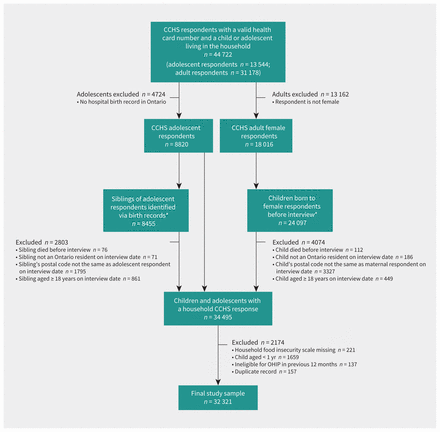
We analyzed data from a total sample of 32 321 children and adolescents, of whom 5216 (16.1%) were living in food-insecure households (1952 [6.0%] marginally food-insecure, 2348 [7.3%] moderately food-insecure, 916 [2.8%] severely food-insecure) (Figure 1). The sociodemographic characteristics of the sample, stratified by household food insecurity status, are presented in Table 1. Findings were consistent across the models (Appendix 1, Supplements 5–11), with some attenuation of effect with increasing levels of adjustment; therefore, our description of the findings focused on the partially adjusted models for consistency with models for which a fully adjusted estimate was not available.

Figure 1:

Flow chart showing the derivation of the study sample using data from 5 waves of the Canadian Community Health Survey (CCHS), linked to health administrative data. *Sample derived through record linkage. Note: OHIP = Ontario Health Insurance Plan.

Table 1:

Sociodemographic characteristics of the children and adolescents included in the study sample, stratified by household food insecurity status

In the year before the survey, 2918 (9.0%) children and adolescents had an outpatient physician visit for a mental or substance use disorder, and 194 (0.6%) children and adolescents had an acute care contact, with evidence of increasing prevalence with increasing severity of food insecurity (Table 2). Food-insecure children and adolescents constituted 23.5% and 24.7% of those with outpatient or acute care visits for mental or substance use disorders in the previous year, respectively. The most common service contacts were for neurodevelopmental disorders (prevalence 4.1%–9.5%) and mood or anxiety disorders (prevalence 3.2%–5.0%), followed by social problems (prevalence 1.1%–1.4%) and other mental disorders (prevalence 1.2%–2.0%). Service contacts for psychotic disorders, substance use disorders and deliberate self-harm were uncommon.

Table 2:

Frequency of outpatient visits, acute care visits (emergency department visits and hospital admissions) and visit diagnoses, by household food insecurity status among children and adolescents in Ontario, Canada

Children and adolescents from food-insecure households had a 55% higher prevalence of outpatient visits for mental or substance use disorders in the previous year, relative to those from food-secure households (prevalence ratio 1.55, 95% CI 1.41–1.70). Similarly, children and adolescents from food-insecure households had a 74% higher prevalence of acute care visits in the previous year, relative to those from food-secure households (prevalence ratio 1.74, 95% CI 1.24–2.45). The findings were consistent in our secondary analyses and showed an association between household food insecurity and visits for mental disorders (prevalence ratio 1.43, 95% CI 1.25–1.64), substance use disorders (prevalence ratio 2.26, 95% CI 1.18–4.33) and neurodevelopmental disorders (prevalence ratio 1.71, 95% CI 1.50–1.95) (Table 3 and Appendix 1, Supplements 5–9).

Table 3:

Association between any household food insecurity and use of health services for a mental or substance use disorder, relative to food-secure households, among children and adolescents in Ontario, Canada

The results of sensitivity analyses using household food insecurity status largely aligned with those of the main analyses (Table 4 and Appendix 1, Supplement 10). We found evidence of a gradient effect, with prevalence increasing with increasing severity of food insecurity (test for trend prevalence ratio 1.25, 95% CI 1.21–1.31). The age-stratified analysis showed slightly higher effect estimates for adolescents in high school (aged 14–17 yr; prevalence ratio 1.69, 95% CI 1.45–1.97), relative to children in preschool and elementary school (age 1–13 yr; prevalence ratio 1.48, 95% CI 1.32–1.66); however, the test for effect modification was not statistically significant (p = 0.06) (Appendix 1, Supplement 11).

Table 4:

Association between household food insecurity status and use of any health services for a mental or substance use disorder among children and adolescents in Ontario, Canada (sensitivity analysis)

Interpretation

Children and adolescents living in food-insecure households in Ontario had a higher prevalence of past-year health service contacts for mental or substance use disorders, and this was not fully accounted for by key confounding factors, such as low household income, single-parent family, number of children in the household or maternal mental or substance use disorders. 1,1719 We also found some evidence that contact with services for a mental or substance use disorder increased with increasing severity of household food insecurity.

Our findings align with previous evidence showing a higher prevalence of psychiatric symptoms and self-reported diagnoses, as well as poorer psychosocial functioning, among children and adolescents experiencing food insecurity in Canada.811 Our findings further suggest that these mental health outcomes are linked to increased health service use for mental and substance use disorders and contribute to higher health system costs.21 Adults experiencing food insecurity in Ontario also have higher health service use for mental and substance use disorders, as well as higher health system costs.22,23

The disproportionately higher use of health services for mental and substance use disorders among children and adolescents in food-insecure households was predominantly driven by visits for neurodevelopmental and mood and anxiety disorders. This is consistent with previous research showing that children and adolescents experiencing food insecurity are more likely to have symptoms of depression and anxiety, a worsening of ADHD symptoms and other behavioural issues.710,17,2426 Food insecurity has also been associated with suicidal ideation and attempts among adolescents,8,9,27 but we found no indication of a higher prevalence of acute care visits for self-harm, although these were uncommon in our sample. The coexistence of household food insecurity and service use for mental and substance use disorders is problematic, given that both of these conditions have each been found to have negative consequences for social, educational and developmental outcomes among children and adolescents.7,28

Children and adolescents from marginalized groups have been shown to have poorer access to mental health care;29 therefore, we have likely underestimated the magnitude of association between household food insecurity and health service use for mental and substance use disorders. Food insecurity is a marker for more widespread and pervasive material deprivation; 1 although it is plausible that household food insecurity may be a direct cause of mental and substance use disorders,30 it is likely to be a marker of risk for a myriad of interconnected socioeconomic factors that contribute to mental and substance use disorders among children and adolescents. Furthermore, mental and substance use disorders may be poorly managed for children and adolescents in food-insecure households, irrespective of the causal mechanism. Future research using complex modelling approaches could better estimate the relative contributions of these social determinants.

Limitations

Our findings are limited to Ontario and are not necessarily generalizable to First Nations groups and people living in remote areas, where food insecurity is particularly prevalent.1 Furthermore, the original survey sampling was not retained for the sample we analyzed and, therefore, survey weights could not be applied to ensure a representative sample (Appendix 1, Supplement 12 provides a comparison of our sample with the characteristics of Ontario households from the 2011 Census; we may have under-represented children from some racial minority groups, recent migrants and those from single-child families). The data used in this study are nearly a decade old, as this was the last available wave of CCHS data linked to the ICES data holdings. The most recent data on food insecurity in Canada suggest that the prevalence of household food insecurity has increased in the intervening years, particularly during the COVID-19 pandemic.31 Other provinces have a higher prevalence of food insecurity than Ontario.1 Assuming that the associations we observed have continued over time and are generalizable across provinces, we would expect more recent pan-Canadian data to show an even greater proportion of children and adolescents from food-insecure families seeking treatment for mental and substance use disorders.

Given the cross-sectional design of our study and the 12-month assessment of exposure and outcome variables, we are unable to establish the temporal relationship between household food insecurity, potential confounders and mental health and substance use problems among children and adolescents. It is possible that a child or adolescent’s mental or substance use disorder may contribute to household food insecurity (e.g., out-of-pocket costs for therapy or medication), although previous Canadian research found that people from food-insecure households are more often nonadherent to medication.32

Child and adolescent mental health services in Ontario are delivered across several sectors;16 missing information on use of mental health services outside of the public-payer health care sector — including community-based mental health programs or school-based psychologists, as well as private-payer services, which are likely used more frequently by food-secure children — may have affected our results. Because the study sample was derived from birth record linkages, father-only families are likely under-represented and information on paternal mental and substance use disorders is missing. Finally, information on the duration of household food insecurity was not available to allow us to explore the effects of cumulative exposure.

Conclusion

Our study adds to a growing body of evidence that suggests that household food insecurity is linked to adverse mental health outcomes among children and adolescents. Household food insecurity represents a modifiable marker of risk for mental and substance use disorders, with evidence of effective public policy interventions. Focused efforts to support food-insecure families should be explored as a target for public mental health efforts to improve child and adolescent mental health and reduce the strain on the mental health system.

Footnotes

  • Competing interests: Kelly Anderson reports funding from the Department of Psychiatry Seed Fund Competition, the Petro Canada Young Innovator Award and the Canadian Institutes of Health Research. Kristin Clemens reports honoraria from the CPD Network and the Canadian Medical and Surgical Knowledge Translation Research Group. No other competing interests were declared.

  • This article has been peer reviewed.

  • Contributors: Kelly Anderson, Kristin Clemens, Britney Le and Salimah Shariff contributed to conception and design of the study. All of the authors contributed to data analysis and interpretation. Kelly Anderson drafted the manuscript. All of the authors revised it critically for important intellectual content, gave final approval of the version to be published and agreed to be accountable for all aspects of the work.

  • Funding: This study received funding from the Children’s Health Research Institute (London, Ont.). Kelly Anderson is supported by a Tier 2 Canada Research Chair in Public Mental Health Research. The funders did not have a role in the research.

  • Data sharing: The data set from this study is held securely in coded form at ICES. While legal data sharing agreements between ICES and data providers (e.g., health care organizations and government) prohibit ICES from making the data set publicly available, access may be granted to those who meet pre-specified criteria for confidential access, available at www.ices.on.ca/DAS (email: dasatices.on.ca). The full data set creation plan and underlying analytic code are available from the authors upon request, understanding that the computer programs may rely upon coding templates or macros that are unique to ICES and are therefore either inaccessible or may require modification. The ICES analysts (Britney Le, Lixia Zhang) had full access to the study database.

  • Disclaimer: This study was supported by ICES, which is funded by an annual grant from the Ontario Ministry of Health (MOH) and the Ministry of Long-Term Care (MLTC). This study used data adapted from the Statistics Canada Postal Code Conversion File, which is based on data licensed from Canada Post Corporation and/or data adapted from the Ontario MOH Postal Code Conversion File, which contains data copied under license from Canada Post Corporation and Statistics Canada. Parts of this material are based on data and information compiled and provided by the Ontario MOH, the Canadian Institute of Health Information (CIHI) and Immigration, Refugee, and Citizenship Canada (IRCC). This study also used data adapted from Statistics Canada (Canadian Community Health Survey 2005, 2007–2008, 2009–2010, 2011–2012 and 2013–2014). This does not constitute an endorsement by Statistics Canada of this product. The analyses, conclusions, opinions and statements expressed herein are solely those of the authors and do not reflect those of the funding or data sources; no endorsement is intended or should be inferred.

This is an Open Access article distributed in accordance with the terms of the Creative Commons Attribution (CC BY-NC-ND 4.0) licence, which permits use, distribution and reproduction in any medium, provided that the original publication is properly cited, the use is noncommercial (i.e., research or educational use), and no modifications or adaptations are made. See: https://creativecommons.org/licenses/by-nc-nd/4.0/

Jill Biden leads initiative to boost women’s health research

0
Jill Biden leads initiative to boost women’s health research

WASHINGTON –


The Biden administration on Monday announced a White House initiative to improve how the U.S. federal government approaches and funds research into the health of women, who make up more than half of the U.S. population but remain understudied and underrepresented in health research.


That underrepresentation can lead to big gaps in research and potentially serious consequences for the health of women across the country, Biden administration officials and others told reporters during a White House conference call to announce the new effort.


The White House Initiative on Women’s Health Research will be led by first lady Jill Biden and the White House Gender Policy Council.


President Joe Biden said he’s long been a believer in the “power of research” to help save lives and get high-quality health care to the people who need it. Surrounded by the first lady and other officials who will have a role in the government-wide effort, Biden signed paperwork Monday in the Oval Office to direct federal departments and agencies to begin their work.


“To achieve scientific breakthroughs and strengthen our ability to prevent, detect and treat diseases, we have to be bold,” the president said in a written statement. He said the initiative will “drive innovation in women’s health and close research gaps.”


Jill Biden said during the conference call that she met earlier this year with former California first lady and women’s health advocate Maria Shriver, who “raised the need for an effort inside and outside government to close the research gaps in women’s health that have persisted far too long.”


“When I brought this issue to my husband, Joe, a few months ago, he listened. And then he took action,” the first lady said. “That is what he does.”


Jill Biden has worked on women’s health issues since the early 1990s, after several of her friends were diagnosed with breast cancer and she created a program in Delaware to teach high school girls about breast health care.


Shriver said she and other advocates of women’s health have spent decades asking for equity in research but that the Democratic president and first lady “understand that we cannot answer the question of how to treat women medically if we do not have the answers that only come from research.”


Shriver said women make up two-thirds of those afflicted with Alzheimer’s disease and multiple sclerosis, and represent more than three-fourths of those who are diagnosed with an auto-immune disease.


Women suffer from depression and anxiety at twice the levels of men, and women of color are two to three times more likely to die of pregnancy-related complications than white women, she said. Millions of other women grapple daily with the side effects of menopause.


“The bottom line is that we can’t treat or prevent them from becoming sick if we have not infested in funding the necessary research,” Shriver said on the call. “That changes today.”


Jennifer Klein, director of the White House Gender Policy Council, said the leaders of government departments and agencies important to women’s health research will participate, including those from the Departments of Health and Human Services, Veterans Affairs, Defence and the National Institutes of Health, among others.


Women’s health issues were raised by most of the women on the Senate health committee during its recent confirmation hearing on Dr. Monica Bertagnolli’s nomination to become permanent director of the National Institutes of Health, one of the world’s leading biomedical research agencies. Bertagnolli gave a broad answer in which she said far too little is known about women’s health through all stages of life.


Biden’s memorandum directs members to report back within 45 days with “concrete recommendations” to improve the prevention, diagnosis and treatment of women’s health issues. It also asks them to set “priority areas of focus,” such as research ranging from heart attacks in women to menopause, where additional investments could be “transformative.”


The president also wants collaboration with the scientific, private sector and philanthropic communities.


Carolyn Mazure will chair the research effort. Mazure joined the first lady’s office from the Yale School of Medicine, where she created its Women’s Health Research Center.


AP Medical Writer Lauran Neergaard contributed to this report.

How to Increase Hemoglobin: Diet, Self-Care, and Supplements

0
How to Increase Hemoglobin: Diet, Self-Care, and Supplements

Ways to increase hemoglobin levels can include consuming more iron or folate and getting regular physical activity. However, other factors, such as what other foods you include in your diet, may also have an effect.

An underlying condition, such as anemia, may cause low hemoglobin levels.

If your doctor has recommended increasing your hemoglobin levels, both medical treatments and lifestyle practices may help.

Read on to learn more about how to increase hemoglobin, including lifestyle and dietary approaches.

1132096589
The Good Brigade/Getty Images

Low hemoglobin can occur due to anemia, which is often

Trusted Source


American Cancer Society
Highly respected international organization
Go to source
caused by an iron deficiency. Iron is vital to hemoglobin production, so getting more iron

Trusted Source


National Institutes of Health Office of Dietary Supplements
Governmental authority
Go to source
through your diet may increase hemoglobin levels.

Read more about iron deficiency anemia.

The following steps may help increase your iron intake:

  • Include iron-rich foods: Aim to include foods rich in iron in your diet. These may include lean meats like beef, poultry, and fish. Plant-based sources include beans, lentils, tofu, spinach, broccoli, and fortified cereals.
  • Consider including heme iron sources: Your body can absorb heme iron, which is found in animal products, more easily

    Trusted Source


    PubMed Central
    Highly respected database from the National Institutes of Health
    Go to source
    than non-heme iron, which is found in plant-based foods.

  • Ask your doctor about iron supplements: Ask a doctor or registered dietitian about iron supplements, such as those that contain

    Trusted Source


    PubMed Central
    Highly respected database from the National Institutes of Health
    Go to source
    ferrous sulfate, ferrous gluconate, or ferrous fumarate. Supplements may help if food sources alone cannot increase your iron levels. A doctor can help you determine the best dosage for you, as getting too much iron can have side effects. 

Always talk with a doctor before making any significant changes to your diet or trying new supplements.

Learn more about iron-rich foods and how much of them you should eat.

Some nutrients and ingredients may increase

Trusted Source


National Institutes of Health Office of Dietary Supplements
Governmental authority
Go to source
the amount of iron your body absorbs from food. To improve iron absorption, consider the following approaches:

  • Pair iron with vitamin C: Try and eat sources of vitamin C alongside iron, such as citrus fruits, bell peppers, or strawberries.
  • Time supplements strategically: If you take iron supplements, try taking them at least 30 minutes before a meal and 2 hours before taking other medications or with vitamin C-rich foods, experts

    Trusted Source


    PubMed Central
    Highly respected database from the National Institutes of Health
    Go to source
    recommend.

  • Cook with iron-boosting herbs: Certain herbs, such as cilantro and parsley, may enhance

    Trusted Source


    PubMed Central
    Highly respected database from the National Institutes of Health
    Go to source
    iron absorption.

See more about vitamin C sources and how much vitamin C you should get.

Iron blockers, or iron absorption inhibitors, are substances that can reduce how much iron your body absorbs during digestion. 

Many iron blockers contain essential nutrients, though. Instead of cutting them from your diet completely, try to eat them with vitamin C and non-heme iron foods. Research from 2023

Trusted Source


PubMed Central
Highly respected database from the National Institutes of Health
Go to source
suggests that consuming vitamin C and non-heme iron sources together may help overcome the effects of iron blockers.

You can also talk with a doctor or registered dietitian for tailored advice or a diet plan.

Examples of iron blockers include:

  • phytates, found in foods like whole grains, legumes, nuts, and seeds
  • alcohol
  • calcium, found in dairy products
  • polyphenols, found

    Trusted Source


    PubMed Central
    Highly respected database from the National Institutes of Health
    Go to source
    in foods like tea and coffee, red wine, some vegetables, and red fruits

  • fiber
  • tannins

    Trusted Source


    PubMed Central
    Highly respected database from the National Institutes of Health
    Go to source
    , found in foods like legumes, tea and coffee, and leafy green vegetables

A deficiency in folate, or vitamin B9, can also lead to anemia and low hemoglobin levels. You can consume more folate through dietary adjustments and supplements. 

Foods rich in folate can include

Trusted Source


National Institutes of Health Office of Dietary Supplements
Governmental authority
Go to source
:

  • cruciferous vegetables, such as broccoli or asparagus
  • avocados
  • dark leafy greens, such as kale and spinach
  • legumes, such as beans and chickpeas
  • citrus fruits
  • whole grains, like brown rice, quinoa, and whole wheat products
  • foods fortified

    Trusted Source


    Food and Drug Administration (FDA)
    Governmental authority
    Go to source
    with folate, such as some cereals, breads, and grains

Steaming or microwaving vegetables instead of boiling them may help them retain more folate.

You can also discuss folate supplements with a doctor.

Learn more about low folate, folate consumption recommendations, and treatments.

Regular activity, such as jogging, may help improve hemoglobin levels. Research from 2020 suggests this may be because physical activity can increase the need for oxygen in the cells.

Exercise may also stimulate the production of red blood cells, which contain hemoglobin, so it can increase overall hemoglobin levels in your body. 

A 2019 study suggests that the body may absorb iron better after morning exercise.

Symptoms of low hemoglobin

Symptoms of low hemoglobin, or anemia, include:

If you experience any of these symptoms, contact a doctor for diagnosis.

Learn more about anemia, including its types, causes, and treatment options.

Sometimes, self-care methods, diet, and supplements might not be enough to treat low hemoglobin on their own. Also, some approaches can lead to side effects.

Always talk with a doctor before self-treating a condition and make sure to follow their recommended treatment advice.

For the best outcome, remember to attend any follow-up appointments and blood tests, and talk with a doctor if you notice any new or changing symptoms.

Ways to increase hemoglobin levels include increasing how much iron and folate you get through diet or supplements, as well as getting regular physical activity. These factors may help your body produce more hemoglobin.

Iron and folate-rich foods include meat, seafood, legumes, and leafy green vegetables. Vitamin C, which can be found in citrus fruits and bell peppers, may also help improve iron absorption.

However, always talk with a doctor before making significant changes to your diet or trying new supplements.

If you’re concerned about your hemoglobin levels or underlying health, also consider talking with a doctor for tailored advice.

30 At-Home Resistance Band Exercises and Workouts for 2023

0
30 At-Home Resistance Band Exercises and Workouts for 2023

BUILDING STRENGTH AND MUSCLE isn’t always about lifting the heaviest weights in the gym. You build size and strength when you put your muscles under tension. Creating that tension doesn’t have to mean fully-loaded up barbells and dumbbells the size of your head. Resistance bands will challenge your muscles in different and useful ways—if you know what you’re doing.

You may have bought a few resistance bands at some point to perk up your at-home workouts. You might’ve used them a couple times, accompanying them to your YouTube-led sweat sessions in your living room. When you’re just using these tools in a pinch, you might not be able to appreciate the benefits of resistance bands if there are barbells, dumbbells, and other weights available.

We don’t blame you for wanting to pump some iron. But, you are missing out on a load of benefits that incorporating resistance bands into your training brings. Their advantages goes beyond their affordability and storable qualities that make them great companions to your home gym and on-the-go workouts. They’re also incredibly versatile. There’s a resistance band exercise to accompany any leg day, chest day, or arm day you may have programmed. Work them into your warmups, finishers, or as mainstay exercises in your strength training routines to better your movement patterns and achieve the gains you’ve been looking for—in the gym, or at home.

Here’s your resistance band primer, for training at home and anywhere else.

Why Resistance Bands Work

J. Ivan Rodrguez Pacheco / EyeEm//Getty Images

Even if you have dumbbells and kettlebells at home for doing basic movements, having a resistance band around can bring serious value to your workouts.

Why? Two words: Accommodating resistance. Essentially, the farther you pull a resistance band, the more it “resists” you. That’s a different type of resistance than, say, a dumbbell.

Take a biceps curl. Curl the dumbbell upwards, and there comes a point where the curl actually gets “easy” for your biceps, near the top of the motion. The length of the lever that challenges your biceps decreases as you finish the exercise, meaning gravity can no longer create challenge with the dumbbell (and your muscle no longer needs to create as much force to fight that challenge).

Do the same curl with a resistance band and as you near the top, it doesn’t get easier; instead, you have to work to earn the squeeze at the top of the curl. The stretched band is fighting you more, forcing you to accelerate through the entire range of motion and challenging your muscle fibers in a different way. You’ll have to squeeze your muscles extra-hard to fight banded resistance, a habit that will improve your dumbbell training, too.

Does that make bands better than dumbbells? No. But both tools can have a place in your training, and in the grand workout scheme, both tools can complement each other. One tool (hint: not the dumbbell), however, is so tiny that you can easily fit it in your backpack for any and every road trip.

The Best Ways to Use Bands

That all makes resistance bands a quality option for any workout. But in much the same way you might mix barbells, dumbbells, and cables at the gym, you ideally want to mix up your training with resistance bands too. Try these approaches with bands (and know that there are many more too).

Full Workout

Yes, you can use resistance bands for an entire full-body workout; they’ll challenge and push your body. Depending on the size of your resistance band, you might not be able to go incredibly heavy on some of the motions where you’ll want more challenge, such as deadlifts and squats, so if you’re doing a bands-only full-body session, consider doing this as a circuit. Aim for one pull move (a row or pulldown or curl), one push move (a pushup, overhead press, or triceps pressdown-style motion) and one leg move (squat, deadlift, or lunge) in every full-body session.

Finishers

If you have access to dumbbells and barbells, or if you’re advanced enough with your bodyweight to create unilateral challenges (think: pistol squats and post pushups), consider using bands near the end of your workout. They’re a great way to promote an active and aggressive chest squeeze on a pushup.

Drop Sets

One great way to use bands at home is to use them in drop sets. A drop set has you starting with a heavier weight (or a more challenging version of a move), then “dropping” into a lighter weight or more basic version of an exercise. Because you’re fatigued from the initial work you put in on the harder move, the easier move feels, well, harder. Try it with squats. Do 10 resistance band squats, holding the band under your feet and with your hands at your shoulders. Immediately release the band and do 10 standard squats. Do 3 sets. Enjoy the burn.

The Resistance Band Exercises

Mix-and-match these moves to create resistance band workouts that you can do anytime, anywhere. And when in doubt, remember to think full-body (one pull move, one push move, one leg move).

Pallof Press

preview for Pallof Press | Form Check

Why: You’ll rock your abs in this classic abdominal exercise. The Pallof press takes advantage of banded resistance to challenge your core against all rotation.

How to Do It:

  • Attach a resistance band to an anchor at a height to which you can grab it with both hands in a tall kneeling position.
  • Kneel far enough away from the anchor so that there is some tension in the band. Grasp the band with both hands in front of your chest. Squeeze your glutes and core to create tension in your body.
  • Look straight ahead and tighten up your shoulder blades. Extend your arms away from your torso. Fight the pull of the cable or band by keeping your glutes and core tight. Hold for a second before returning back to the starting position.

Triceps Pressdown Countdown Series

preview for Eb&Swole: Countup-Countdown Triceps Blast

Why: This move from fitness director Ebenezer Samuel, C.S.C.S. is all about isolating your triceps, reinforcing the idea that even when your arms are straight, your triceps must be working.

How to Do It:

  • Tie a long resistance band up to a high anchor point. Kneel underneath it. Grab onto the band with both hands. Pull to where both arms are straight.
  • Bend at the elbow on one side, and push back down. Ensure that the upper portion of the arm stays locked in place, and there’s no movement through the shoulder. The other arm should remain straight as you do this.
  • Then, hinge slightly at the hips and press the band perpendicular to your chest. Do the same, bending at the elbow so that you drop your hand up and back towards your face. The other arm should remain straight.

Rotator Cuff Shoulder Warmup

preview for Rotator Cuff and Shoulder Warmup

Why: Attack the small, supporting musculature within your shoulders, bulletproofing your upper body for bench presses and pullups alike with this series of moves.

How to Do It:

External Rotation:

  • Anchor the resistance band to where it is in line with your waist. Walk a few steps away from the anchor point—the further you go, the more resistance you’ll have.
  • Grab onto the band with the outside hand, and bend your elbow at 90 degrees. Lock it into your side.
  • Move your forearm so that it pulls away from the midline of your body. Do 30 reps on each side.

Internal Rotation:

  • Anchor the resistance band to where it is in line with your waist. Walk a few steps away from the anchor point—the further you go, the more resistance you’ll have.
  • Turn and grab the band so the resistance faces the other direction from the external rotation.
  • Grab onto the band with the outside hand, and bend your elbow at 90 degrees. Lock it into your side.
  • Move your forearm so that it pulls in towards the midline of your body.
  • Do 30 reps on each side.

Low Lat Pull:

  • Wrap the band around an anchor point to where it’s in line with your hips. Grab onto both sides of the band.
  • Maintaining a slight bend in the elbow, pull the band back towards your hips.
  • Do 30 reps.

Band Pull Aparts:

  • Hold the band with both hands in front of you at shoulder height.
  • Squeeze the shoulder blades to pull your hands apart, bringing them in line with your body. Stop where your hands are by your shoulders.
  • Do 30 reps.

Archer Row:

  • Hold the band and extend one arm out to the side a little higher than shoulder height.
  • Using the opposite arm, pull by bending the elbow out to the side and back. Think about pulling the shoulder blade back while doing so.
  • Do 30 reps.

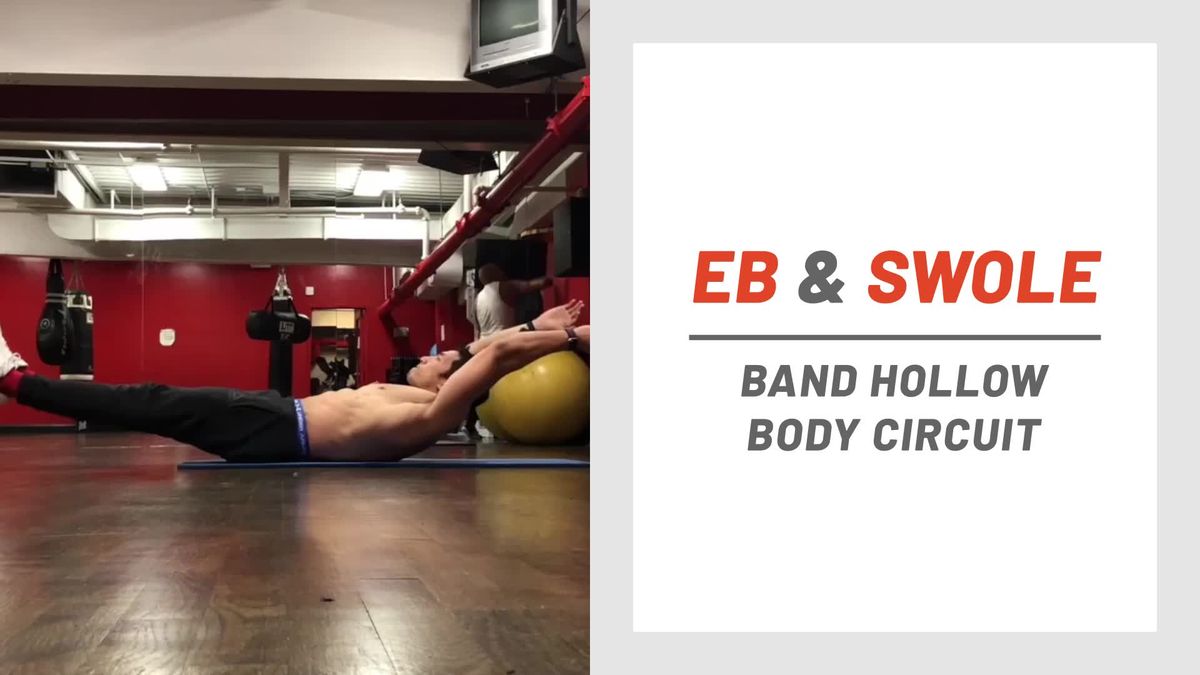
Hollow Hold Banded Core Series

preview for Eb & Swole: Band Hollow Body Circuit

Why: This one is all about abs, fighting against both anti-rotation and anti-extension (can you keep your core contracted no matter how the band pulls you?). It looks easy. It’s not though.

How to Do It:

  • Anchor the band low to the ground.
  • Start in a hollow hold position: lay on your back and squeeze your abs to lift up your legs slightly off the ground and reach your hands backwards. Squeeze tight so that your low back doesn’t come up off the ground.
  • Grab the band with one hand. Do 8 reps of straight arm pull downs: pulling the band all the way down to your hip while maintaining a straight arm.
  • After those 8, pull the band and hold to where the arm is perpendicular with your torso. Hold for 8 seconds.
  • Add in some flutter kicks for 8 reps, lifting and lowering your legs only a few inches while maintaining that hollow body position.
  • Do 3 sets per side.

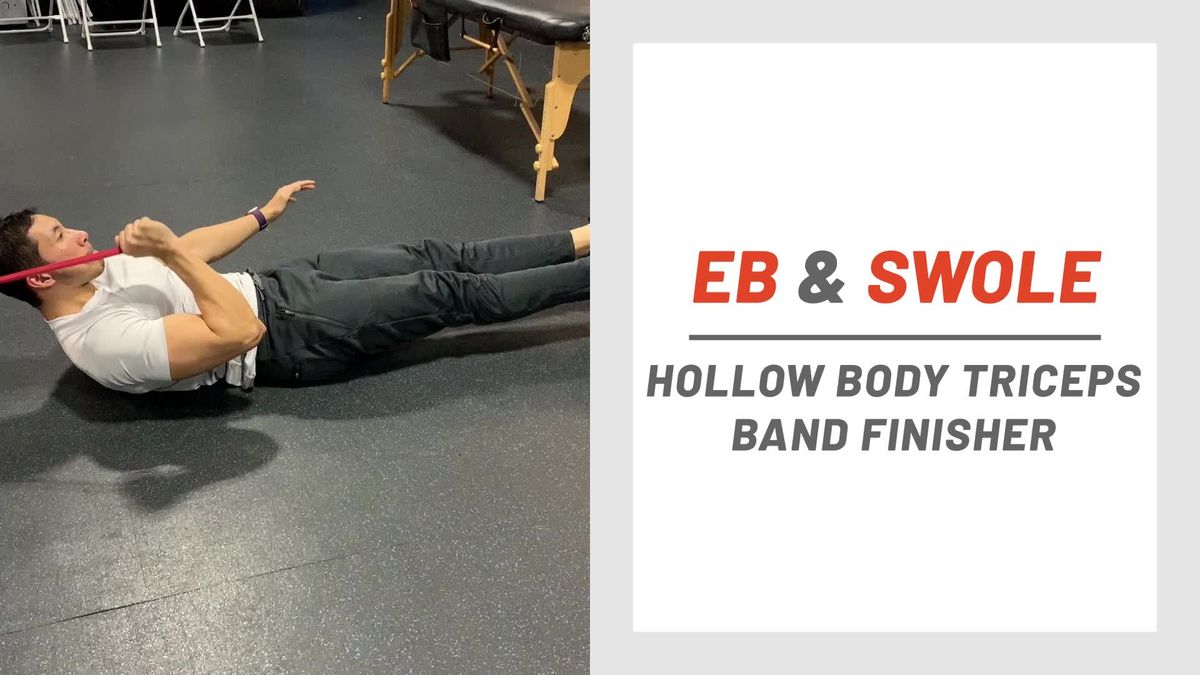
Hollow Hold Triceps Series

preview for Eb & Swole: Hollow Body Triceps Band Finisher

Why: You’ll train your triceps and get valuable ab work here.

How to Do It:

  • Anchor the band low to the ground.
  • Start in a hollow hold position: lay on your back and squeeze your abs to lift up your legs and arms slightly off the ground, keeping your arm parallel with the ground. Squeeze tight so that your low back doesn’t come up off the ground.
  • Grab the band with one hand. Do 8 tricep extensions, bending and straightening at the elbow to pull the band down towards your waist. Keep your upper arm parallel to the ground.
  • After those 8 reps, shift your upper arm to perpendicular to the ground. Squeeze the tricep and straighten the elbow to point the arm towards the ceiling. Do 8 reps here.
  • Do 3 sets per side.

Copenhagen Plank Mini Band Challenge

preview for Eb and Swole: Copenhagen Miniband Plank Challenge

Why: Copenhagen planks are difficult enough to begin with—add in a mini band, and you have a whole other challenge.

How to Do It:

  • Place a mini band around your feet. Start in the Copenhagen plank position by planting your top foot on a bench or raised surface. The closer you put your knee to the bench, the less difficult this will be.
  • Place your forearm perpendicular to your torso on the ground. Think about squeezing both shoulder blades and glutes to raise your hips to create a straight line from your shoulders to your foot.
  • From here, drive your bottom knee forward against the resistance of the band.
  • Do 6 reps. On the last rep, hold the top position for 6 seconds. Do 3 sets on both sides.

Half-Iso Kneeling Straight-Arm Pulldown

preview for Eb & Swole: Half-iso Straight Arm Kneeling Pulldown

Why: This one will light up your back, and there’s a lot more ab challenge in it than you may expect at first.

How to Do It:

  • Tie a long resistance band up to a high anchor point. Kneel underneath it, with your glutes squeezed and abs engaged. Grab onto the band with both hands, and pull to where both arms are straight.
  • One arm at a time, bring your arm up diagonally towards your head. On the way down, pull the band down and apart.
  • Do 3 sets of 10 to 12 reps.

Hollow Hold Fly to Banded Pushup Finisher

preview for Eb & Swole: Pushup to Hollow Body Hellset

Why: We label this a finisher, but it can easily be a main element in any chest workout too. You’ll roll around on the floor and build muscle too!

How to Do It:

  • Loop the resistance band through your thumbs and around your back. Start in a high plank position, with your shoulders directly over top of your wrists and your heels over your toes. Squeeze the abs and glutes to maintain a flat back.
  • Punch out 10 reps of pushups through the resistance of the band. After those 10 reps, keep the band in place and roll over onto your back.
  • Pull your shoulder blades about an inch off the ground, and pull your legs off the ground too. Squeeze your abs to press the lower back into the ground.
  • Straighten the arms above your chest. With a slight bend in the elbow, lower down and squeeze back up to do a banded chest fly. Do 10 reps.
  • Alternate the two movements, pyramiding your way down to zero reps.

Chaos Band L-Sit Chinup

preview for Eb & Swole: Chaos Band L-Sit Chinup

Why: This one isn’t for the faint of heart, and it’s certainly not easy. It will force you to remove any kipping or rocking from your chin up. Build up to it—if you dare.

How to Do It:

  • Set up your chaos band overhead.
  • Grab on, and pull your legs up to where you create a 90 degree bend through the hips. Maintain this position.
  • Pull your elbows back and down to bring your chin up to the band. Squeeze the abs and core tight, aiming not to move any other part of the body.
  • If the leg hold feels too difficult, tuck your knees back towards your chest. You’ll still be working your abs, with less pull of gravity.
  • Do 3 sets of 4 to 6 reps.

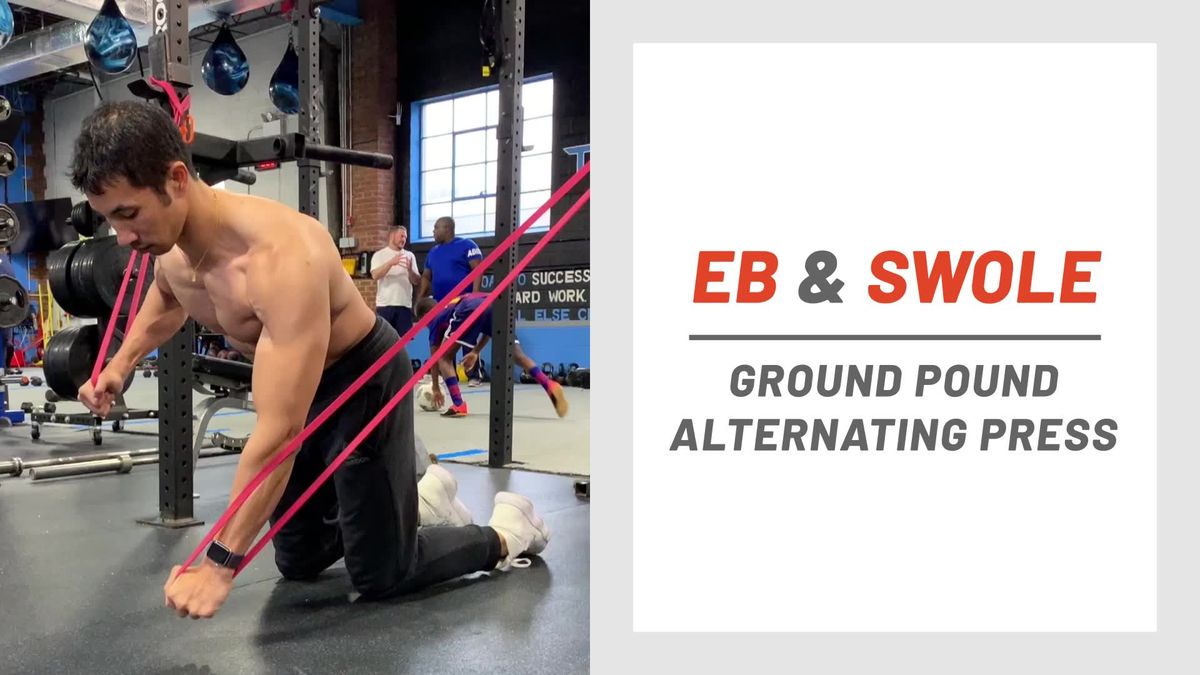
Ground-Pound Alternating Press

preview for Eb & Swole: Ground Pound Alternating Press

Why: This one will build your chest and challenge your core simultaneously. And yes it’s fun to punch the ground.

How to Do It:

  • Attach two bands to an anchor point about waist high on either side of a rack.
  • Start in a tall kneeling position and wrap your hands into each band. Hinge through the hips maintaining a flat back by keeping the abs locked in.
  • From there, drive one arm to the ground. Hold that position while you drive the other arm to the ground. Slowly bring one arm back at a time.
  • Do 3 sets of 8 to 10.

Crucifix Arm Finisher

preview for Eb & Swole: Crucifix Flex Finisher

Why: One resistance band, one structure, plenty of biceps and triceps pump fun.

How to Do It:

  • Anchor your band around hip height.
  • Start in a tall kneeling position. Grab the band with the side closest to the anchor point.
  • Extend that arm out to the side to where the elbow is in line with the shoulder. Curl the band towards your face, not to move the upper arm. Do 10 reps.
  • Flip around and remain in the tall kneeling position. Grab the band with the same hand, with it around your head.
  • Keep the hips and shoulders square forward. Extend the arm out to the side for a tricep extension, without allowing the upper arm to move. Do 10 reps.
  • Alternate the two movements, pyramiding your way down to zero.

Half-Kneeling Archer Row

preview for Eb & Swole: Half-Kneeling Archer Row

Why: Bulletproof your shoulders and build mid-back strength (and more ab strength than you think too) with this one.

How to Do It:

  • Set up in a half kneeling position with one knee propped up.
  • Hold the band and extend the arm on the same side as the propped knee out to the side a little higher than shoulder level.
  • Using the opposite arm, pull by bending the elbow out to the side and back. Think about pulling the shoulder blade back while doing so.

Partner Hollow Body Pallof Game

preview for Eb & Swole: Partner Hollow Body Band Raise

Why: Grab a partner and inject some fun (and serious anti-rotational challenge too!) into your workout with this finishing ab game.

How to Do It:

  • Set up with your partner shoulder to shoulder facing opposite directions.
  • Both of you will get into a hollow body hold position: lay on your back and squeeze your abs to lift up your legs slightly off the ground. Squeeze tight so that your low back doesn’t come up off the floor. Hold on to either end of the resistance bands.
  • Press the band up towards the ceiling at any point between your chest and over your head. You and your partner will choose random spots between this point so the pull to your partner is different every time.
  • Once you press out, do 3 seconds of flutter kicks in that position before returning back to the beginning.
  • Do 2 sets per side.

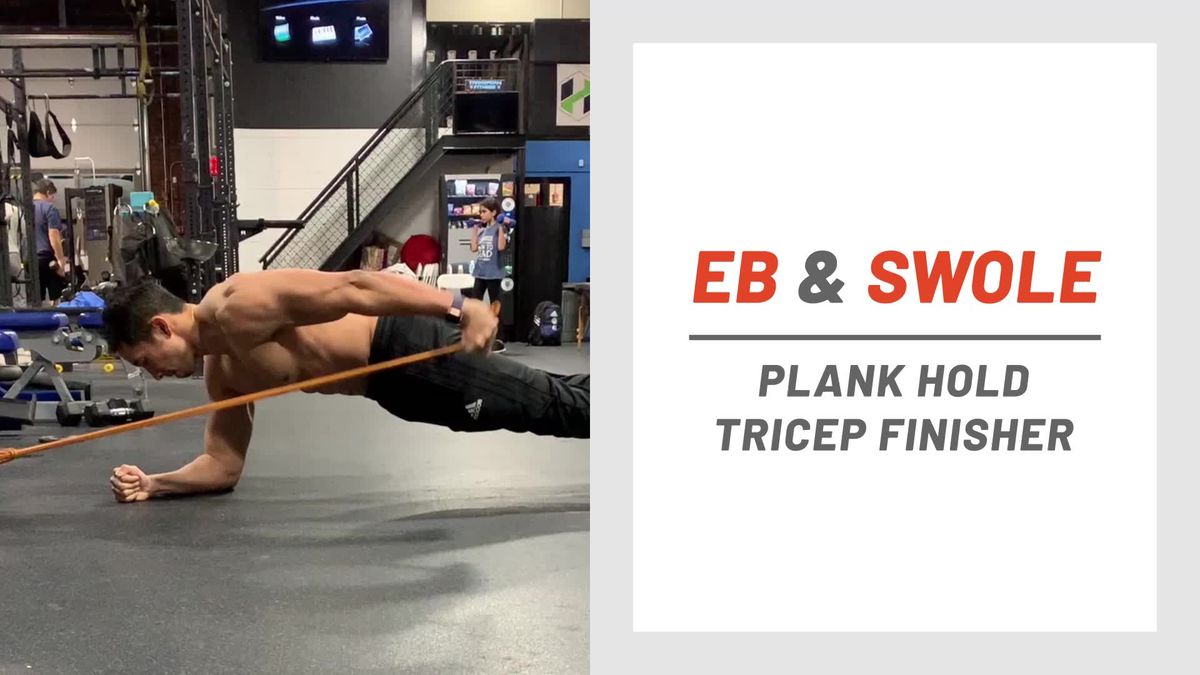
Plank Triceps Kickback

preview for Eb & Swole: Plank Hold Triceps Finisher

Why: Yes, with bands, you can grow your arms and sculpt your abs all at once! You’ll do that here.

How to Do It:

  • Anchor your band at a low height.
  • Set up in a low plank position. Stack your elbows directly beneath your shoulders and extend your legs. Rest your weight on your elbows and your toes.
  • Squeeze your glutes and core to create full-body tension. Think about pulling your belly button into your spine. Your back should form a straight line; don’t let your pelvis dip down or your butt to rise up.
  • Grab the band with one hand. Pull down to where your upper arm is in line with your torso. Bend and straighten at the elbow for a tricep extension. Don’t move your upper arm.

Chest Fly Finisher

preview for Eb & Swole: Chest Fly Finisher

Why: Find two posts and get ready to blow up your chest with this move, which is all about squeezing through the middle of your chest.

How to Do It:

  • Anchor your bands a bit higher than hip height.
  • Start in the kneeling position. Grab one band in each hand.
  • With a slight bend in the elbow, pull both bands together in front of your chest. Maintain that contraction with one arm while doing another rep with the opposite arm.
  • Do 3 sets of 8 to 10 reps.

Face Pull

preview for Resistance Band Face Pull

Why: The face pull, when done correctly, will light up your back and bulletproof your shoulders. Fun fact: It’s best with bands.

How to Do It:

  • Anchor your band at face height.
  • Grab the band with both hands. Pull the band back towards your face, keeping the elbow in line with the shoulder, coming into a goal post position with your arms.
  • Squeeze the shoulder blades together as you pull. Hold for count before releasing.

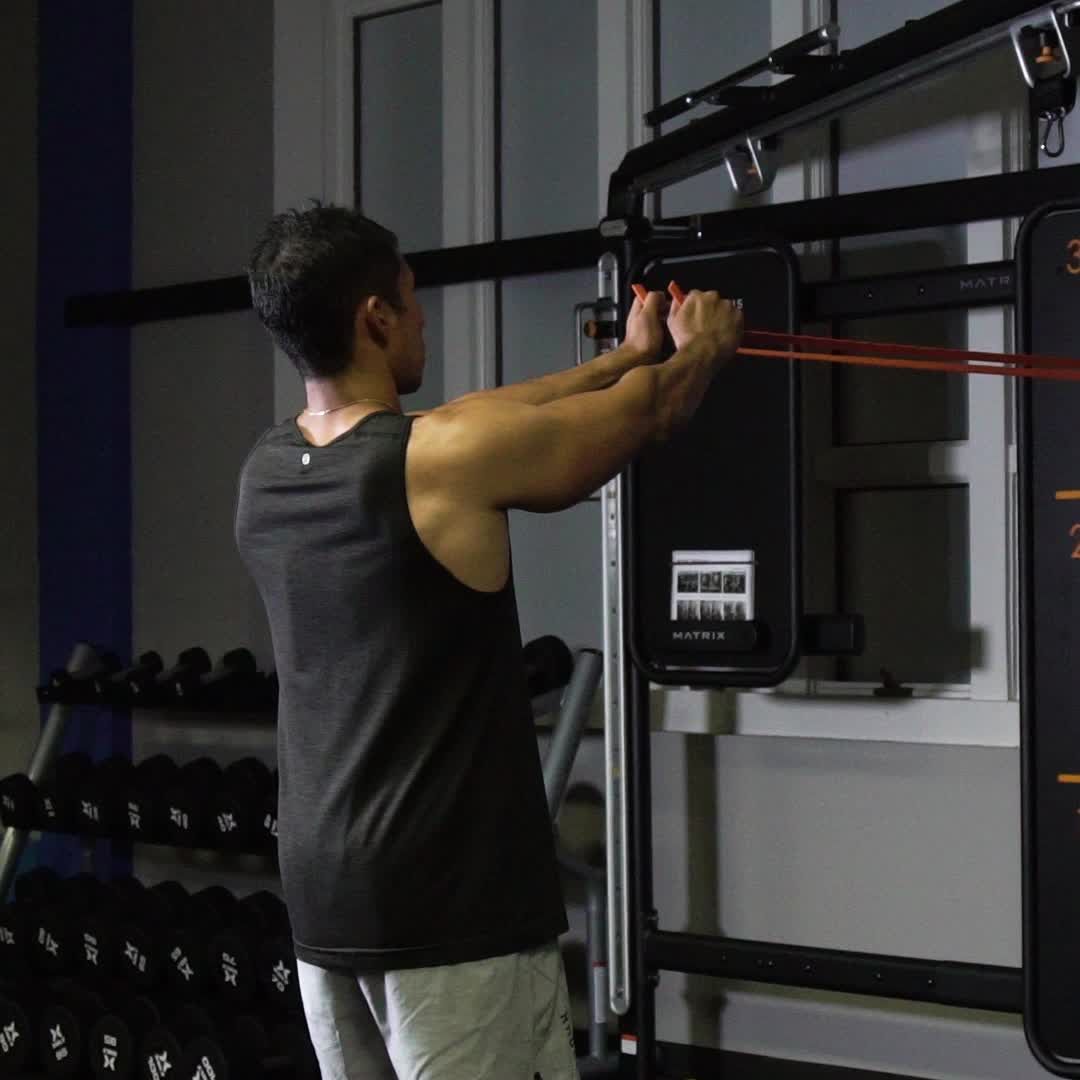
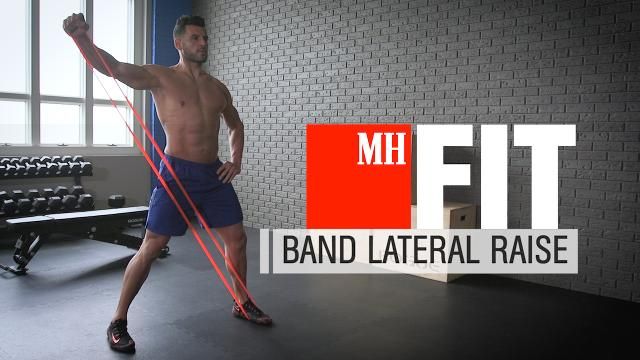
Resistance Band Lateral Raise

preview for Band Lateral Raise

Why: Add depth to your shoulders with this simple resistance band move.

How to Do It:

  • Anchor the band by looping it through one foot. Grab onto the band with the opposite arm.
  • Raise the arm up to shoulder level while maintaining a slight bend through the elbow.
  • Hold for a count at the top. Slowly lower back to the starting position.
  • Do 15 to 20 reps.

Resistance Band Athleticism Moves

preview for 5 Moves You Can Do With a Band and a Bar

Why: Build speed and athleticism with these moves from trainer Gerren Lilles.

How to Do It:

Banded Side Shuffles:

  • Anchor the band at hip height. Step into the band and place it across your hips.
  • Shuffle out to the side against the resistance of the band, not crossing the feet.
  • Stay low in the legs. Control the return back to the anchor point.

Banded Running in Place:

  • Anchor the band at hip height. Step into the band and place it across your hips.
  • Run against the resistance of the band, pushing off and landing on the toes.

Banded Anti-Rotation Hold:

  • Anchor the band at hip height. Grab onto the band.
  • Stand far enough away from the anchor so that there is some tension in the band. Grasp the band with both hands in front of your chest. Squeeze your glutes and core to create tension in your body.
  • Look straight ahead and tighten up your shoulder blades. Extend your arms away from your torso. Fight the pull of the cable or band by keeping your glutes and core tight. Hold here.

Banded Row:

  • Anchor the band at hip height. Grab onto the band with one hand.
  • Set the feet up in a staggered stance, with one foot in front of the other. Square up to the anchor point.
  • Pull the elbow down and back, contracting the shoulder blade as you pull.
  • Hold here for a second before releasing.

Banded Pushup with Feet to Hands:

  • Anchor the band low to the ground. Step your feet inside so that it is resting over the top of your feet.
  • Start in a high plank position, with your shoulders directly over top of your wrists and your heels over your toes. Squeeze the abs and glutes to maintain a flat back. Drop your chest to the floor for one pushup.
  • Upon return, jump your feet into your hands against the resistance of the band by bending at the knee and hip.

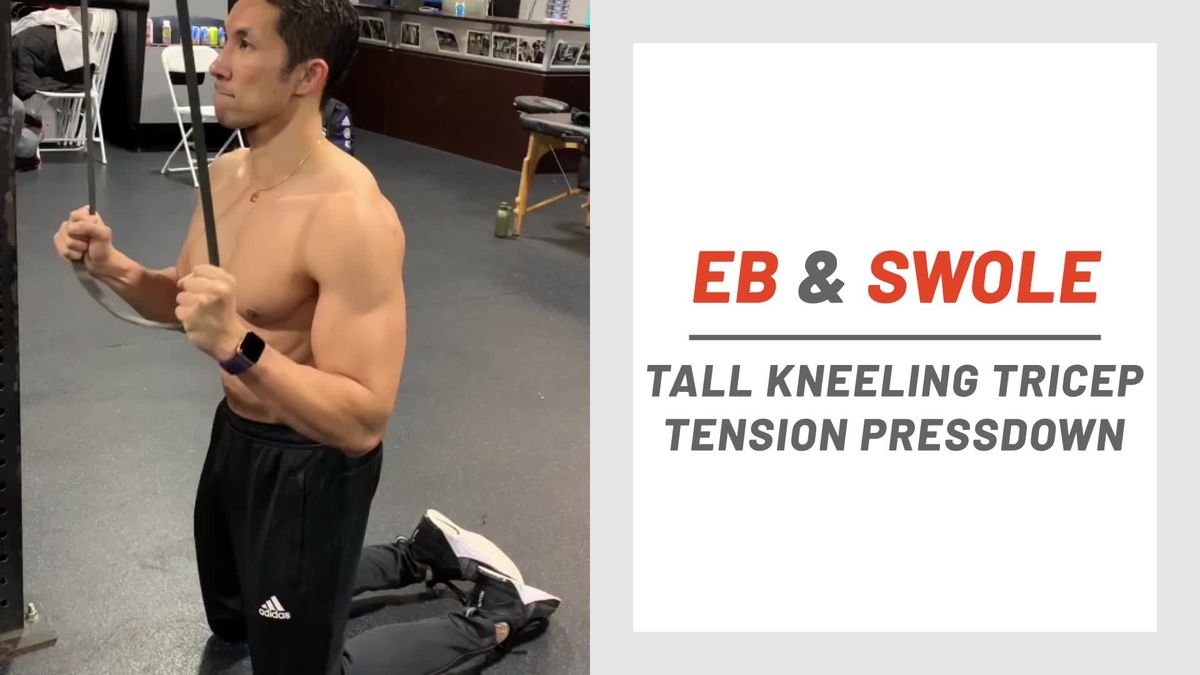
Banded Triceps Pressdown Series

preview for EB & Swole: Tall Kneeling Tricep Tension Pressdown

Why: Another move that’ll push your triceps to the limit, forcing you to own the straight-arm position.

How to Do It:

  • Tie a long resistance band up to a high anchor point. Kneel underneath it, with your glutes squeezed and abs engaged. Grab onto the band with both hands, and pull to where both arms are straight.
  • Keep the upper arm tight into the body and straighten at the elbow by squeezing the triceps.
  • Once your forearm gets a little lower than elbow height, hold for a few seconds. Then, continue pressing down to finish the rep.

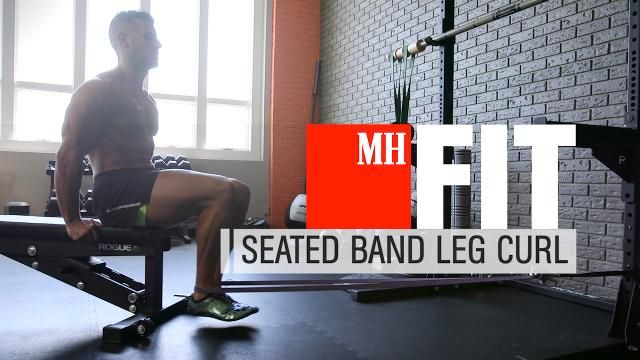
Banded Leg Curl

preview for Seated Band Leg Curl

Why: This move adds hamstring size and strength. And you don’t need a lot of room to do it, either.

How to Do It:

  • Anchor your band around halfway up shin height. Lace your feet inside to where the band is resting on your Achilles.
  • Sit on a bench some distance away from the anchor point. The further away you are, the more resistance you’ll get on the exercise.
  • Start with your legs straightened in front of you. Curl your heels down and under, pulling them towards your bottom. Hold for a second before releasing.

Banded Row to Curl

Why: The row is one of the key movements to build your back. To increase your strength, you’ll also need bicep strength. This move works both.

How to Do It:

  • Start in a seated position, legs straight, band wrapped around your feet, core tight. Arms should hold the ends of the resistance band.
  • Relax your shoulders. Squeeze your shoulder blades.
  • Pull the band back toward your ribcage, focusing on pulling from the elbows. Return to the start.
  • Immediately tighten your core, rotate your palms so they face skyward. Without moving your elbows above your shoulders, curl the bands toward your torso, squeeze when you get near the top. Do 1 rep.
  • Return to rowing position. Do 2 row reps, followed by 2 curl reps.
  • Repeat the pattern until you’ve done 5 row reps and 5 curl reps.
  • Do 3 sets.

Resistance Band Preacher Curls

preview for Eb and Swole: Seated Row-to-Curl Series

Why: If you’re looking for exercises to help to build bigger arms, look no further than the preacher curl. This variation uses only a resistance band, so you can do it anywhere.

How to Do It:

  • Start seated on the ground, legs straight, core tight. Loop the resistance band around your feet. Grab a handle with each hand and curl up, raising your upper arms so elbows are slightly below shoulders. Don’t let your elbows shift up and down.
  • Squeeze one biceps hard, while doing a curl rep on the other side. Repeat on the other side. Focus on taking your time during each curl rep.
  • Do 3 sets of 10 to 12.

Headshot of Ebenezer Samuel,  C.S.C.S.

Ebenezer Samuel, C.S.C.S., is the fitness director of Men’s Health and a certified trainer with more than 10 years of training experience. He’s logged training time with NFL athletes and track athletes and his current training regimen includes weight training, HIIT conditioning, and yoga. Before joining Men’s Health in 2017, he served as a sports columnist and tech columnist for the New York Daily News.  

Headshot of Brett Williams, NASM

Brett Williams, a senior editor at Men’s Health, is a NASM-CPT certified trainer and former pro football player and tech reporter. You can find his work elsewhere at Mashable, Thrillist, and other outlets.

Genetic embryo testing; Orilissa reduces menstrual bleeding

0
Genetic embryo testing; Orilissa reduces menstrual bleeding

November 16, 2023

1 min read


We were unable to process your request. Please try again later. If you continue to have this issue please contact [email protected].

Experts have the ability to genetically screen embryos for a variety of diseases, but questions remain about which diseases should be screened, according to Sigal Klipstein, MD.

“Should you test only for life-limiting diseases that lead to death in childhood?” she asked “Should you test for diseases that can decrease life expectancy? Should you test for diseases that don’t develop until later in life? And what about predispositions for diseases like breast cancer?”


Experts have the ability to genetically screen embryos for a variety of diseases, but questions remain about which diseases should be screened, according to Sigal Klipstein, MD.

Healio spoke with Klipstein about these ethical questions and what the future of reproductive endocrinology and infertility might hold. It was the top story in women’s health last week.

The second top story was about a study that showed premenopausal women who received one-daily Orilissa (elagolix, AbbVie) experienced a reduction in heavy menstrual bleeding.

Read these and more top stories in women’s health below:

Ethical dilemmas in genetic embryo testing: A discussion with Sigal Klipstein, MD

As a child, Klipstein would visit the Museum of Science and Industry in Chicago with her parents and be intrigued by the developing human exhibit, where she saw the progression of embryos to fetuses. Read more.

Once-daily elagolix significantly reduces heavy menstrual bleeding for premenopausal women

Elagolix 150 mg once daily significantly reduced heavy menstrual bleeding from uterine leiomyomas among premenopausal women, according to trial results published in Obstetrics & Gynecology. Read more.

Exposure to nitrogen dioxide, particulate matter increases miscarriage risk

Exposure to air pollution around the time of conception was linked to an increased risk for miscarriage compared with less exposure, according to study results presented at the ASRM Scientific Congress & Expo. Read more.

Early induced abortion not a risk factor for Rh sensitization

Induced abortion during the first trimester did not increase risk for Rh sensitization, which suggests that Rh testing and treatment in pregnancy is unnecessary before 12 weeks gestation, researchers reported in JAMA. Read more.

First-trimester cesarean scar pregnancy manageable with some surgical, medical treatments

Cesarean scar pregnancy in the first trimester can be effectively managed through suction evacuation, balloon treatment or surgical excision, researchers reported in the American Journal of Obstetrics and Gynecology. Read more.

‘I was overeating’: the Zoe nutrition app founders on diet, raising millions and the perfect microbiome | Food & drink i…

0
‘I was overeating’: the Zoe nutrition app founders on diet, raising millions and the perfect microbiome | Food & drink i…

Tim Spector, professor of genetics and co-founder of the Zoe personal nutrition company, is recovering from a mild illness when the Observer meets him and the firm’s other founders.

“People expect Tim to have the immune system of perfection,” jokes co-founder and chief executive Jonathan Wolf, “but even he, with his almost perfect microbiome, occasionally gets sick.”

Since its launch in April 2022, more than 130,000 people have signed up to Zoe’s personalised nutrition programme, which aims to improve gut and metabolic health. Spector is a familiar figure on TV and radio, and through his books The Diet Myth and Spoon-Fed.

Zoe customers can be spotted by the circular yellow arm patch that means they are wearing a blood sugar sensor. Carrie Johnson, wife of former prime minister Boris Johnson, recently revealed on Instagram that she had signed up. Television presenter Davina McCall is one of its biggest advocates.

Zoe (“life” in Greek), gives personalised advice via an app on what users should eat, based on the results of gut health and blood fat tests and 14 days of blood sugar monitoring, all done at home and sent off to a lab.

Spector does not believe in miracle diets. But he has faith in the microbiome – the trillions of bacteria, viruses and fungi living in our gut – which as well as digesting food also play a vital role in regulating our immune system and our brain chemistry. “We’ve now realised that food is the most important choice individuals can make for their health,” he says.

Born in north London, he trained as a doctor, then became professor of genetic epidemiology at King’s College London. In 1992, he set up a registry of 15,000 adult twins at St Thomas’ hospital in London, and his TwinsUK and Predict studies have shown that even genetically identical people respond to foods very differently.

He had his first eureka moment in 2012 during the twin study when he looked for factors that would explain why some had different diseases. “It was only when I tested the microbiome, that was the first thing I’ve ever found that was radically different between identical twins.”

He had another “aha” moment on a skiing trip, after suffering a mini-stroke that left him unwell for three months. He reassessed what he knew about healthy eating.

“I was moving away from being an epidemiologist, studying populations, to wanting to give individuals precise advice. And that first individual was me.”

Davina McCall is one of Zoe’s celebrity advocates. Photograph: ITV/Shutterstock

Spector discovered that his high-carb breakfast of muesli with low-fat milk and orange juice was “super unhealthy for me: it left me drained, tired and probably made me hungrier. So I was overeating, which meant I slowly gained a kilo a year.”

These days, he does not eat until 11am, when he has kefir and full-fat yoghurt with berries, nuts and seeds, with a plant-based meal such as curry for lunch.

Wolf studied physics at Oxford and spent 20 years working for tech companies. He gained experience in artificial intelligence in his previous job as chief product officer at Criteo, one of Europe’s biggest tech firms. He says he overcame food intolerances by ditching highly processed carbs and switching to a plant- and fibre-rich diet. “At breakfast, I’m hungry, so yoghurt and nuts is not enough. I still have some bread, but I have rye bread and I often have avocado as well.”

The third co-founder, and Zoe president, is George Hadjigeorgiou, an engineer from Greece. He set up the largest online food takeaway company in Greece, e-food.gr, which was sold to Germany’s Delivery Hero in 2015. He had high cholesterol but cut it by 40% by switching to berries, nuts and seeds, fish, pulses and extra virgin olive oil that he brings from Crete every year.

He and Wolf had worked together at Yahoo. After hearing a public talk by Spector about the twins study, they decided to put together a personalised nutrition business pitch.

“I said we really needed to do a big science project to prove this,” recounts Spector. “And you guys are gonna go and raise several million for this to happen. I really wasn’t sure whether I’d see them again.”

But they raised €7m of seed money and Zoe was born in 2017. Then came Covid. The trio decided to pause the project in March 2020 and launched a Covid symptom tracker app, which went on to have more than 4 million users.

“It really proved that if you could get millions of people to participate in science at home, you can do better science than has ever been done in laboratories,” says Wolf.

Spector’s five top nutrition tips include eating a plant-rich diet, fasting overnight and reducing ultra-processed foods – from 60% in the UK to close to the 15% in Mediterranean countries.

A decade ago, his son Tom, then a student at Aberystwyth University, volunteered, as an experiment, to eat just McDonald’s food for 10 days. Tom reported feeling good for three days, but then became lethargic and unwell. While he didn’t gain weight, Spector says, “what was really worrying was that he lost about 30% of his microbial species, and even now, his microbiome is below average”.

Zoe has identified almost 5,000 never-before-seen gut bacteria. Of those, 100 were strongly associated with health across all 35,000 participants – 50 good and 50 bad. This feeds into the app and members’ personalised scores will be updated over time.

Some doctors have reportedly said that personalised nutrition apps can cause healthy people unnecessary worry. Zoe says it “delivers evidence-based advice and a clinically validated personalised nutrition programme designed to improve health”.

The company will this week release the results of its recent Method study, showing that people who followed Zoe’s personalised programme for 18 weeks saw improvements compared with a group receiving standard dietary advice. The Zoe group lost weight and had healthier body composition, improved blood fats and a better gut microbiome.

Critics had said earlier that the trial was flawed because people knew which group they were in. Among those critics are Deborah Cohen, former Newsnight health editor, and Margaret McCartney, a GP and writer, who wrote on UnHerd: “Zoe is only one of hundreds of apps that measure our biometrics in this age of the quantified self. But … are these promises of personalised advice based on sound medicine?”

A recent surge in demand means new Zoe users have to wait several weeks for their testing kit. It has so far attracted $101m in investment from several venture capital firms, Dragons’ Den’s Steven Bartlett, and NFL champions Eli Manning and Ositadimma “Osi” Umenyiora.

Results filed with Companies House show Zoe made a pre-tax loss of £10.5m in the year to the end of August 2022, up from £7.9m the year before, despite a jump in revenue to £5.9m from £1.8m, as distribution and salesforce costs also surged.

Joining the programme is not cheap: a starter kit costs £299.99 and membership starts at £24.99 a month. The company says the price will come down as lab testing gets cheaper, and in the meantime it provides free health advice through podcasts. It also hopes to work with the NHS in future and says its member database is anonymised. And data is also not shared with health insurers.

“We know from our Covid discussions how painful it is to get anything agreed in the NHS, but the three of us would love the NHS to adopt the Zoe programmes in some form or another,” Spector says.

CV

Tim Spector

Age 65

Family Married with two children.

Education University College School, London; St Bartholomew’s hospital medical school, London.

Last holiday Istria, Croatia.

Best advice he’s been given “Ensure you enjoy what you’re doing, otherwise life will be boring.”

Biggest career mistake “I applied for very bad jobs, but luckily never got them.”

Words he overuses “Marvellous” and “complete rubbish”.

How he relaxes Sports, cooking, red wine and meditation.

Jonathan Wolf

Age 48

Family Married with two children.

Education Physics at Oxford University.

Last holiday Italy.

Best advice he’s been given “Do something you love.”

Biggest career mistake “Joining a dotcom firm in March 2000, on the day the Nasdaq bubble popped. At the time it was worth billions, and eight months later I was laid off.”

Words he overuses “Amazing”, “actionable advice”.

How he relaxes “I am known across the company for my need for a nice cup of tea at frequent intervals.”

George Hadjigeorgiou

Age 48

Family Married with two children.

Education Anatolia College, Greece. Studied mechanical engineering at Tufts University, Boston, and Massachusetts Institute of Technology.

Last holiday Skopelos, Greece.

Best advice he’s been given “Truth is the beginning of beautiful outcomes.”

Biggest career mistake “Working for big companies longer than I should have.”

Words he overuses “Focus”, “orthogonal”, “double-click”.

How he relaxes “Going to a musical with my family, tennis, karaoke – if one can bear my terrible singing.”